
On unreasonable LOD requirements, dishonest tenders, and who really benefits
A friend called me last week. BIM consultant, hands-on experience, knows what he’s doing. The situation he described was nothing new to me, yet it hit the same way it always does.
The call
He’s taking part in a public tender, he said. The contracting authority, following what has become a well-worn script, has requested a LOD that is simply unreasonable for the type of project and the phase the tender sits in. Not ambitious. Unreasonable. The structural and MEP engineers involved have been clear: they can’t get there, not within the budget, not within the timescales in sight. And not just because of resources.
The building is an existing one. Much of the information needed to satisfy that LOD would have to be reconstructed from documentation that is partial, contradictory, and often simply absent. This isn’t survey work. It’s archaeology.

My colleague then put to me a question that should have an obvious answer, and instead, in our sector, has become a far-too-common strategic dilemma:
Do I tell the truth and propose a realistic LOD?
Or do I say what they want to hear and deal with it later?
We should stop for a moment on this. Because the very fact that this is an open question — one we had to think through carefully, rather than answer in two seconds — tells you everything that’s wrong with our market.
The alternative that shouldn’t exist
Let’s set aside the ethical dimension for a moment. From a purely technical standpoint, what does it mean to commit in a tender to a LOD you know you can’t deliver?
It’s common practice. The mechanism is well known, and it rests on three unspoken assumptions:
- Contracting authorities don’t want to re-run tenders. Restarting an award procedure is costly, slow, and politically awkward. Whoever has already won knows that the window for renegotiation — before the Information Management Plan is signed — is very real.
- BIM still carries too little weight. In many contracts, the digital components represent a marginal fraction of the total value. Nobody rescinds a ten-million-euro contract because the model came in at LOD 300 instead of LOD 350. Even if it means your clash detection is worthless.
- Nobody really checks. Verifying information quality requires expertise, time, and tools that the contracting authority rarely has in-house.
The result? Those who lie win the tender. Those who tell the truth — often — lose it, because on the other side there’s always someone promising the impossible.

Let’s call it what it is
I want to be precise, because — as the Italian filmmaker Nanni Moretti once said — words matter.
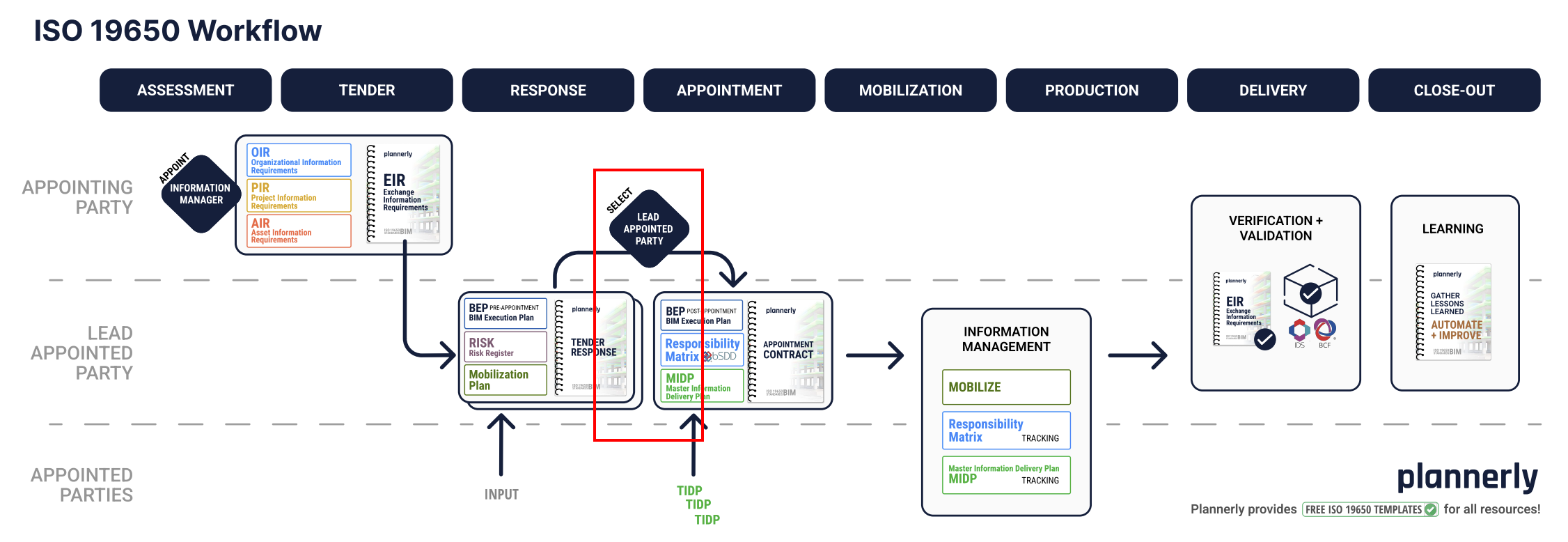
The gap between the tender submission and the Execution Plan exists for a legitimate reason: it is unreasonable to ask a professional to produce complete documentation on a project they don’t yet know whether they’ll be appointed to manage. Producing a full Plan is costly work, far more so than an Offer, and that work must have a guarantee of payment. Italian regulation carries the same logic that underpins the gap between pre-contract and post-contract BIM Execution Plan. We just call it by different names.
However.
Submitting an Offer (or a Pre-Contract) with full awareness that the stated deliverables will not be met — knowing they will be walked back before the Plan is signed — in the context of a public procurement, has a name, at least in Italy.
We call it fraud against the State.
Articles 640 and 640-bis of the Italian Criminal Code, to be precise, the latter being aggravated fraud for obtaining public funding: inducing the public administration into error through deception, using false documents or misleading statements, resulting in financial damage. The fact that it is common practice does not make it lawful. The fact that no one prosecutes it does not make it invisible.
The deeper problem is that between Offer and Plan there should be — and should be formally regulated as — certain non-negotiable elements: intended model uses, LOD, CDE, and personally I would add the name of the BIM manager ’cause I’m sick and tired to be involved in the tendering phase only to find out my client was appointed and then disappeared on me. LOD is not a technical detail to be renegotiated after the fact: it’s a contractual deliverable. Offering it in the knowledge that you won’t deliver it is fraud.
I understand this sounds strong, but I keep asking myself: how routine does something have to become before we stop calling it what it is?

The real damage isn’t only to the State
There is a direct harm — the public client receives a product different from the one they contracted for, or at least the one they signed for — and there is a systemic harm: every time this practice works, it consolidates itself as an implicit industry norm.
But there is a third harm, the one that stings the most: those who work well are structurally penalised.
My colleague — who wants to propose realistic LODs, grounded in an analysis of available sources, with a proper investigation plan for the existing building — finds himself competing against someone who writes exactly what the contracting authority wants to read, with every intention of walking it back later. It’s like running a race where half the competitors started by car.
Every contract awarded on an implausible promise degrades the perceived value of BIM as a whole: when the LOD doesn’t materialise (and trust me, it won’t), it won’t be the individual operator who pays the reputational price. It will be the discipline. The client will conclude that BIM is smoke and mirrors, that models are useless, that information management is a bureaucratic shakedown with no return. And they’ll think that because someone sold it badly, knowing they were selling it badly.
The supplier’s job is to educate, not to comply
One of the deepest dysfunctions in our sector is the idea that the supplier must say yes, that the client is always right, that the correct proposal is the one the contracting authority wants to hear.
We discussed exactly this last week at Politecnico di Milano, in the context of Facility Management. Yes, there was LEGO involved.
That’s not how it works. Or at least, it shouldn’t be. When your doctor tells you you’re eating too little, he may be offending your desire to lose weight quickly but he’s protecting you. When a structural engineer says the slab won’t carry the specified load, he’s not sabotaging the project; he’s doing his job. The BIM manager who presents a realistic LOD — motivated, grounded in a contextual analysis of available sources and an honest estimate of time and cost — is doing their job. They’re building a sound professional relationship with a client who didn’t issue that requirement to be told yes, but to open a conversation with that target in mind.
The one who promises the impossible to win the tender is just buying time. And costing all of us our credibility.
The real difference between those who work well and those who don’t isn’t the LOD you put in the tender: it’s the willingness — and the courage — to explain why. And if everyone stopped lying through their teeth just to get the job, if our sector weren’t so bent on taking work at any cost in the hope of making something back by cutting corners on quality and safety, we wouldn’t be having this conversation.






No Comments