
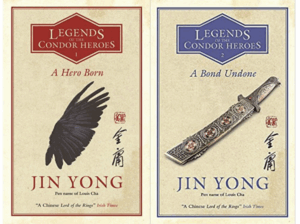
Ok, I tried reading this book, for the reasons I was explaining yesterday. It’s the first part, arbitrarily mutilated from the first novel of a body of work called The Condor Trilogy. Basically they took book 1, Shèdiāo Yīngxióng Zhuàn (射鵰英雄傳) that literally should be something like “The Legend of the Eagle-Shooting Heroes”, and chopped it in two parts. So if you think the novel ends abruptly, you’re probably right. I wouldn’t know, ’cause I couldn’t finish it.
But let’s proceed with order.
Jin Yong (pen name of Louis Cha, 1924 – 2018) is possibly the most influential modern writer of wuxia, that kind of Chinese “martial-heroes” fiction where warriors fly and break swords out of sheer will. The book is an historical adventure set in early-13th-century China, and it was serialised from 1957 to 1959. The second and third books of the trilogy are The Return of the Condor Heroes (神鵰俠侶) and The Heaven Sword and Dragon Saber (倚天屠龍記).
As far as I could go, which is around 70% into the book, it follows the origin story of Guo Jing, the son of a murdered Song patriot, and his mysterious promised brother / rival whom we haven’t met yet. It all starts with a Taoist monk who becomes friends with the parents of the two boys while their wives are pregnant, but he causes the fathers to be killed and the wives to flee. After a tiff with a group of travelling warriors, the group and the monk strike a bargain: each of them will find one of the two children, train them, and have them fight in a duel when they’re of age. This is the best I can do to explain you the plot, and if it doesn’t make sense it’s because of the huge cultural difference. I swear it’s all very logical and coherent when you read it in the book. The characters and plot are simple enough for a (very) young adult, provided you don’t have expectations. That wasn’t the problem.
Nor the problem was the historical backdrop of the Jurchen invasion of the Song empire: the capital and much of the territory have fallen, while the Mongol tribes are being unified under Gengis Khan. Guo Jing is raised among the Mongols under Gengis Khan’s protection, up close and personal, and that was good.
The problem was that the Italian translation is absolutely awful, it seems written by a toddler who constantly feels the need to assure that characters are extraordinarily fast, astonishingly strong, superlatively everything, announces the moves in quotation marks and uses such a colloquial slang that’s borderlining grammatical horror. The original Chinese trope of the pure-hearted boy comes across as a simpleton, and people constantly fighting for honour over a bad word come across as brawlers. And I was told it’s the translation by people who read Chinese, so don’t take my word for it: take theirs.
Plus, the book is called “The Legend of the eagle-hunter” and I swear there are no eagles in this book.

No Comments