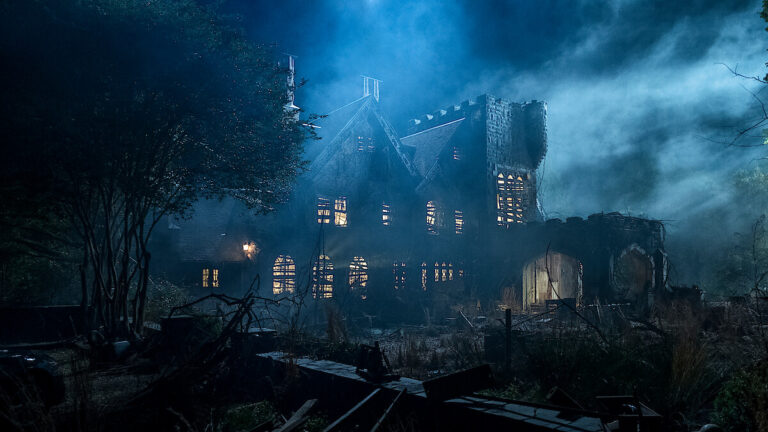
"All this he saw, for one moment breathless and intense, vivid on the morning sky; and still, as he looked, he lived; and still, as he lived, he wondered."

Pride Month 2025: Art of the Day

Neither Man Nor Woman, but Saint: the Iconography of St. Marina the Monk

In the hagiographic tradition of Eastern Christianity, Saint Marina the Monk (more properly known as Marinos) occupies a space that defies categories. Assigned female at birth, Marina disguised herself as a man to live in a monastery with her father. There, she took the name Marinos, donned monastic robes, and lived for decades as a male monk, her gender undisclosed to the brotherhood.

When falsely accused of fathering a child, Marina accepted punishment without revealing her assigned sex. She lived in disgrace, raising the child in humility and silence, until her death when the truth was discovered, not as a scandal, but a revelation of holiness and divine mystery.

In icons, Marina is often portrayed like any other monk: tonsured, robed, solemn — but with visual markers that invite deeper reading. In some traditions, Marina is shown bearded, symbolising full assimilation into the male monastic world. In others, she is portrayed cradling the orphan she raised — an image of maternal masculinity. Sometimes a lion is present, referencing stories of her retreat into the wilderness, where her sanctity brought even wild creatures to peace.

This iconography resists simplification. Marina is not “disguised” as a man. She is venerated as a monk — the identity she lived and died as. Her sanctity is not framed as despite her gender fluidity, but through it. In Orthodox Christianity, some saints are not worshipped for fitting social norms — they are honoured for transcending them.
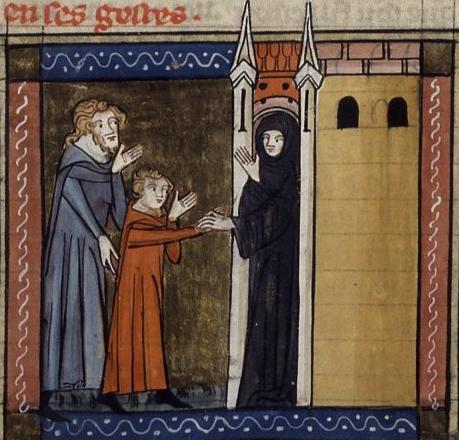
Marina (in red) is being brought to a monastery by her father Eugenius. 14th-century French manuscript.
Spooktober

Spooktober 25 – The Phantom Farm House (2)

Continues from yesterday… ATORRENT of rain held us marooned the next day. Miss Leahy was confined to her room, with a nurse in constant attendance and the house doctor making hourly calls. She was on the verge of a nervous collapse, he told me, crying

Read More »
books and literature

Alix Harrow’s The Once and Future Witches

I wouldn’t have started this book on my own, and for many reasons. One of them is that in Italy it’s marketed as Young Adult Fiction, and I hate most of that stuff, and the other is its imposing length: 600 pages. I was distracted,

Read More »
Spooktober

Spooktober 24 – The Phantom Farm House (1)

“The Phantom Farmhouse” is a short story written by Seabury Quinn, first published in the October 1923 issue of Weird Tales. It is one of Quinn’s most famous standalone works outside of his popular Jules de Grandin detective series. I had been at the new

Read More »
Share on LinkedIn
Throw on Reddit
Roll on Tumblr
Mail it
No Comments

Post A Comment

This site uses Akismet to reduce spam. Learn how your comment data is processed.

RELATED POSTS

Spooktober 25 – The Phantom Farm House (2)

Continues from yesterday… ATORRENT of rain held us marooned the next day. Miss Leahy was confined to her room, with a nurse in constant attendance and the house doctor making hourly calls. She was on the verge of a nervous collapse, he told me, crying

Read More

Alix Harrow’s The Once and Future Witches

I wouldn’t have started this book on my own, and for many reasons. One of them is that in Italy it’s marketed as Young Adult Fiction, and I hate most of that stuff, and the other is its imposing length: 600 pages. I was distracted,

Read More

Spooktober 24 – The Phantom Farm House (1)

“The Phantom Farmhouse” is a short story written by Seabury Quinn, first published in the October 1923 issue of Weird Tales. It is one of Quinn’s most famous standalone works outside of his popular Jules de Grandin detective series. I had been at the new

Read More