"All this he saw, for one moment breathless and intense, vivid on the morning sky; and still, as he looked, he lived; and still, as he lived, he wondered."

Pride Month 2025: Art of the Day

Neither Man Nor Woman, but Saint: the Iconography of St. Marina the Monk

In the hagiographic tradition of Eastern Christianity, Saint Marina the Monk (more properly known as Marinos) occupies a space that defies categories. Assigned female at birth, Marina disguised herself as a man to live in a monastery with her father. There, she took the name Marinos, donned monastic robes, and lived for decades as a male monk, her gender undisclosed to the brotherhood.

When falsely accused of fathering a child, Marina accepted punishment without revealing her assigned sex. She lived in disgrace, raising the child in humility and silence, until her death when the truth was discovered, not as a scandal, but a revelation of holiness and divine mystery.

In icons, Marina is often portrayed like any other monk: tonsured, robed, solemn — but with visual markers that invite deeper reading. In some traditions, Marina is shown bearded, symbolising full assimilation into the male monastic world. In others, she is portrayed cradling the orphan she raised — an image of maternal masculinity. Sometimes a lion is present, referencing stories of her retreat into the wilderness, where her sanctity brought even wild creatures to peace.

This iconography resists simplification. Marina is not “disguised” as a man. She is venerated as a monk — the identity she lived and died as. Her sanctity is not framed as despite her gender fluidity, but through it. In Orthodox Christianity, some saints are not worshipped for fitting social norms — they are honoured for transcending them.
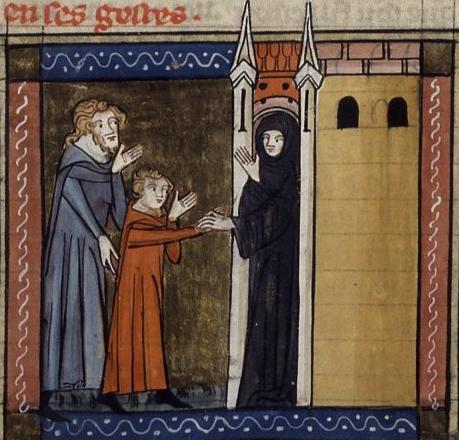

Marina (in red) is being brought to a monastery by her father Eugenius. 14th-century French manuscript.
Spooktober

Spooktober 23 – The Immortal Hand

“The Immortal Hand” is a supernatural short story written by pulp author Arlton Eadie (the pseudonym of Leopold Leonard Eady). It was originally published on March 1929 in Weird Tales and features interior artwork by the prominent pulp illustrator C.C. Senf. “With a calm and

Read More »
Spooktober

Spooktober 22 – The Lifted Veil (2)

Continues from yesterday… CHAPTER II. Before the autumn was at an end, and while the brown leaves still stood thick on the beeches in our park, my brother and Bertha were engaged to each other, and it was understood that their marriage was to take place

Read More »
architecture, engineering and construction

Be an expert on Doors, please

On outsourcing to AI agents without losing more than you gain Last week, I promised a colleague that, by the end of an article, she’d understand what everyone means when they say they “connected an AI agent to Revit via MCP”. I also promised she’d

Read More »
Share on LinkedIn
Throw on Reddit
Roll on Tumblr
Mail it
No Comments

Post A Comment

This site uses Akismet to reduce spam. Learn how your comment data is processed.

RELATED POSTS

Spooktober 23 – The Immortal Hand

“The Immortal Hand” is a supernatural short story written by pulp author Arlton Eadie (the pseudonym of Leopold Leonard Eady). It was originally published on March 1929 in Weird Tales and features interior artwork by the prominent pulp illustrator C.C. Senf. “With a calm and

Read More

Spooktober 22 – The Lifted Veil (2)

Continues from yesterday… CHAPTER II. Before the autumn was at an end, and while the brown leaves still stood thick on the beeches in our park, my brother and Bertha were engaged to each other, and it was understood that their marriage was to take place

Read More

Be an expert on Doors, please

On outsourcing to AI agents without losing more than you gain Last week, I promised a colleague that, by the end of an article, she’d understand what everyone means when they say they “connected an AI agent to Revit via MCP”. I also promised she’d

Read More