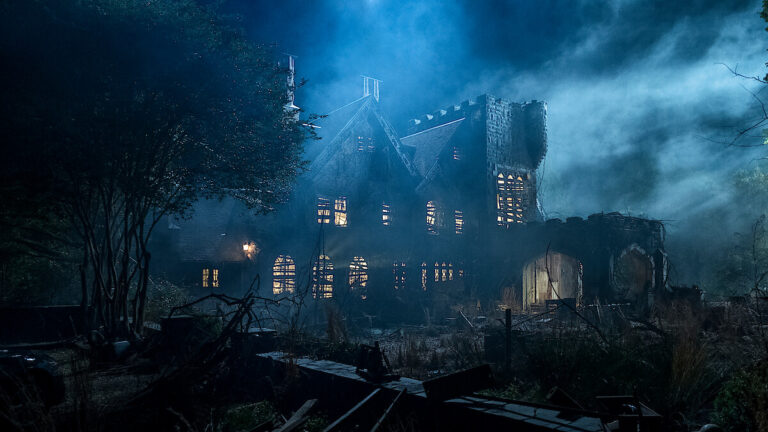
"All this he saw, for one moment breathless and intense, vivid on the morning sky; and still, as he looked, he lived; and still, as he lived, he wondered."

Pride Month 2025: Art of the Day

Neither Man Nor Woman, but Saint: the Iconography of St. Marina the Monk

In the hagiographic tradition of Eastern Christianity, Saint Marina the Monk (more properly known as Marinos) occupies a space that defies categories. Assigned female at birth, Marina disguised herself as a man to live in a monastery with her father. There, she took the name Marinos, donned monastic robes, and lived for decades as a male monk, her gender undisclosed to the brotherhood.

When falsely accused of fathering a child, Marina accepted punishment without revealing her assigned sex. She lived in disgrace, raising the child in humility and silence, until her death when the truth was discovered, not as a scandal, but a revelation of holiness and divine mystery.

In icons, Marina is often portrayed like any other monk: tonsured, robed, solemn — but with visual markers that invite deeper reading. In some traditions, Marina is shown bearded, symbolising full assimilation into the male monastic world. In others, she is portrayed cradling the orphan she raised — an image of maternal masculinity. Sometimes a lion is present, referencing stories of her retreat into the wilderness, where her sanctity brought even wild creatures to peace.

This iconography resists simplification. Marina is not “disguised” as a man. She is venerated as a monk — the identity she lived and died as. Her sanctity is not framed as despite her gender fluidity, but through it. In Orthodox Christianity, some saints are not worshipped for fitting social norms — they are honoured for transcending them.
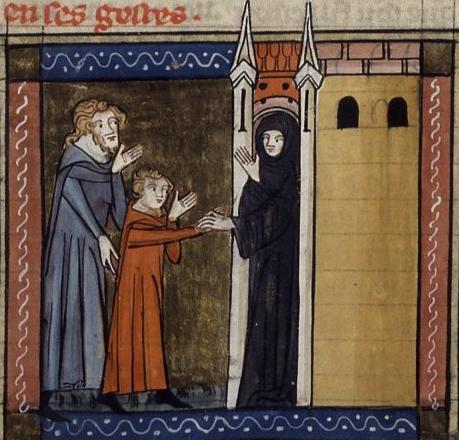
Marina (in red) is being brought to a monastery by her father Eugenius. 14th-century French manuscript.
Spooktober

Spooktober 27 – The Black Monk (2)

Chapter 3 After supper, when the visitors had gone, he went to his room and lay down on the sofa: he wanted to think about the monk. But a minute later Tanya came in. “Here, Andryusha; read father’s articles,” she said, giving him a bundle

Read More »
Spooktober

Spooktober 26 – The Black Monk (1)

Anton Chekhov (1860–1904) was a Russian physician, short-story writer and playwright, and I’m not particularly fond of him, though he’s widely regarded as one of the greatest masters of modern short fiction and who am I to argue? His work is celebrated for its psychological

Read More »
art and fashion

Beauty and Ugliness: an exhibition

A few pictures from the recently closed exhibition on Beauty and Ugliness as an aesthetic paradigma in which what’s ideal and what’s grotesque melt together as sides of the same coin. The exhibition featured works by Brueghel (lent from the other exhibition at Palazzo Reale),

Read More »
Share on LinkedIn
Throw on Reddit
Roll on Tumblr
Mail it
No Comments

Post A Comment

This site uses Akismet to reduce spam. Learn how your comment data is processed.

RELATED POSTS

Spooktober 27 – The Black Monk (2)

Chapter 3 After supper, when the visitors had gone, he went to his room and lay down on the sofa: he wanted to think about the monk. But a minute later Tanya came in. “Here, Andryusha; read father’s articles,” she said, giving him a bundle

Read More

Spooktober 26 – The Black Monk (1)

Anton Chekhov (1860–1904) was a Russian physician, short-story writer and playwright, and I’m not particularly fond of him, though he’s widely regarded as one of the greatest masters of modern short fiction and who am I to argue? His work is celebrated for its psychological

Read More

Beauty and Ugliness: an exhibition

A few pictures from the recently closed exhibition on Beauty and Ugliness as an aesthetic paradigma in which what’s ideal and what’s grotesque melt together as sides of the same coin. The exhibition featured works by Brueghel (lent from the other exhibition at Palazzo Reale),

Read More