
Well, the new draft of the ISO 19650 has been out for public consultation for a week, now, and I have the feeling nobody’s actually consulting the thing, because the heat of the debate has been around the “disappearance of BIM”. I already wrote about it on LinkedIn, and a colleague of mine is presenting the same take in his commentary over here.
The same concept expressed in a different way would be: ISO was never fond of BIM, its focus was on the production of information, on the procurement mechanisms where such production is involved, and on the necessity of information management. Though the general structure was meant to support all stages, from inception to handover and facility management, its main focus was the client’s side. I said this before.
Keeping this in mind, the shift here is significant, though not disconnected from the objects the original ISO already pursued. What I want to do in this article is tackle the main differences and then give you my critical perspectives on what this will mean (because the public consultation will only be able to impress fine adjustments to the norm, but the general setting and direction of the norm are defined by now) and the industry approach this draft highlights, for the National normative bodies to be mindful about this when they will draft their national appendixes.
Keep in mind that the norm will stay under evaluation from March 10th to June 2nd.
1. The Old ISO is dead, long live the new ISO
In this first part, I’ll retrace the steps of the old ISO 19650 and guide you through reading the new one, instead of commenting the new draft secton by section. This means that you’ll find clauses as they were numbered in ISO 19650-1:2018 (often referred to as Ed. 2018), and where you can find similar or significantly shifted concepts in ISO/DIS 19650-1:2026 (often referred to as DIS 2026).
In a separate article, I’ll treat the entirely new concepts, and then — only then — I’ll explicitly lay out a general comment and disclose what I really think of the revision.
Sounds good? If not, you can watch cartoons over here.
1.1. Scope
The old ISO wasn’t fond of BIM, and the new ISO continues down that road, except one shift was finally able to get people’s attention.
| ISO 19650-1:2018 | ISO/DIS 19650-1:2026 |
| «…concepts and principles for information management at a stage of maturity described as ‘building information modelling (BIM) according to the ISO 19650 series’» | «…concepts and principles for information management at a stage of maturity described as ‘information management according to ISO 19650’» |
The removal of the explicit reference to Building Information Modelling (BIM) from the scope continues in the direction already implied in the first version of the standard: moving away from the “BIM” label to embrace the broader concept of “information management.” Similarly, the subtitle of the standard itself removes the phrase “using building information modelling” and becomes simply “Information management.”
The change in name reduces the visibility of BIM as a paradigm recognisable by the market. Organisations, clients, and professionals who have invested in the culture of ISO 19650 now face a rebranding that is not accompanied by a clear transition path. The risk is fragmentation in communication toward the market, especially in contexts where national standardisation (e.g., UNI 11337 in Italy) explicitly refers to BIM. At least in Italy, where the adoption of ISO standards is already weak, this change will not weaken the presence of professionals and companies operating in BIM, but it may make the adoption of the standard more difficult. In other Countries, I fill this will need a heavy awareness campaign, as it was originally done for BIM, and it’s not obvious that companies will be on board with this, especially if the advantages in the paradigm shift aren’t clearly laid out.
In plainer words, people are never happy with rebrandings when they’ve invested resources and energy in the previous brand, and if you’re asking them to invest again in something new, they might just tell you “no” unless they already have the awareness that a paradigm shift is needed.

The term ‘built asset‘ is also replaced by the simpler ‘asset‘, and ‘construction project‘ becomes ‘asset-related project‘. Again, this is consistent with an ambition for broader applicability beyond the construction sector and within facility management.
The widening of scope is theoretically positive but risks diluting the technical specificity that had made the standard operationally relevant for the AEC sector: the standard may lose its role as an operational reference for design and construction without gaining genuine authority in the facility management sector, where well-established information management frameworks already exist.
1.2. Normative References
Both editions declare the absence of normative references, which was puzzling to begin with, but ok. Clause 2 of DIS 2026 remains formally unchanged.
However, it is important to note the original norm just had the coloured scheme with ISO 9001 for quality, 21500 for project management and 55000 for asset management, but DIS 2026 introduces in the Introduction (section 0.2) a detailed map of related standards, classified by relevance (High / Medium to High / Medium / Low to Medium), with Annex A providing further detail on these relationships. This constitutes a substantive change in the normative reference ecosystem, even though Clause 2 formally remains empty.
The decision to keep Clause 2 free of normative references, while introducing an elaborate system of relationships with other standards in an Annex, creates a dissonance: standards such as ISO 7817-1 (Level of information need), ISO 29481-1/2/3 (Information Delivert Manual) and ISO 12006-2/3 (Classification Systems) are in practice indispensable for correct application of the framework, yet their absence from the normative references makes them legally non-binding. This may create ambiguity in the contractual application of the standard, and result in some confusion whenever some of these norms change independently.
Also, the norms in the scheme are thrown all together as if the process is a one-stage-fits-all (which, spoiler alert, is the main issue I have with this norm), while it would be more beneficial to split them between what’s necessary for inception and requirements definition (the Level of Information Need), what’s necessary for production (such as 12006 with classification) and what’s important for delivery (the Delivery Manual).
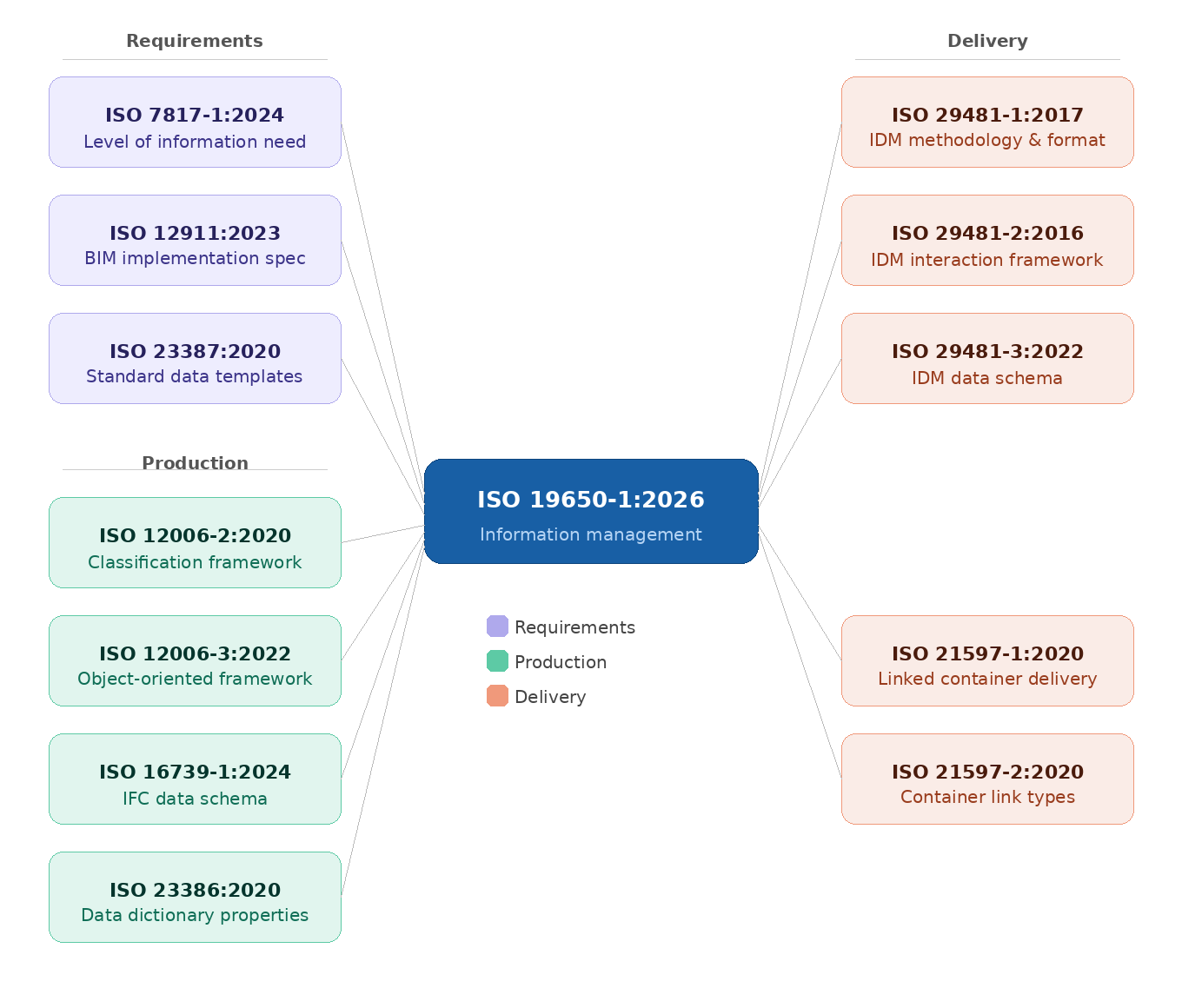
- Requirements (in liliac) are standards that define what information is needed and how much: ISO 7817-1 (Level of Information Need) is the chief one, flanked by ISO 12911 (BIM implementation specification using RASE), and ISO 23387 (data templates for construction objects).
- Production (teal) includes standards that govern how information is structured and represented: ISO 12006-2/3 (classification and object-oriented frameworks), ISO 16739-1 (IFC data schema), and ISO 23386 (data dictionary properties).
- Delivery (coral) contains standards that define how information is exchanged and packaged: the full ISO 29481 trilogy (IDM methodology, interaction framework, data schema) and ISO 21597-1/2 (linked container delivery and link types).
Just a proposal.
3. Terms and Definitions
This is arguably the clause that undergoes the most profound changes, which of course always reflects a fundamental shift. Ed. 2018 organised its terms into three sub-groups (general terms; terms related to assets and projects; terms related to information management). DIS 2026 eliminates this tripartition, reducing to two groups, suppressing several terms and introducing new ones. Let’s see if I can try and do a point-by-point analysis on this, with a little help from some friends.
I highlight what’s more problematic in my opinion.
3.1. Terms Revised
| 2018 Term / Status | 2026 Term / Status | Critical note |
| delivery team DEPRECATED | information production team | A term deeply embedded in contracts and BEPs is deprecated without a transitional period, which creates compatibility issues with existing documentation. Moreover, the original term allowed for a broader and more general approach, while this term seems to suggest we’ll have the design team on one side and then people inputing information on the other, which of course isn’t the intent of the norm. |
| task team SUPPRESSED | Absorbed into appointed party | This simplifies the model but loses granularity in describing the organisational structures of a project, which is consistent with the general direction of the new norm. |
| exchange information requirements (EIR) DEPRECATED | information production requirements | The EIR is a widely adopted contractual instrument, and the original norm made a mess of things by shifting it from the original meaning (Employer’s Information Requirements) to a phase-specific document dependent on the Project Information Requirements. It was difficult enough for the market to accept this split, and I have very rarely seen this done right. The replacement of the term, while I applaud not using the same acronym with a different meaning, will require substantial revision of standard-form contracts, employer’s information requirements templates and procurement documents. |
| responsibility matrix DEPRECATED | assignment matrix | This drives me CRAZY. Widely used for RACI frameworks within BIM Execution Plans, the change not only misaligns the standard with established industry practice but also has the guts to believe ISO 19650 will be strong enough to uphold a tool (the responsibility matrix) that has been in use in project management since the 1950s. Fun fact: the matrix was originally called “responsibility assignment matrix”, and the term “assignment” was withdrawn because it works best when it’s negotiated. I guess the construction industry never learns. |
| common data environment (CDE) REMOVED, though not officially deprecated | “operational framework to facilitate the collaborative production of information” | The new definition formally separates the CDE as a concept (framework) from enabling technologies as implementation. It’s a mature approach, for sure, but the industry still wasn’t clear on the concept that the CDE, as originally intended, was an ecosystem of technological solutions interconnected by workflows and procedures, and in many instances the term is used to indicate the main platform in use. Like many other changes, this feels disconnected from the industry’s actual state. |
3.2. Terms Added
DIS 2026 introduces terms either absent from Ed. 2018, or significantly shifted from the original meaning, such as data, information constraint, information production and information production workflow, approve / authorize / accept (as distinct terms), enabling technologies (which I like a lot), linked enterprise system, information production archive and journal, reference information, information protocol, documentation.
Without getting into detail of all of them, let’s keep one thing in mind: the terminological granularity of DIS 2026 is significantly greater. While this is useful for technical precision, it also increases the cost of training and adoption for organisations, contributing to a sort of ISO 19650 fatigue for those who weren’t speaking the original standard fluently. Many of these new terms have either direct or presumed implications for roles, responsibilities and the scope of tools. Their introduction without a well-defined transition pathway risks generating confusion during the period of coexistence between the two editions, and the dragging along of some terms that will be very hard to die (the BIM execution plan isn’t going anywhere, in my opinion).
4. Information Management Perspectives and Collaborative Working
Ed. 2018 titled this section ‘Asset and project information, perspectives and collaborative working’ and included the maturity stages figure (Stages 1, 2, 3), positioning ‘BIM according to ISO 19650’ at Stage 2. DIS 2026 radically restructures this clause.
4.1. Suppression of the staged maturity model
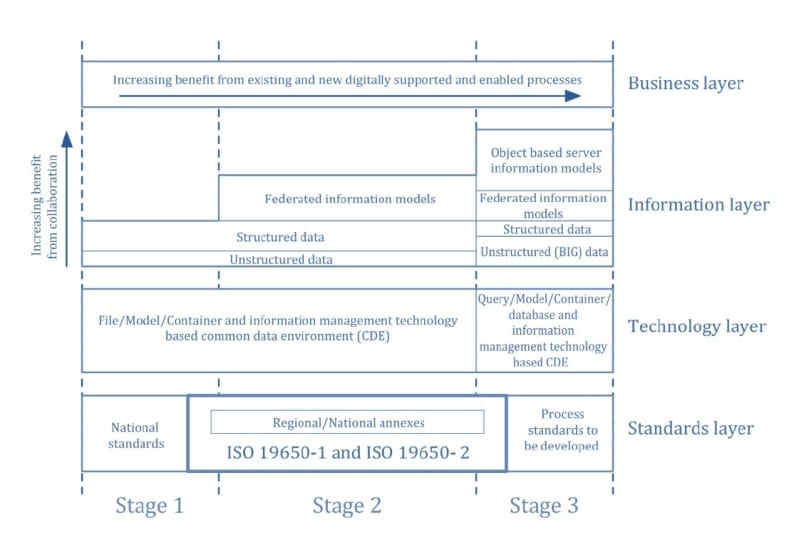
The three-stage maturity figure does not appear in DIS 2026, and the concept disappears entirely. This is one of the most significant losses for the market, because the staged maturity model was a powerful communication tool, adopted by change management programmes to structure adoption roadmaps. Its removal deprives the standard of an element with strong operational traction. New national frameworks may be needed to replace its function, but one fundamental issue still stands: this new norm seems to be saying “if you aren’t up to speed, we don’t care about you anymore”. All of this while withdrawing the main tool for actually getting up to speed.
4.2. Evolution of information management perspectives
Ed. 2018 identified four perspectives (asset owner, asset user, project delivery, society), and DIS 2026 retains the concept but renames and generalises them:
- organisational management perspective;
- asset management perspective;
- asset-related project management perspective (which is a mouthful);
- other perspectives.
The perspectives also play a fundamental role in shaping requirements, in a more explicit way, and I’m very glad to see this old idea of mine being incorporated in the norm because maybe it means I’m not crazy. If you’ve ever done a BIM execution planning workshop with me, you’ll remember we always start from stakeholders, often in the more manageable form of personas.
Clause 4 of DIS 2026 also introduces an explicit sub-clause on principles for collaborative working (4.4), drawing in part from Clause 9 of Ed. 2018, with added references to enabling technologies and information security management.
4.4. Principles for Collaborative Working
The first thing to note is architectural. In the 2018 edition, the principles for collaborative working occupied a standalone clause (Clause 9, “Information container-based collaborative working”) sitting between the discussion of delivery team capability (Clause 8) and information delivery planning (Clause 10). It was a self-contained block of six lettered principles, presented at the same hierarchical level as all other operational clauses.
In the DIS 2026, those principles have been absorbed into Clause 4.4 as a sub-clause of the broader “Information management, perspectives, collaborative working and ISO 19650” section, sitting alongside the discussion of what ISO 19650 is and what perspectives it recognises. This is not a minor editorial choice. By embedding collaborative working principles inside a foundational, conceptual clause rather than leaving them as an operational clause in their own right, the drafters signal that collaboration is now considered a precondition of the framework rather than one of its procedural steps. The message is: you do not arrive at collaboration through a sequence of steps; you begin from it.
This repositioning is conceptually sound. However, it comes at a cost in navigability: a practitioner looking for rules of collaborative working will no longer find them in a dedicated, clearly signposted location. In the 2018 edition, Clause 9 was easy to cite contractually (“the appointed party shall comply with the principles of Clause 9”). In the DIS 2026, Clause 4.4 sits inside an introductory section, which may make it feel less binding in contractual contexts.
Note: Comparing the six principles
Both clauses present six lettered principles (a through f). The correspondence is close but not exact, and the differences are telling.
| Principle (a) — authorship and intellectual property | Two changes deserve attention. First, the agent of authorship shifts from a generic “authors” to the specific “appointed parties.” This is consistent with the broader terminological rationalisation of the DIS 2026, but it narrows the principle: in the 2018 version, any individual or organisation producing information was implicitly bound by this principle regardless of their formal role, which I didn’t particularly like. In the DIS 2026, the principle applies explicitly only to those holding a formal appointment, though this is contradicted further on in the norm. This may leave a gap for cases where information is produced informally or outside a structured appointment. Second, the reference to data libraries is added to the list of approved sources. This is a meaningful addition that acknowledges the growing role of object libraries, manufacturer data, and shared digital resources in information production, and a practical recognition of how BIM workflows actually operate in 2026 versus 2018. |
| Principle (b) — clarity of information requirements | This is one of the most substantive changes in the entire clause. The 2018 version distinguished between high-level requirements (from interested parties broadly) and detailed requirements (from the appointing party specifically). The DIS 2026 collapses this distinction and, crucially, adds two new concepts: information purposes and information constraints: – Information purposes — the subject of the entirely new Clause 5 — represent the “why” behind any information requirement, the business or operational need it serves. – Information constraints represent the limits and conditions under which information may be produced or used (security classification, data protection, contractual limitations). This enrichment of the conceptual vocabulary is arguably the most intellectually mature development in the DIS 2026. It moves the framework from a transactional model (“specify what you need, deliver what is specified”) towards a purposive model (“understand why information is needed, then specify it accordingly”). In practice, however, this sophistication demands a level of organisational analysis and user engagement that many appointing parties — particularly public clients with limited in-house information management capability — will find challenging to implement without dedicated support which, I’m sure, some authors of the ISO will be very glad to sell them. |
| Principle (c) — capability and capacity assessment | The two versions are substantially equivalent: both require that the capability and capacity of the prospective delivery team (2018) or information production team (2026) be assessed before appointment. The 2026 version adds “information constraints” to the list of items against which the assessment is made, consistent with the new conceptual apparatus introduced elsewhere. The change is incremental rather than substantive. |
| Principle (d) — the common data environment | The substitution of “CDE” with “enabling technologies” here is directly linked to the redefinition of the CDE discussed elsewhere in the DIS 2026. In the 2018 edition, the CDE was understood primarily as a shared digital environment made of interconnected technological solutions. In the DIS 2026, the CDE is redefined as an operational framework comprising both the workflow and the enabling technologies; the technologies are therefore one component of the CDE, not synonymous with it, and this redefinition is trying to reinforce a concept that has very rarely been understood by the market. The practical consequence of this shift is significant for procurement. Under the 2018 wording, specifying “a CDE” in a contract or EIR was a reasonably well-understood requirement that the market had learned to respond to with specific software solutions as a primary platform and the related management. Under the DIS 2026, requiring “enabling technologies that enable the information production workflow” is a more abstract specification that could be met in many different ways. While this is intellectually cleaner, it may introduce ambiguity in tender evaluation and make it harder to assess compliance. Also notable is the removal of maintain from the list of activities that actors must be able to perform. In the 2018 version, the CDE had to be accessible to those who “produce, use and maintain” information. The DIS 2026 reduces this to “produce and use.” Whether this omission is intentional or editorial is unclear, but it is potentially significant: information maintenance — keeping information current, correcting errors, managing obsolescence — is a real and ongoing activity that should arguably remain within the scope of the collaborative working principles. |
| Principle (e) — technology conformance | The 2018 version required “information models to be developed using technologies that are able to conform to this document.” The DIS 2026 expands this to “information containers and information models to be produced using enabling technologies that are able to conform to all relevant parts of ISO 19650.” The expansion is logical and expected, as the concept of the container was obscure and didn’t have much success with the market. With the ISO 19650 series now comprising six parts (including Parts 4, 5 and 6 on information exchange, security and health and safety respectively), compliance with Part 1 alone is insufficient. The new wording correctly points towards the full series as the conformance benchmark. |
| Principle (f) — information security | Both versions include a principle on security processes covering unauthorised access, information loss or corruption, degradation and obsolescence. The wording is nearly identical, with one significant difference: the 2018 version applied these security processes “during the whole life time of the asset”; the DIS 2026 simply says “during the life cycle of the asset.” This is a terminological alignment rather than a substantive change, but it is worth noting that the DIS 2026 also cross-references ISO 19650-5 more explicitly and repeatedly throughout the document, giving security a more prominent role in the overall framework than it enjoyed in 2018, as it should be. |
What is gained and what is lost
The DIS 2026 version of the collaborative working principles is more conceptually refined than its 2018 predecessor. The introduction of information purposes and information constraints in principle (b) represents genuine intellectual progress. The alignment of terminology with the broader rationalisation of the standard (appointed parties, enabling technologies, information production) is consistent and coherent.
What is lost, or at least weakened, is the operational directness of the 2018 clause. Clause 9 of the 2018 edition read like a checklist that a practitioner could work through before starting a project. Clause 4.4 of the DIS 2026 reads more like a statement of philosophy. Both have their place, but the market — particularly the portion of it that has not yet reached high maturity in information management — benefits more from the former.
A further concern is that by embedding the collaborative working principles inside a foundational clause rather than leaving them in an operational position, the DIS 2026 may inadvertently reduce their contractual and practical weight. Standards users and procurement specialists tend to look to numbered clauses in the operational body of a standard as the locus of obligations. A principle buried in Clause 4.4 may be treated as guidance rather than requirement, even if the “should” language is formally equivalent throughout the document.
Finally, the removal of “authors” as the agent of principle (a) in favour of “appointed parties” deserves to be reconsidered. The production of information in complex projects involves many individuals — junior designers, surveyors, specialist subcontractors — who produce information but do not themselves hold formal appointments. The 2018 formulation implicitly encompassed all of them. The DIS 2026 formulation does not, and this is a step backwards in terms of the comprehensiveness of the collaborative working framework. And this is a problem throughout the whole part 1 and part 2, as we’ll see.
5. Information Requirements and Information Models
Clause 5 of Ed. 2018 (‘Definition of information requirements and resulting information models’) was the most articulated clause of the original standard, describing the OIR to AIR/PIR to EIR to AIM/PIM hierarchy through the well-known Figure 2.

In DIS 2026, this structure has been profoundly reorganised and distributed across multiple clauses. The corresponding concepts are found primarily in Clause 7 (Information requirements and information constraints) and Clause 12 (Information models), as well as in Annex B (Figure B.1, which attempts a correspondence with the old Figure 2).
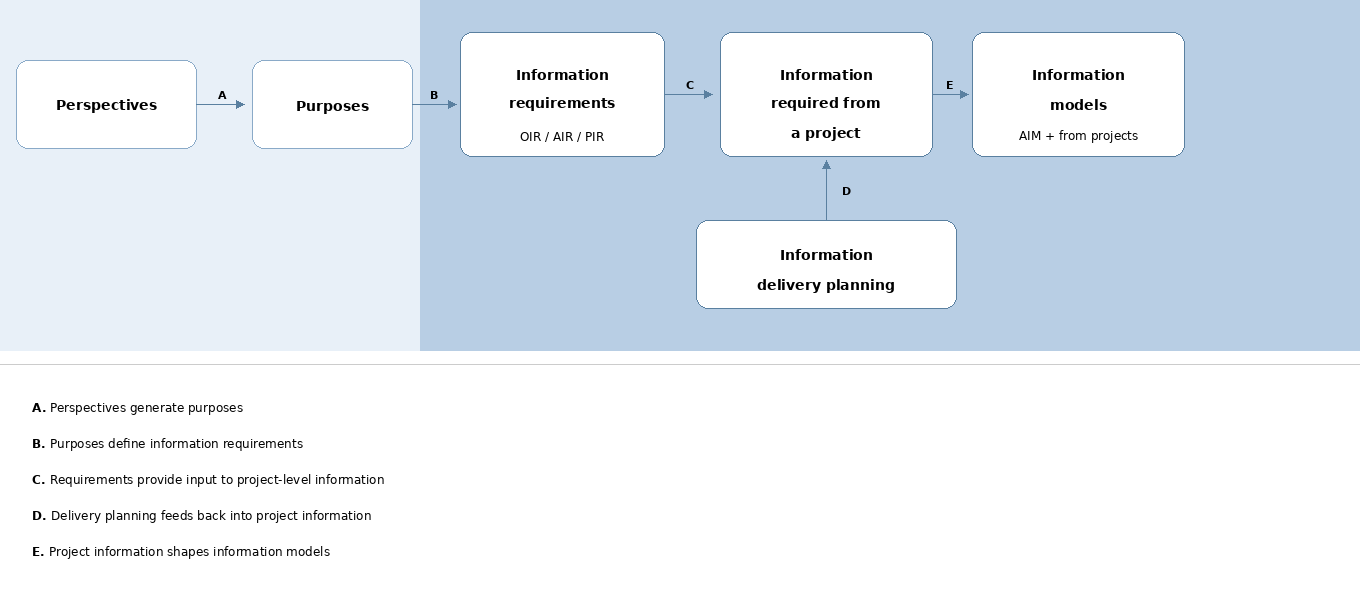
Let’s see what’s happening.
5.1-3. OIR, AIR, PIR
The three types of information requirements (OIR, AIR, PIR) survive in DIS 2026 with no acronym as Organizational Information Requirements, Asset Information Requirements, Project Information Requirements (Clause 7.2.1), but lose their dedicated sub-clauses and are treated more briefly as categories of appointing party requirements.
This is consistent with the attempt of collapsing the production of information during design and construction with the management principles through the management of the asset, which I believe is the main problem of this revision.
5.5. Suppression of EIR as an autonomous concept
The Exchange Information Requirements (EIR) are deprecated and replaced by Information Production Requirements (IPR), another acronym only few people will probably use. This change has significant operational implications: the EIR was the central contractual document through which the appointing party expressed its information requirements to the lead appointed party during procurement, and its terminological replacement is not neutral: the EIR is now embedded in international standard-form contracts (e.g. NEC4, JCT with BIM Protocol) and in the information requirements of globally significant public clients (Highways England, HS2, etc.). Its deprecation will require revision of these instruments and may introduce legal uncertainty during the transitional period.
It is strongly recommended that Annex B or an application guidance document explicitly set out how IPR correspond to EIR for contractual purposes.
So, how do we specify stuff?
Through another significant new element in Clause 6.6: the information protocol, which has no equivalent in Clause 7 of the 2018 edition (more on that later). The clause states: “An information protocol should also be used to clarify the obligations and liabilities of each party in an appointment.”
The information protocol itself is defined in Clause 3.2.33 as “a set of obligations relating to appointment specific information,” with the note that it “can be embedded within a form of contract or can be attached as an annex.” This is a direct borrowing from UK contractual practice, where the CIC BIM Protocol and its successor documents under the UK BIM Framework have for years served as the mechanism for incorporating information management obligations into standard-form contracts. The formalisation of this concept at ISO level is a welcome development: it creates a normative basis for the kind of contractual instrument that sophisticated markets have already developed independently, and it signals to less mature markets that information management obligations need to be embedded in appointment documents rather than treated as supplementary guidance. BIM needs to be detailed in the contract, in case this still needs to be said.
However, the introduction of the information protocol also raises questions that the DIS 2026 does not answer. The standard provides no guidance on:
- what an information protocol should contain,
- how it should be structured,
- how it relates to other appointment documents such as the information production requirements or the information production standard,
- whether it is the appointing party’s document, the lead appointed party’s document, or a jointly agreed instrument,
- what happens when the protocol conflicts with the underlying contract.
Everyone who has worked five minutes in the industry would know that these are not trivial questions: in practice, the value of a contractual instrument depends almost entirely on how it is drafted and how it interacts with the other documents in the appointment package. A normative reference to the concept without any guidance on its content risks creating a market in which “information protocol” becomes a checkbox term — present in appointments nominally but without real substance — rather than a genuinely functional governance tool.
The appropriate response would be for ISO or its national mirror committees to develop a Technical Report or guidance document on the information protocol, providing model clauses and examples of how it should be drafted for different procurement routes and contract types. Without this, the gap between the standard’s intent and market practice is likely to remain wide.

5.6/7 — AIM and PIM
The Asset Information Model (AIM) survives and is treated extensively in Clause 12.2.1. The Project Information Model (PIM), however, no longer appears as a defined term: in DIS 2026 there are only ‘information models produced by information production teams’ (Clause 12.2.2), which contribute to the AIM.
The suppression of the PIM as a distinct entity is consistent with the logic of unifying the process across the entire asset life cycle, but it eliminates an operationally well-established concept and negates the structural distinctions between an information model for design and construction and an information model for asset management. The market had developed skills, templates and workflows specifically for PIM management; its disappearance requires a complete rethink of project document management structures. Which you know if you’ve worked five minutes in the industry.
Note: Information models produced by information production teams
Now’s the time to take a closer look at Clause 12.2.2 and its most consequential aspect, as we were saying, is what it doesn’t contain anymore: the Project Information Model. In the 2018 edition, the PIM was a defined term (Clause 3.3.10) and a dedicated sub-clause (Clause 5.7). It was described as supporting the delivery of the project and contributing to the AIM, with specific examples of what it could contain in terms of project geometry, location of equipment, performance requirements, method of construction, scheduling, costing, details of installed systems and components, and an explicit recognition of the work it takes to transform a model for construction (PIM) into a model for management (AIM). I wrote about it here.
In the DIS 2026, the Project Information Model and its functional role is absorbed into the generic category of information models produced by information production teams. These models are characterised solely by their relationship to the AIM — they still contribute to it — and by their alignment with information production milestones. The rich descriptive content of Clause 5.7 of the 2018 edition has been entirely discarded.
This is a problem, in my opinion, for multiple reasons. The PIM in the 2018 framework, for starters, had a clear dual identity: it was both a process artefact (evolving through the delivery phase, from design intent model to virtual construction model, as described in Note 1 to Clause 3.3.10) and a product (the information deliverable handed over at the end of a project to support the AIM). This duality gave it operational substance. Practitioners knew what a Project Information Model was, though very few used the acronym, what it contained at different stages, and what happened to it at project completion.
When the DIS 2026 erases this identity, we have information models that “can be produced at any time” and “can also be an output from the project.” The language is deliberately open and non-prescriptive, reflecting the DIS 2026’s broader ambition to be applicable across the full asset life cycle and across sectors beyond construction but, in achieving that generality, the clause loses the specificity that made the Project Information Model a useful concept for the design and construction community.
This, again, is in line with the general approach of the norm. The DIS 2026 is built on a fundamentally different conceptual architecture from the 2018 edition, one in which the distinction between delivery phase and operational phase — so central to the 2018 framework — is dissolved into a continuous, trigger-event-driven life cycle in which the trigger events aren’t defined. In that architecture, a category of information model defined by its association with the “delivery phase” (as the PIM was) has no natural place. If every project is simply a response to a trigger event, and trigger events can occur at any point in the asset life cycle, then the information produced during any project is, structurally, the same kind of thing regardless of whether the asset is being designed for the first time or being refurbished for the third time.
The 2018 Clause 5.7 stated that the PIM “supports the delivery of the project and contributes to the AIM to support asset management activities.” It specified that the PIM “should also be stored to provide a long-term archive of the project and for auditing purposes.” It also gave concrete examples: project geometry, location of equipment, performance requirements during design, method of construction, scheduling, costing, maintenance requirements during construction.
Clause 12.2.2 of the DIS 2026 preserves two of these elements explicitly: the requirement to store all revisions for archiving and audit purposes, and the general principle that the models contribute to the Asset Information Model. The concrete examples, however, are gone, relocated to a note within Clause 12.2.2 that reads as illustrative rather than definitional. The note mentions “geometry, location of equipment to be installed, performance requirements during design, methods of construction, scheduling, costing and details of installed systems, components and equipment, including maintenance requirements.” This is almost verbatim from the 2018 Project Information Model description, which raises an uncomfortable question: if I’m overreacting and the content is the same, why was the concept renamed and stripped of its defined status?
The answer appears to be that the DIS 2026 is attempting to signal that this type of information model is not exclusive to the design and construction context. By demoting the examples to a note and removing the defined term, the clause tries to open the concept to other sectors and other trigger events — a factory extension, a maintenance programme, an inspection cycle — where the word “project” in “Project Information Model” might feel limiting. If so, this intent is what I take issues with: an information model during design and construction is a totally different animal that deserves a separate treatment. The current approach creates a standard that is less accessible to its primary user base without being demonstrably more accessible to the new audiences it is trying to reach. And I think it is because it shifted the attention to another primary user base: clients and asset managers, because that’s where the money is.

The Aggregation Mechanism
One genuinely new and valuable element in Clause 12.2.2 is the explicit treatment of aggregation: “Aggregation of information to the asset information model(s) should be informed by those information requirements and should occur once that information has been accepted by the appointing party.”
The 2018 edition was implicit on this point. It described the transfer of information from PIM to AIM at the end of a project (shown as point C in Figure 3 of the 2018 edition), but it did not specify the conditions under which that transfer should take place. The DIS 2026 makes the condition explicit, stating that aggregation happens after acceptance by the appointing party, and it is scoped by the information requirements identified at project initiation or through change control.
Unfortunately, this also overlooks the many aggregations and the coordination work that’s necessary to actually reach something to give to the appointing party. This isn’t a focus on the norm. The fairies do it.

The merit of this, on the other side, is establishing that the AIM should not become a passive repository into which everything produced during a project is automatically deposited: aggregation is a selective, requirements-driven act performed under the governance of the appointing party. Information that was produced during a project but is not required by the appointing party does not go into the Asset Information Model but stays in the project record. This distinction between the project archive and the Asset Information Model is sharper in the DIS 2026 than it was in the 2018 edition, and the market should take note of it.
The same sharpness appears in the DIS 2026’s Clause 13, which states explicitly: “During projects, information can be produced that is not required by the appointing party or is not needed for asset management.” Well, thank you darling, as I actually need to work. This information, of course, won’t be aggregated into the asset information model but, as it’s stated, should be retained as part of the record of each project. This is an important governance principle that was only implicit in the 2018 framework, and it might have an impact on the delivery of open data, that might be devoid of some operational structure, versus the requirement to deliver the information models with their native production infrastructure.
The question of the design intent model and the virtual construction model
Note 1 to Clause 3.3.10 of the 2018 edition introduced two important concepts within the life of the Project Information Model: the design intent model (the Project Information Model at the design stage, representing intended outcomes) and the virtual construction model (the Project Information Model at the construction stage, representing the asset as it is being built). These two sub-concepts helped practitioners understand how the Project Information Model evolved during delivery and what it represented at any given point in the project.
The DIS 2026 drops both terms entirely. There is no reference to design intent, no reference to virtual construction, and no equivalent conceptual structure for describing how information models evolve during a project. The information production milestones introduced in Clause 7.2.3 partially fill this gap by establishing the events or dates at which information is required, but they operate at a scheduling level rather than a conceptual level. They tell you when information is due, not what kind of information the model represents at each stage of its development.
This is a gap that ISO 19650-3 will need to address. If Part 1 no longer provides a conceptual framework for the evolution of the project information model through design and construction, Part 3 — which is intended to provide implementation guidance — must step in. Until Part 3 is published and available, practitioners will be left without normative guidance on a question that is central to their daily work.
Implications for the market
The combined effect of the changes in Clause 12.2.2 can be summarised in three practical implications.
- Documental and contractual revisions. Every contract, BIM execution plan (oops, I said it), Exchange Information Requirements document (oops, I said it again), and project protocol that references the Project Information Model will need to be reviewed and updated. The term has no normative status in the DIS 2026. Organisations that continue to use it will be operating with terminology that is disconnected from the current edition of the standard, which creates ambiguity in contractual interpretation and potential disputes over compliance.
- The software market will need to adapt. Many platforms, model management tools, and project management systems are built around the PIM/AIM distinction as defined in the 2018 edition, with dedicated containers, workflows, and naming conventions for PIM content versus AIM content. The DIS 2026’s more fluid treatment of “information models produced by information production teams” does not map cleanly onto this infrastructure. Platform vendors will need to decide how to represent the new conceptual architecture in their products, and there is a risk of divergence between implementations during the transitional period. Considering that Facility Management is its own discipline with its own tools, I don’t see this happening.
- The training and competency development infrastructure of the industry — which has spent years building curricula around the old framework — faces a significant revision exercise. The Project Information Model and its relationships within the hierarchy weren’t a peripheral concept; it was, for most practitioners, the primary deliverable of a BIM-enabled project. Explaining to the market that the Project information Model still exists in practice but no longer exists as a defined term in the standard requires careful communication and risks generating confusion that could set back adoption progress in less mature markets.
6. The Information Delivery Cycle
Clause 6 of Ed. 2018 described the information delivery cycle aligned with the asset life cycle, with its four fundamental principles and the explanatory figures (Figures 3-9) of the information flow through key decision points. In DIS 2026, this clause corresponds to Clause 6 (The information management process according to ISO 19650), which reorganises the content and adds new sub-clauses:
- 6.3. trigger events and asset-related projects;
- 6.4. interfaces between parties;
- 6.5. information management steps;
- 6.6. assignment of activities.
6.2. Alignment with the asset life cycle
Figure 3 of Ed. 2018 (the green circle with delivery phase / operational phase and points A, B, C) is replaced by Figure 2 of DIS 2026, which explicitly adds ‘Facility Management’ (with reference to ISO 41001) alongside Asset Management. This signals the explicit inclusion of FM within the scope of the standard, where the previous version had a more generic reference to ISO 55000 for Asset Management.
The introduction of Facility Management as an explicit perspective would be a noteworthy and potentially positive development, capable of broadening the base of normative stakeholders, if this didn’t come with a total disregard of the design and construction processes. Also, the standard provides no specific operational guidance for FM, deferring to ISO 41001. This may amount to a statement of intent rather than genuine integration.
6.3. Trigger events (new articulation)
The project management concept of trigger event existed in Ed. 2018 (Clause 3.2.13) but was treated marginally. In DIS 2026 it is elevated to a structural element of the framework: Clause 6.3 defines it as the driver of the process and introduces the concept of asset-related project as the holistic response to a trigger event.
The term asset-related project, which does not appear in the 2018 edition and which carries more structural weight than its apparent simplicity might suggest, is one of the more significant conceptual introductions. In the DIS 2026, a project is defined in alignment with any project management framework ever, as “a unique process consisting of a set of coordinated and controlled activities undertaken to achieve an objective,” with the clarifying note that an asset-related project specifically refers to “design, construction, maintenance and other activities related to a physical asset.” The concept is introduced in direct association with the trigger event mechanism: whenever a trigger event occurs — whether planned or unplanned, whether a component failure, a change of ownership, a regulatory inspection, or the decision to extend a building — the holistic organisational and physical response to that event is the asset-related project, while the information management and production response that runs in parallel with it constitutes the project in the narrower, ISO 19650 sense. This layering is conceptually careful: it separates the work done on the asset (the asset-related project) from the work done on the information about the asset (the project), while keeping the two aligned through the common driver of the trigger event. The practical effect is to extend the applicability of the ISO 19650 framework well beyond the design and construction context to which the 2018 edition was primarily oriented, encompassing routine maintenance cycles, periodic inspections, reactive repairs, change-of-use refurbishments, and end-of-life decommissioning. As already stated, my problem is that it does so on equal footing with new build delivery. In doing so, the DIS 2026 positions information management not as a feature of major capital projects but as a continuous organisational discipline that persists for the entire duration of the appointing party’s interest in the asset, which is good, but leaves designers and contractors with no specific framework and no guidance.

6.4. Roles and interfaces between parties
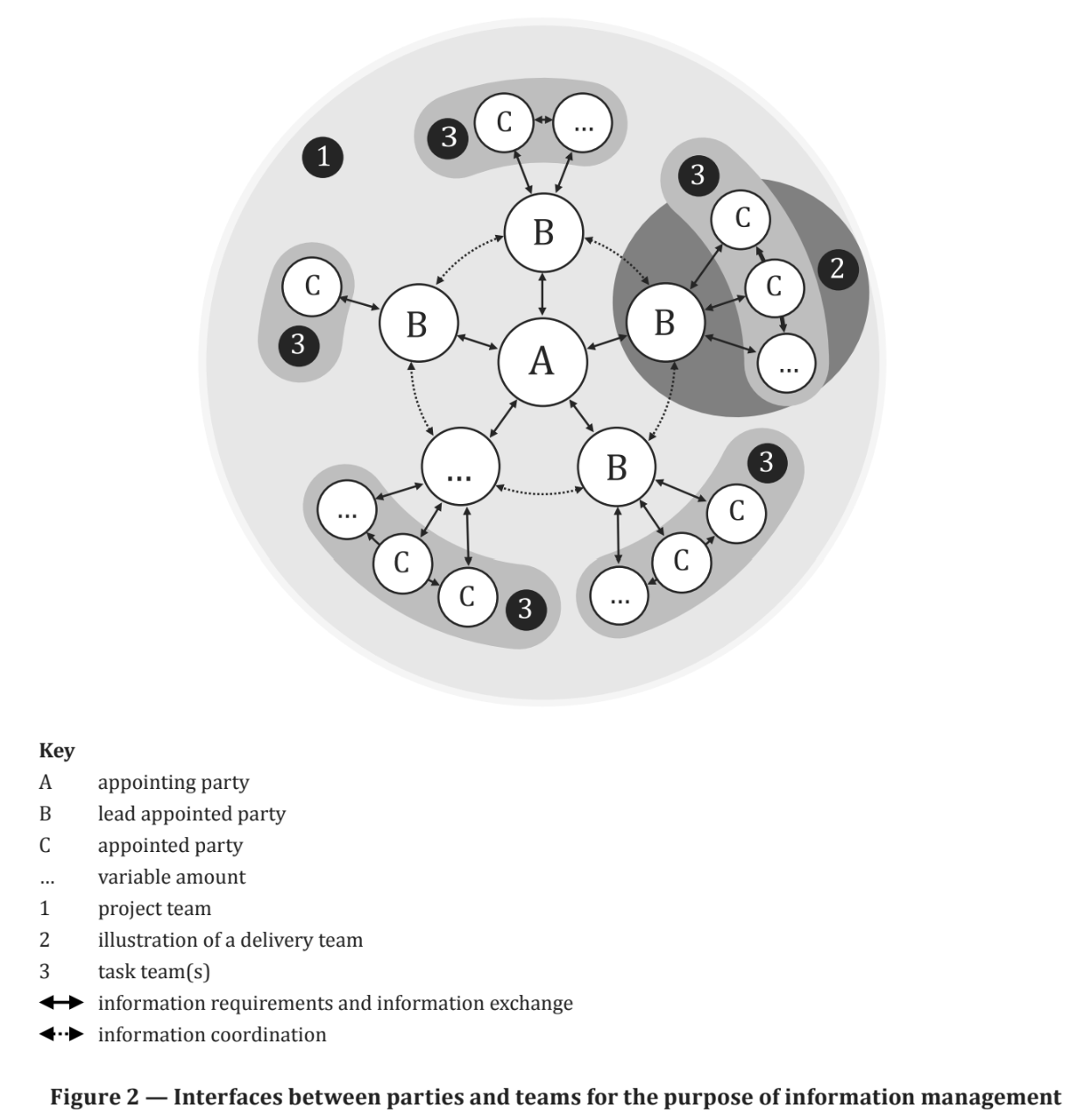
Figure 3 of DIS 2026 illustrates the interfaces between appointing party (A), lead appointed party (B) and appointed party (C) as nodes in a network, abandoning the linear hierarchical representation of Figures 6-9 of Ed. 2018 and introducing a simplified version of Figure 2 in Ed. 2018. The roles of appointing party, lead appointed party and appointed party are also described in detail with concept taken from part 2 Ed. 2018. An improved clarity in role definition is always welcome. However, the suppression of the key decision point as an explicit process structure (implicitly replaced by the trigger event to project sequence) reduces process readability for less experienced appointing parties. Anyway, this is possibly all that’s left of the old part 2. And definitely not what I would have saved.
7. Information Management Functions
Clause 7 of Ed. 2018 described information management functions divided into asset information management functions (7.2), project information management functions (7.3) and task information management functions (7.4). Of course, this distinction is gone. In DIS 2026, these contents are absorbed into Clause 6.6 (Assignment of information management activities), and the tripartition by function type is abandoned; in its place, the emphasis falls on accountability and delegation between the three types of parties.
The clause on “Assignment of information management activities” is a sub-clause of the broad process overview clause, more abstract and terminologically updated. A single unified treatment of assignment applies across all parties and all phases of the asset life cycle, and the unicorns fly high in the sky.

The word functions itself disappears. The DIS 2026 speaks throughout of activities rather than functions, a choice that is consistent with its broader preference for process language over role language. Whether this distinction is meaningful in practice is debatable, but it signals an intent to describe what people do rather than what they are, which aligns with the DIS 2026’s explicit warning — preserved from the 2018 edition — against confusing information management assignments with job titles or professional designations. I agree with this in principle, unless it’s used to deny that information management, production and coordination are actual jobs so that people can avoid paying professionals, in which case, fuck them.
Particular attention should be paid to the disappearance of the task information management function (Clause 7.4 of the 2018 edition) alongside the task team. This function addressed the coordination of information at the level of individual task teams, what the DIS 2026 would now describe as the activities of appointed parties within an information production team. The 2018 clause explicitly noted that task information management was “concerned both with the information associated with that task and with the requirement to coordinate information across multiple tasks.” This cross-task coordination responsibility is not explicitly addressed in Clause 6.6 of the DIS 2026 and it’s one of the norm’s worst weaknesses in my opinion. It is implicitly present in the broader treatment of the lead appointed party’s coordination role, but the explicit articulation of the task-level coordination obligation has been lost, which may create gaps in complex projects where the boundary between different appointed parties’ information production activities requires careful management.
Accountability and Delegation
Clause 6.6 introduces a clearer and more explicit treatment of accountability than anything in Clause 7 of the 2018 edition. The DIS 2026 explicitly states that an appointing party is accountable for the successful outcome of the information management process and of each project they initiate, and a lead appointed party is accountable for the successful outcome of their appointment from their appointing party. The 2018 edition was considerably more diffuse on this point, which I didn’t particularly like: clause 7.1 generically stated that functions had to be embedded into appointments and that “information management functions, responsibility and authority” had to be allocated to “parties on the basis of their appropriateness and ability to perform them”, but it did not establish a clear hierarchy of accountability. The result, in practice, was frequent uncertainty about who bore ultimate responsibility when information management processes broke down, a problem well documented in post-occupancy and lessons-learned reviews across the industry.
The DIS 2026’s treatment is more precise, and establishes a two-tier accountability structure: the appointing party is accountable for the process as a whole and for each project, while the lead appointed party is accountable for their specific appointment. Importantly, the clause also addresses delegation: “The responsible party can delegate responsibility to another party but only on the basis of their capability and capacity to perform the necessary activities.” This condition on delegation — capability and capacity must be demonstrated — isn’t new but stays operationally significant. It prevents the common practice of cascading responsibility downwards through a supply chain to parties who may lack the skills or resources to discharge it effectively, and it connects the assignment provisions directly to the capability and capacity review requirements of Clause 10.
This is one of the clearest improvements in the DIS 2026 relative to the 2018 edition. The accountability framework feels more robust, more explicit, and more directly actionable. It should translate into clearer appointment documents and, over time, into better-defined roles in complex multi-party projects.
Succession Planning
One element of the 2018 Clause 7 that the DIS 2026 preserves almost verbatim is the succession planning requirement. The 2018 edition stated: “given the long-term nature of asset management it is almost certain that functions will be fulfilled by a succession of organizations or individuals. It is therefore important that succession planning is properly addressed in the information management process.” The DIS 2026 retains this language with only minor terminological adjustments.
The preservation is appropriate. Succession planning in information management is a genuine and often neglected challenge, particularly for long-lived assets such as infrastructure networks, public buildings, and industrial facilities. The individuals and organisations who establish an information management framework at the beginning of an asset’s life will almost certainly not be the same ones managing it twenty or thirty years later. The continuity of the framework — its processes, its data structures, its governance arrangements — depends on succession planning being treated as a first-class concern rather than an afterthought. The DIS 2026 is right to retain this emphasis.
Relationship between information management and design responsibilities
Both the 2018 edition and the DIS 2026 include the caveat that “information management functions (2019) / assignments (2026) should not refer to design responsibilities”. The intent of this provision is to maintain the separation between the management of information and the technical or professional responsibilities associated with producing it, preventing, for example, the information manager from being held liable for design decisions embedded in the information they are managing.
This caveat was understandable in 2018, when the information manager was a relatively new role in many markets, and there was genuine risk of scope confusion. In 2026, however, the relationship between information management and design has become considerably more complex. In integrated project delivery models, design authorship and information management are often possible only if performed by the same individuals using the same tools. In automated workflows involving model checking, clash detection, and algorithmic design, the boundary between information management (checking that information meets the required format and level of detail) and design review (assessing whether the design meets the required performance) is genuinely blurred. The blanket caveat that information management should not refer to design responsibilities may therefore be insufficient as a governance principle for the most sophisticated contemporary delivery methods, and the standard would benefit from a more nuanced treatment of where this boundary lies and how it should be managed when it becomes unclear.
8. Team Capability and Capacity
Clause 8 of Ed. 2018 (‘Delivery team capability and capacity’) finds its correspondence in Clause 10 of DIS 2026 (‘Information production team capability and capacity’). The content appears substantially equivalent, with the terminological substitution of delivery team for information production team. Explicit reference is added to the verification of capability and capacity in relation to the security activities required by ISO 19650-5. A small but significant change in Clause 10.2: Ed. 2018 required “the ability to work in a collaborative way, and their experience in information container-based collaborative working“; DIS 2026 changes this to “experience in implementing information management according to ISO 19650″, and this strengthens the reference to the normative series as an evaluation benchmark, but again we’re in a situation where many people might be superstars in managing things that no one is actually producing.

9. Collaborative Working and the Common Data Environment
Clauses 9 (Information container-based collaborative working) and 12 (Common data environment solution and workflow) of Ed. 2018 converge into Clause 11 of DIS 2026 (Common data environment), which is profoundly restructured in view of the reinforced approach to the CDE as a collaborative framework with tools in support.
Ed. 2018 defined the CDE as “agreed source of information for any given project or asset, for collecting, managing and disseminating each information container through a managed process,” and it was up to National Annexes and implementation guidelines to vocally specify that this wasn’t meant to be a single technological solution (I did it last time here). DIS 2026 redefines it as an operational framework to facilitate the collaborative production of information, explicitly articulated into two components: information production workflow and enabling technologies.
Workflow
When it comes to the workflow, another welcome change is the introduction of the SUBMITTED stage. Where Ed. 2018 provided for four states (Work in Progress, Shared, Published, Archive), DIS 2026 introduces a fifth state inserted between SHARED and PUBLISHED, to preserve that limbo where lived information containers that were submitted but hadn’t been approved yet.
Just to be clear:
| Ed. 2018 | DIS 2026 |
| 0. WORK IN PROGRESS | 0. WORK IN PROGRESS |
| 1. SHARED | 1. SHARED |
| (nor provided) | 2. SUBMITTED (new) |
| 2. PUBLISHED | 3. PUBLISHED |
| 3. ARCHIVE | 4. ARCHIVED |
The SUBMITTED state formalises the transition from within the team (SHARED) to outside, i.e. to the appointing party or third parties. In the SHARED to SUBMITTED transition, the container is approved for a specific use; in the SUBMITTED to PUBLISHED transition it is accepted by the appointing party. The introduction of the SUBMITTED state responds to a real need identified during implementation of the 2018 standard: the absence of an intermediate state between internal team sharing and final publication was creating ambiguity in sharing platform workflows. The change is coherent and an improvement. The impact on software systems already configured to the four states of Ed. 2018 will need to be assessed, and lots of people will have to create lots of folders.
Enabling Technologies
DIS 2026 introduces the concept of enabling technologies as a formal element of the CDE framework, with its own definition (3.2.26) and dedicated sub-clause (11.4). Examples listed include: information modelling platforms, databases, geospatial information systems, electronic document management systems. The concept of linked enterprise system (3.2.27) is also introduced, enabling integration with business systems such as ERP, CAFM and scheduling systems. The formalisation of enabling technologies and linked enterprise systems is an important signal of the framework’s evolution towards integration with the broader digital business ecosystem. This brings ISO 19650 closer to concepts such as Digital Twin and smart asset management, without explicitly naming them (DIS 2026 mentions them in the Asset Information Model section but excludes them from its scope).
10. Information Delivery Planning
Clause 10 of Ed. 2018 (Information delivery planning) corresponds to Clause 9 of DIS 2026 (Information production planning). The core content is preserved but with important terminological and structural changes.
10.4. Federation strategy and information container breakdown
The concepts of federation strategy and information container breakdown structure, treated in Ed. 2018 in some depth (with the dedicated Annex A), are simplified in DIS 2026 to sub-clauses 9.2 and 9.3, with operational detail deferred to ISO 19650-3. The decision to move the applicative detail on aggregation to ISO 19650-3 is understandable within the logic of separating principles (Part 1) from implementation (Part 3). However, Annex A of Ed. 2018 was one of the most cited resources in training courses and practical projects; its suppression in Part 1 reduces the accessibility of the standard for organisations without access to the full series.
11. Collaborative Production of Information
Clause 11 of Ed. 2018 (Managing the collaborative production of information) contained the main concepts of Level of information need (11.2) and Information quality (11.3). In DIS 2026 these topics are redistributed. Let’s see how.
11.2 — Level of information need
The concept of Level of information need (don’t call them LOIN, the British will get hungry) survives in DIS 2026 (Clause 7.2.2) with an important update: it is explicitly linked to standard ISO 7817-1:2024, which didn’t exist back in 2018 (duh) and now provides the definitional reference framework. In Ed. 2018, LOIN was treated more autonomously, with freely definable metrics. Linking LOIN to ISO 7817-1 brings conceptual order, but it also means that correct LOIN implementation won’t require the study of an additional standard: the market is already being trained on the LOIN taxonomy (geometrical information, alphanumerical information, documentation) that differs from established practices (LOD/LOI/LOIN as defined in other national frameworks), and this is an ongoing struggle DIS 2026 supports.

11.3. Information quality
Information quality requirements are deferred in DIS 2026 to ISO 19650-4, which will specify the criteria for decisions on changes of state of information containers. This is a coherent normative architecture choice but one that increases dependency on the full series for complete implementation, and how can I comment on something that isn’t out yet?
12. Framework Summary
Clause 13 of Ed. 2018 (‘Summary of BIM according to the ISO 19650 series’), with the well-known Figure 11 (the circular process overview diagram), finds its correspondence in Clause 13 of DIS 2026 (‘Summary of information management according to ISO 19650’).
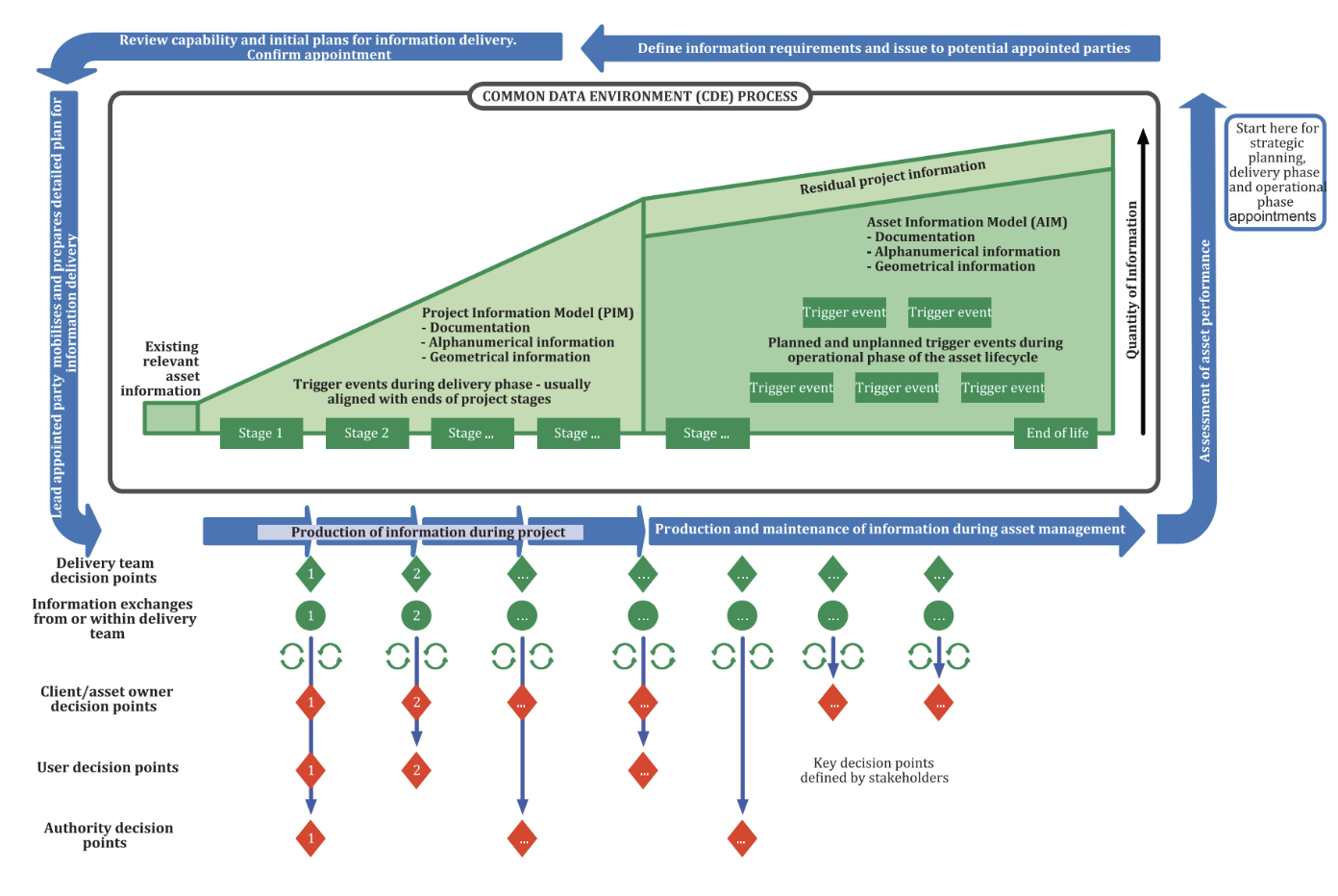
The new Clause 13 does not include a summary figure equivalent to Figure 11 of Ed. 2018 (THANK GOD). The content is rewritten with emphasis on the organisational management of the process rather than the information flow structure. The emerging idea is that the information management process should be adopted by the appointing party at an organisational level before being applied to individual assets and projects. However, as is the case for everything else in the norm, there’s no explicit connection being made between the organisational level and the project level, and no clarity on what the organisational level represents for actors working in the design and construction stages.
That’s all for now. See you next week to try and get a grip onto the new concepts.






No Comments