
Last week I wrote a piece on the use of flow principles in technical training, focusing on the principles you can design for. Specifically, Csikszentmihalyi names eight characteristics of flow, and the article only worked with three of them — clear goals, immediate feedback, and the challenge-skill balance — because those are the only ones you can actually build into a course. The other five are what happens after the first three are in place: deepening concentration, absorption in the present, a sense of control, an altered perception of time, and the dissolution of the ego.
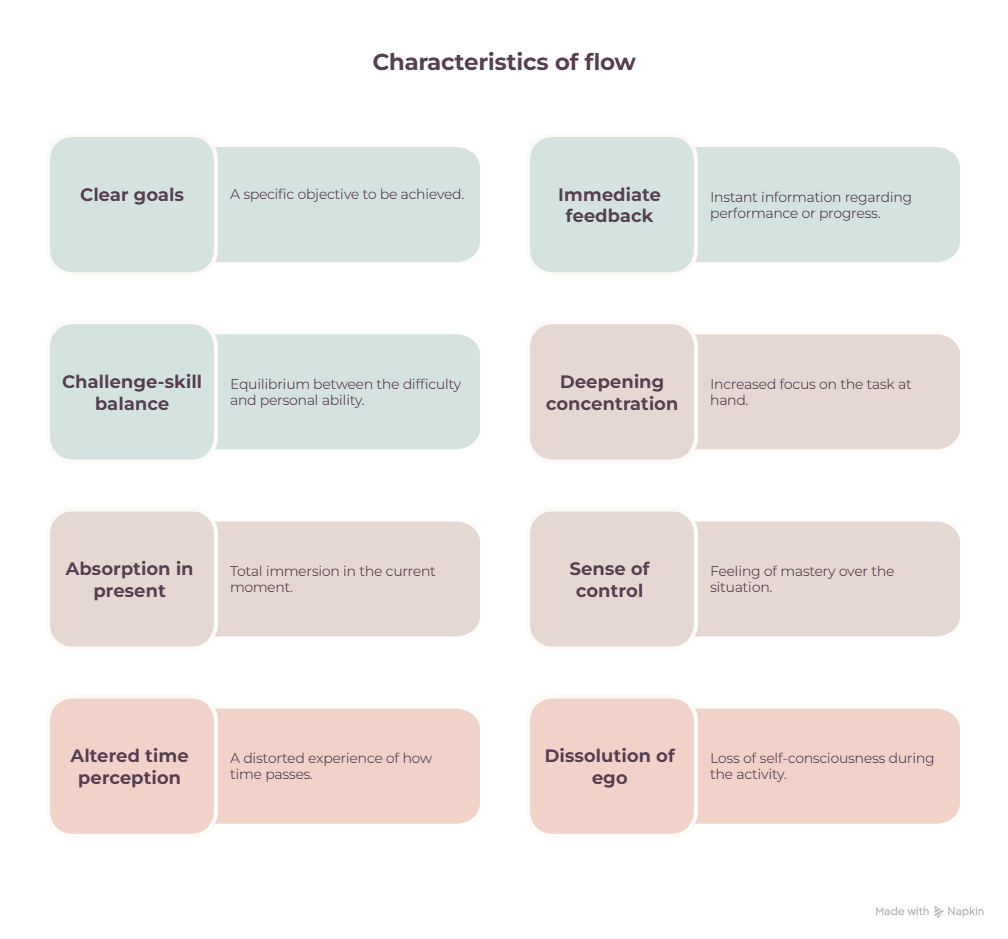
Once you grasped the general principle, it’s easy to slide from being able to see the signs and assuming you can design for these signs directly, and that slide produces exactly the kind of theatre the first article criticised in gamification: surface features bolted onto a system that doesn’t actually work. You don’t get deep concentration by asking people to concentrate, any more than you get a balanced budget by asking the spreadsheet to do some yoga. The five elements are diagnostics. They tell you whether the calibration underneath is right. Read that way, they’re some of the most useful signals a trainer has, and almost nobody in technical training is trained to read them. So, this week, let’s take a closer look at them.
1. Concentration
When challenge and skill are matched, concentration is effortless: it happens as a side effect, the way water finds its level. This is the most reliable real-time signal a trainer has that a task is correctly calibrated for the person doing it, and it’s available during the activity. A room where people are visibly concentrating — heads down, quiet, occasional low murmurs of problem-solving rather than social chat — is a room where the challenge-skill balance is working. A room where people are chatting, checking phones, or asking off-topic questions is telling you the same thing boredom always tells you: recalibrate.
The trap is trying to manufacture this directly with quiet rooms, anachronistic no-phone policies, focus time framing. None of that produces concentration: it just produces the appearance of concentration, with irritation underneath. Concentration is downstream of the task being right. If it’s not showing up, the fix is the task, not the room’s discipline.

2. Absorption in the present
Full absorption in a task — the sense that here and now is what matters — is invaluable for skill acquisition. It’s also the point in technical training most likely to produce a specific failure: skills might transfer beautifully to the exact same activity demonstrated by the trainer, and less well to the messier version of the same problem at work. Absorption narrows attention to the task in front of you; that’s what makes flow effective for acquiring a discrete skill, and exactly what makes it a poor vehicle, on its own, for teaching judgment, where by technical judgment I mean knowing when a technique applies and when it doesn’t, which requires holding context in mind that absorption is actively suppressing.
The practical implication is that, after a flow-state exercise, you might deliberately break the absorption and ask people to zoom out by reflecting on where does the skill fit, and when it wouldn’t be appropriate for the task at hand. when you’re doing that, you’re cashing the flow in, and using it also for the thing it’s bad at producing on its own: a flexible approach that lasts beyond the flow state.

3. Sense of control
Flow produces a strong subjective feeling of control — over the task and, by extension, over one’s competence. That feeling is a large part of why flow states are pleasant and why people seek them out. It is also, in a training context, the effect most likely to mislead both the participant and the trainer, because a feeling of control is not the same thing as actual competence, and the gap between the two is invisible from inside the experience.
This is important because flow is most easily achieved on well-defined, well-scaffolded tasks, which is exactly the kind of task a course provides and exactly the kind of task real work doesn’t. Someone can experience genuine, well-calibrated flow solving a clean training exercise and walk out with a sense of control that doesn’t survive contact with a real project’s ambiguity. The fix isn’t to avoid producing this feeling — you want people confident enough to try things — but to not mistake the presence of flow, on its own, for evidence that the skill has actually transferred. Confidence generated by flow needs a reality check built into the course design: a final exercise deliberately less clean than the ones that came before it, specifically to test whether the sense of control holds up outside the conditions that produced it.

4. Altered time perception
Time distortion during the flow state — sessions that feel like they took ten minutes when ninety passed or, God forbid, the reverse — is one of the most reported features of the state, and one of the most immediately practical for a trainer to watch for, because it shows up in a very mundane way: people ignore breaks, run past the scheduled end of an exercise, and are annoyed rather than relieved when told to stop. That’s a good sign about the exercise and a genuine logistics problem for the day’s schedule. It also cuts the other way: an exercise where time visibly drags, where people are checking the clock, is failing on calibration regardless of what the content looks like on paper.
The practical use here is administrative, and every good trainer knows this trick: build slack into the schedule around any exercise you expect to work well, because if it works, people will not want to stop on cue. Treat the request for five more minutes as data, not an interruption to the plan. The plan is always expendable in the face of people’s actual learning.

5. Ego dissolution
The most extreme reported effect of flow is a temporary drop in self-monitoring: people forget to track how they’re coming across, whether they look competent, what their status in the room is. In deep flow, this can extend to something closer to losing a sense of self as separate from the activity. It’s real, and in creative and athletic contexts it’s often the most valued part of the experience.
In technical training, it needs more caution than the other four, for a specific reason: a lot of technical work is critical to a certain degree of safety or compliance, and self-monitoring is not always the enemy there. Sometimes it’s the thing standing between a person and a tragic error. A modeller in deep flow who has stopped checking their own output against a standard is not obviously better off than one who hasn’t. This is the one effect you shouldn’t chase it, and don’t read its absence as a design failure. Concentration, presence, a working sense of control, and comfortable time distortion are worth designing toward. Full ego dissolution, in a context where the whole point is producing verifiable, checkable technical output, is not obviously a feature.

Reading the effects
The throughline across all five is the same: they’re instruments, not targets. A trainer who learns to read concentration, absorption, felt control, and time distortion in real time has a live diagnostic for whether the challenge-skill balance from last week’s article is actually working, better than any end-of-day survey, because it’s available while there’s still time to adjust the next task. Chasing the effects directly, on the other hand — trying to manufacture focus, immersion, confidence, or a sense of timelessness through framing and atmosphere rather than through the task itself — is the same mistake gamification makes when it bolts a leaderboard onto a lecture. It produces the look of flow without the mechanism, and it doesn’t survive the first real exercise that isn’t perfectly calibrated.
Beware.


No Comments