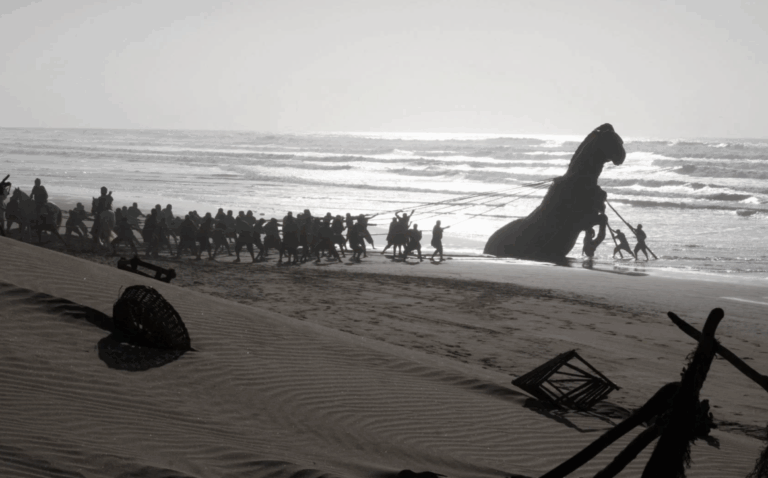
"All this he saw, for one moment breathless and intense, vivid on the morning sky; and still, as he looked, he lived; and still, as he lived, he wondered."

#ChthonicThursday: the Amduat

Alternatively translated “That Which Is In the Afterworld” or “Text of the Hidden Chamber Which is in the Underworld”, and called Kitab al-Akhira in Arabic, the Amduat is a funerary text from the New Kingdom and it has been found inscribed on the walls of tombs such as the one of Thutmose III, whose entire tomb is thought to mirror the geography of the afterlife.

The text recounts the journey of Ra, the Egyptian sun god, as he travels daily through the underworld from sunset in the west to sunrise in the east. This journey symbolizes continual death and rebirth, with the sun ‘dying’ at sunset and being ‘reborn’ at dawn, and it’s one hell of a journey (quite literally). According to belief, the deceased Pharaoh underwent the same journey, ultimately being reborn to join Ra eternally. Numerous gods and goddesses, including Khepri, Isis, and Osiris, assist both Ra and the departed soul on this voyage in the Duat, alongside many unnamed or unknown deities.

As well as enumerating and naming the inhabitants of the Duat, which we find in other texts, the Amduat is unique because it dives into detail about the geography of the Egyptian Underworld.

The Duat is divided into twelve regions, as many as the hours of the night, each of them inhabited by allies and presenting different adversaries for the Pharaoh and the Sun God’s conjoined journey. The Amduat catalogues these deities and creatures, such as the serpent of Mehen or the ‘World Encircler’, and portrays their varied roles in aiding or obstructing Ra and the departed soul. Primarily, the Amduat provides guidance to the pharaoh by unveiling the names and attributes of these entities, so that this knowledge will empower him to seek assistance or counter their influence, and detailing the geography as a proper map, to ease the journey.

Today on my Patreon we take a look at these twelve sections.

movies and tv

The Lychee Road

On the plane to Taiwan, the entertainment selection was limited but this caught my eye: it’s a 2025 movie, labelled as historical comedy, in which a Tang Dynasty minor official is framed by his colleagues into performing an impossible task: delivering fresh lychees from a

Read More »
architecture, engineering and construction

Fuorisalone 2026

I am not ready. I am so not ready. I feel like I just got back from Taiwan (which I did), Rome in between, and now I must prepare to depart for Denmark and I am so not ready for the Design Week. Still, the

Read More »
books and literature

Project Hail Mary

I really wanted to like this book, having liked The Martian and… well, we don’t talk about Project Artemis. I enjoyed the movie just fine, and I hoped the book would fix some oversimplifications and convenient occurrences depicted there. Also, the main character is a

Read More »
Share on LinkedIn
Throw on Reddit
Roll on Tumblr
Mail it
No Comments

Post A Comment

This site uses Akismet to reduce spam. Learn how your comment data is processed.

RELATED POSTS

The Lychee Road

On the plane to Taiwan, the entertainment selection was limited but this caught my eye: it’s a 2025 movie, labelled as historical comedy, in which a Tang Dynasty minor official is framed by his colleagues into performing an impossible task: delivering fresh lychees from a

Read More

Fuorisalone 2026

I am not ready. I am so not ready. I feel like I just got back from Taiwan (which I did), Rome in between, and now I must prepare to depart for Denmark and I am so not ready for the Design Week. Still, the

Read More

Project Hail Mary

I really wanted to like this book, having liked The Martian and… well, we don’t talk about Project Artemis. I enjoyed the movie just fine, and I hoped the book would fix some oversimplifications and convenient occurrences depicted there. Also, the main character is a

Read More