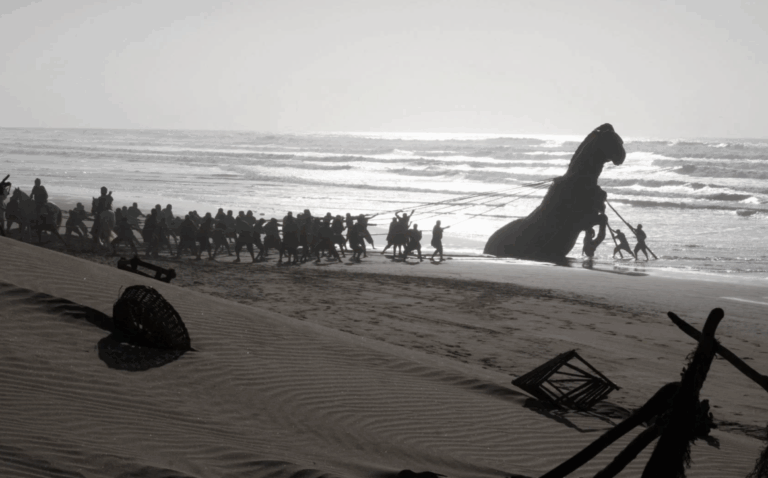
"All this he saw, for one moment breathless and intense, vivid on the morning sky; and still, as he looked, he lived; and still, as he lived, he wondered."

Altered Carbon

C22B45EC-B7E0-4FE7-9D57-92C23F0D9474
One of the finest sci-fi series I’ve seen in a while starts off with a dissatisfying episode that might give you the temptation to give it up. Don’t. I know that the concept is ripped off a novel by Arthur Clarke and I know that you might feel like you’re trapped in a science fiction trivia, for all the concepts you will see that you’ve already seen elsewhere. And I know that you’d rather feel like stabbing yourself in a leg before witnessing more of Martha Higareda’s “acting”. And I won’t lie to you: the second part doesn’t get any better. The first one, however, reach a certain peak to almost become a feature and one might argue that every episode is centered around a topos of sci-fi. I didn’t read the novel, so I don’t know if this is the case.
However, you should resist the urge of dropping it, and keep going. I promise it will be worth your time.

The story revolves around a former terrorist, whose conscience gets reinstated in the body of… well, ok, no spoilers. It’s an investigation and a damn good one. It has Joel Kinnaman as the main guy and James Purfoy is magnificent in the role of the murder victim who hires him to find the killer. A mention of honour also goes to Chris Conner: his Poe is one of the best characters, brings a little steampunk in an otherwise explicitly cyberpunkish series.
What I found to be more deserving is the way everything is significant to the main plot and how all seemingly loose ends got tied together, in the end. In this way, it is as good as Heroes season 1, or even Westworld. Watch it.


Summertime

The Path You Have to Sing

Alexis Wright‘s Carpentaria, an epic work set in a fictional town called Desperance, opens before there are any people in it at all: an ancestral serpent, “a creature larger than storm clouds,” descends from the stars and drags itself across the wet clay of the

Read More »
movies and tv

But for pursuit of virtue and of knowledge

I’m sure you’ve read enough analysis of Nolan’s Odyssey to last a lifetime, and you don’t need another European ranting that he changed stuff, so I’m not going to. Instead, I’d like to talk about the movie in itself, as an independent work, granting the

Read More »
Summertime

A Pilgrimage With No Shrine

The full German title of today’s book is Die Ringe des Saturn: Eine englische Wallfahrt — “The Rings of Saturn: An English Pilgrimage” — and it was written by W.G. Sebald, a German-born writer, essayist, poet, and literary scholar who lived much of his life

Read More »
Share on LinkedIn
Throw on Reddit
Roll on Tumblr
Mail it
No Comments

Post A Comment

This site uses Akismet to reduce spam. Learn how your comment data is processed.

RELATED POSTS

The Path You Have to Sing

Alexis Wright‘s Carpentaria, an epic work set in a fictional town called Desperance, opens before there are any people in it at all: an ancestral serpent, “a creature larger than storm clouds,” descends from the stars and drags itself across the wet clay of the

Read More

But for pursuit of virtue and of knowledge

I’m sure you’ve read enough analysis of Nolan’s Odyssey to last a lifetime, and you don’t need another European ranting that he changed stuff, so I’m not going to. Instead, I’d like to talk about the movie in itself, as an independent work, granting the

Read More

A Pilgrimage With No Shrine

The full German title of today’s book is Die Ringe des Saturn: Eine englische Wallfahrt — “The Rings of Saturn: An English Pilgrimage” — and it was written by W.G. Sebald, a German-born writer, essayist, poet, and literary scholar who lived much of his life

Read More