"All this he saw, for one moment breathless and intense, vivid on the morning sky; and still, as he looked, he lived; and still, as he lived, he wondered."

Altered Carbon

C22B45EC-B7E0-4FE7-9D57-92C23F0D9474
One of the finest sci-fi series I’ve seen in a while starts off with a dissatisfying episode that might give you the temptation to give it up. Don’t. I know that the concept is ripped off a novel by Arthur Clarke and I know that you might feel like you’re trapped in a science fiction trivia, for all the concepts you will see that you’ve already seen elsewhere. And I know that you’d rather feel like stabbing yourself in a leg before witnessing more of Martha Higareda’s “acting”. And I won’t lie to you: the second part doesn’t get any better. The first one, however, reach a certain peak to almost become a feature and one might argue that every episode is centered around a topos of sci-fi. I didn’t read the novel, so I don’t know if this is the case.
However, you should resist the urge of dropping it, and keep going. I promise it will be worth your time.

The story revolves around a former terrorist, whose conscience gets reinstated in the body of… well, ok, no spoilers. It’s an investigation and a damn good one. It has Joel Kinnaman as the main guy and James Purfoy is magnificent in the role of the murder victim who hires him to find the killer. A mention of honour also goes to Chris Conner: his Poe is one of the best characters, brings a little steampunk in an otherwise explicitly cyberpunkish series.
What I found to be more deserving is the way everything is significant to the main plot and how all seemingly loose ends got tied together, in the end. In this way, it is as good as Heroes season 1, or even Westworld. Watch it.

comics and illustration

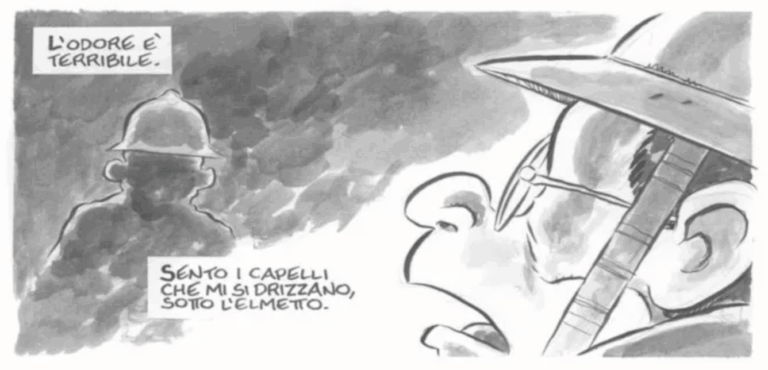
Leo Ortolani, Tapum

A un certo punto ci sarà una battuta, in questo fumetto, e riderete. Sappiate che è l’unica. Com’è giusto che sia. Se devo paragonare quest’opera a qualcosa, il confronto più azzeccato è probabilmente lo spettacolo che Marco Paolini trasse dal Sergente nella neve di Rigoni

Read More »
Summertime

Omeros in the Caribbeans

Derek Walcott was a Saint Lucian poet, playwright, and painter, and one of the major voices of Caribbean literature. He won the Nobel Prize in Literature in 1992, and his work often explores Caribbean history, identity, colonial inheritance, and the meeting of European and African

Read More »
books and literature

Ioanna Papadopoulou’s The Castaway and the Witch

I had a genuine “oh shit” moment when I read the author’s preface saying this was darker than “Winter Harvest” because – and I absolutely ADORED “Winter Harvest” – that was pitch-black dark. I thought “we’re all going to die”. This maybe has something to

Read More »
Share on LinkedIn
Throw on Reddit
Roll on Tumblr
Mail it
No Comments

Post A Comment

This site uses Akismet to reduce spam. Learn how your comment data is processed.

RELATED POSTS

Leo Ortolani, Tapum

A un certo punto ci sarà una battuta, in questo fumetto, e riderete. Sappiate che è l’unica. Com’è giusto che sia. Se devo paragonare quest’opera a qualcosa, il confronto più azzeccato è probabilmente lo spettacolo che Marco Paolini trasse dal Sergente nella neve di Rigoni

Read More

Omeros in the Caribbeans

Derek Walcott was a Saint Lucian poet, playwright, and painter, and one of the major voices of Caribbean literature. He won the Nobel Prize in Literature in 1992, and his work often explores Caribbean history, identity, colonial inheritance, and the meeting of European and African

Read More

Ioanna Papadopoulou’s The Castaway and the Witch

I had a genuine “oh shit” moment when I read the author’s preface saying this was darker than “Winter Harvest” because – and I absolutely ADORED “Winter Harvest” – that was pitch-black dark. I thought “we’re all going to die”. This maybe has something to

Read More