
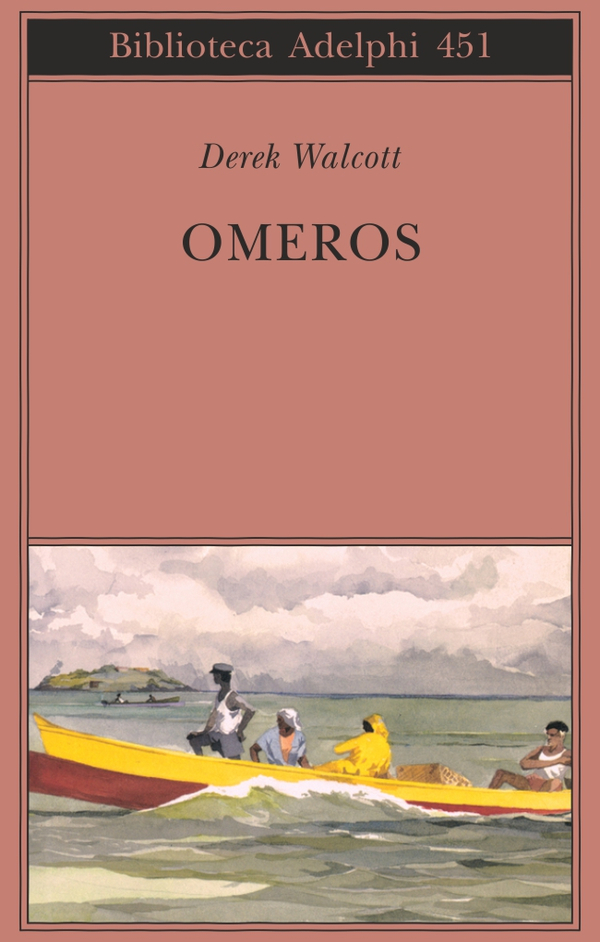
Derek Walcott was a Saint Lucian poet, playwright, and painter, and one of the major voices of Caribbean literature. He won the Nobel Prize in Literature in 1992, and his work often explores Caribbean history, identity, colonial inheritance, and the meeting of European and African cultural traditions. Omeros is Walcott’s best-known long poem, published in 1990, an epic reimagining of Homer’s Iliad and Odyssey in a Caribbean setting, especially around Saint Lucia, that turns classical myth into a meditation on fishing communities, memory, colonialism, and artistic creation.

Among many other things, Omeros is also an argument about how many journeys are actually happening at once inside what looks like a single one, and Walcott makes this explicit by comparing his fisherman Achille’s Atlantic crossing to his own work at the desk: there are two journeys in every odyssey, he writes, one on worried water, the other crouched and motionless, without noise, for both, the self is a mast, and a desk can be a raft as easily as an actual hull can. And then, in the same passage, the poem makes its stranger claim: that the real journey is motionless, that the sea only moves around an island that appears to be moving, and that the travelling hand always knows it must return to the port it started from. The island doesn’t get left; it gets circled, described, returned to, described again.
This retunes something I’d been treating, across the last week of this series, as a fairly stable opposition: paths that arrive somewhere, against paths that loop back and deliver you only to yourself. Walcott’s circling isn’t quite either. It’s not Pizarnik’s mirror, where the walker meets no one but her own reflection at the end of the falling. It’s closer to an orbit: a real distance covered, real water crossed, real labour in the crossing, but organised around a centre that never actually recedes, the way an island stays exactly where it is, no matter how far the boat that’s circling it appears to have travelled. The desk and the fishing canoe are doing structurally the same thing, in Walcott’s account: both are vehicles for going a very long way without ever quite leaving.
The more demanding threshold in this book, though, isn’t a path at all. It’s Philoctete’s wound: a gash on his shin from a rusted anchor that refuses, page after page, to heal. “I am blest with this wound,” he says, in the island Creole Walcott lets him speak in, “which will never heal.” Blessed with it, and cursed with it in the same breath, because the wound isn’t only his: Walcott ties it explicitly to the anchors and shackles of the slave ships, so that Philoctete’s unclosing shin becomes the place where the history of the island keeps a door propped open that everyone else has learned to walk past. A threshold, properly speaking, is supposed to resolve. You cross it and you’re on the other side. Philoctete’s wound is a threshold that cannot be crossed.
What eventually treats it is not modern medicine, which Philoctete tries and abandons, but a healer, Ma Kilman, who cures him with a plant whose lineage runs back to Africa, to the same ancestral ground the wound itself was pointing toward all along. The cure closes the wound by finally addressing its cause directly, going back to the actual source rather than around it.
That distinction feels important for anyone who is confronted by heritage and designs in places carrying a wound of their own: a demolished neighbourhood, a colonial building nobody’s sure whether to preserve or erase, a site whose present use sits directly on top of a use nobody wants to remember. The reflex, professionally, is to heal these sites the way you’d heal a defect: smooth the scar, resurface, let the new fabric knit over the old one until the joint disappears. Walcott’s Philoctete suggests a much less easy alternative, which is that some wounds are only properly closed by a cure that goes back and answers the actual history, rather than one that simply covers the site with enough new material that the history stops being visible.
Food for thought.


No Comments