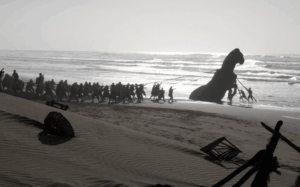
"All this he saw, for one moment breathless and intense, vivid on the morning sky; and still, as he looked, he lived; and still, as he lived, he wondered."

#AdventCalendar Day 21: Apple Soup

Ingredients (serves 4 people):

  • 5 quinces;
  • a glass of almond milk (you know the drill);
  • a litre of beef stock;
  • 30 grams of butter;
  • a pinch of sugar;
  • a pinch of ginger;
  • powdered cinnamon.

Recipe:

Peel the quinces and mince them in cubes after removing the core. Place the pieces in a pan and cover with the almond milk, the butter, the sugar and the ginger. Cook it on a low fire until the liquid has shrunk, then mush it to a pulp and place it in a pan with the broth. Cook for 20 minutes more on a slightly more live fire. When you place it in the serving bowls, sprinkle each portion with cinnamon.

Quinces?

Quinces are not apples and I strongly suggest not to swap them in this recipe, unless you want to make a dessert.

As a symbol sacred to Aphrodite, a quince possibly played a role in a lost poem by Callimachus that has been preserved in a prose epitome. In this tale, Acontius, upon spotting his beloved in the temple courtyard of Aphrodite, plucks a quince from the sacred orchard. He then inscribes a message on its skin and discreetly rolls it at the feet of the illiterate nurse accompanying the girl. Intrigued by the gesture, the nurse hands the quince to the girl, who, upon reading the inscription aloud, unwittingly utters a solemn vow to marry Acontius, swearing by Aphrodite herself. Such vows spoken within the goddess’s sacred precinct are considered unbreakable. We do not know how the story ends, but Acontius is a real asshole.

Pliny the Elder, in his Natural History, refers to “numerous varieties” of quince and provides descriptions of four of them.

In the Akkadian language, the fruit was identified as “supurgillu,” referred to collectively as “quinces”. This term was adopted into Aramaic as “sparglin”. During the Mishnaic Hebrew era in Judea, it was known as “prishin”, a borrowing term from Jewish Palestinian Aramaic meaning “the miraculous [fruit].” Quince thrived in the warmth of the Mesopotamian plain, an environment where apples did not flourish, and some in ancient times even dubbed this fruit “golden apples.” Modern scholars speculate they might be the famed fruit in the Hesperides garden.


Summertime

The Path You Have to Sing

Alexis Wright‘s Carpentaria, an epic work set in a fictional town called Desperance, opens before there are any people in it at all: an ancestral serpent, “a creature larger than storm clouds,” descends from the stars and drags itself across the wet clay of the

Read More »
movies and tv

But for pursuit of virtue and of knowledge

I’m sure you’ve read enough analysis of Nolan’s Odyssey to last a lifetime, and you don’t need another European ranting that he changed stuff, so I’m not going to. Instead, I’d like to talk about the movie in itself, as an independent work, granting the

Read More »
Summertime

A Pilgrimage With No Shrine

The full German title of today’s book is Die Ringe des Saturn: Eine englische Wallfahrt — “The Rings of Saturn: An English Pilgrimage” — and it was written by W.G. Sebald, a German-born writer, essayist, poet, and literary scholar who lived much of his life

Read More »
Share on LinkedIn
Throw on Reddit
Roll on Tumblr
Mail it
No Comments

Post A Comment

This site uses Akismet to reduce spam. Learn how your comment data is processed.

RELATED POSTS

The Path You Have to Sing

Alexis Wright‘s Carpentaria, an epic work set in a fictional town called Desperance, opens before there are any people in it at all: an ancestral serpent, “a creature larger than storm clouds,” descends from the stars and drags itself across the wet clay of the

Read More

But for pursuit of virtue and of knowledge

I’m sure you’ve read enough analysis of Nolan’s Odyssey to last a lifetime, and you don’t need another European ranting that he changed stuff, so I’m not going to. Instead, I’d like to talk about the movie in itself, as an independent work, granting the

Read More

A Pilgrimage With No Shrine

The full German title of today’s book is Die Ringe des Saturn: Eine englische Wallfahrt — “The Rings of Saturn: An English Pilgrimage” — and it was written by W.G. Sebald, a German-born writer, essayist, poet, and literary scholar who lived much of his life

Read More