
“Advanced BIM”: what does that even mean?
“Advanced BIM” is one of those expressions that sound authoritative and yet, when you ask what it actually describes, the answers become very vague very quickly. The statement doesn’t mean anything, and it drives me crazy equally quickly. In many organisations, advanced simply means: we produce detailed models. Sometimes it means: we use clash detection. In more ambitious cases: we automate some tasks. The word stretches to cover almost any improvement in modelling technique or tool sophistication.
But this ambiguity is inherited by a mix of misused commercial buzzwords, simplified frameworks and a willful ignorance of actual frameworks to define maturity.
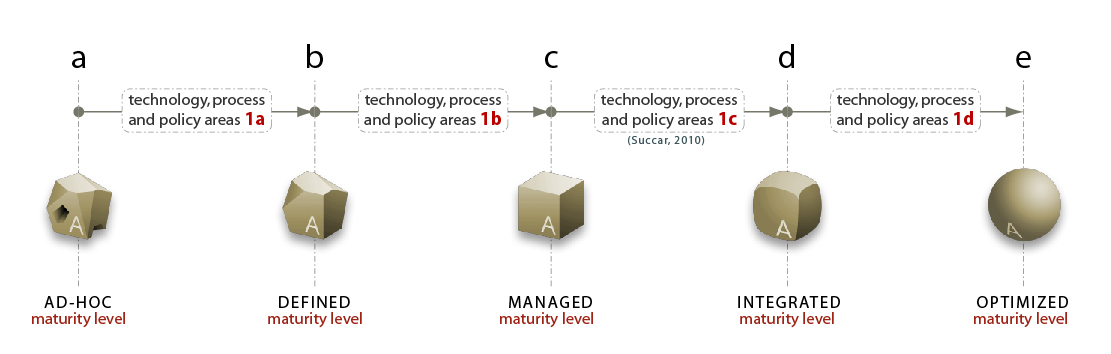
1. The Legacy of Levels
For years, the industry leaned on the UK’s Bew-Richards maturity triangle and the famous BIM levels. Level 0, Level 1, and Level 2, each step suggested progression towards a Nirvana of BIM. The diagram offered something the industry desperately wanted: a ladder. A visible path toward modernity.
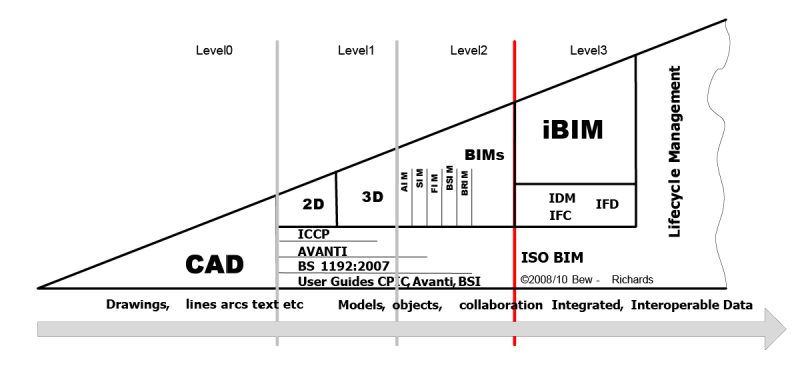
Level 3, in particular, became shorthand for advancement: if you were delivering integrated models and exchanging information in real-time, you were “there.” And by “there,” as we later discovered, was a deep state of mess. The focus of the original progression model, regardless of that small hiccup, was still largely on the presence of models and their coordination. That framework served an important transitional purpose, of course, but it was eventually superseded by approaches centred on the Common Data Environment (CDE) and information management principles formalised in standards like ISO 19650.
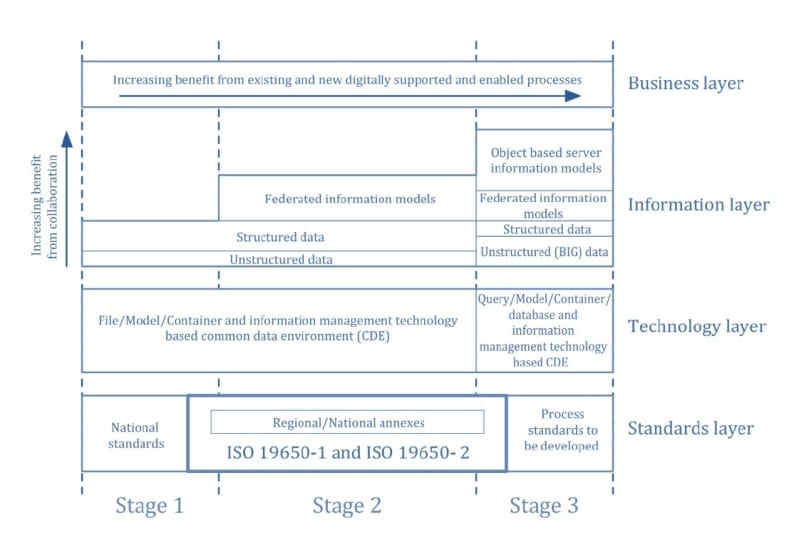
Why?
Because the industry slowly realised that maturity could not be measured by the existence of models alone: it had to be measured by the reliability of information flows, defined responsibilities, controlled processes, and by the governance of data across the lifecycle. The shift from levels to information management marked a conceptual evolution: from artefact-centric thinking to system-centric thinking.
And yet, culturally, many organisations remained anchored to the old logic: the model stayed at the centre of the narrative.
2. Maturity vs. Modelling Sophistication
Today, advanced BIM (whatever that means) is often equated with some kind of modelling complexity. High level of detail (and not development). parametric complexity, visually impressive coordination, generative scripts that are often just design optioneering. Add-ons stacked on top of add-ons.
Even when the conversation moves beyond geometry, the mindset often remains aesthetic, only now the vanity can include scripting and coding. It is no longer just about elegant façades; it is about elegant façades done through elegant scripts. In both cases, however, the centre of gravity remains the same: production.
On top of that, an organisation may produce extraordinarily refined models while lacking:
- consistent naming conventions;
- clear responsibility matrices;
- validated information requirements;
- traceable approval workflows;
- a stable CDE configuration.
In such cases, the output might look advanced, but the system underneath is fragile.
3. Production vs. Decision-Making
If the problem is that production remains the centre of gravity, then the question becomes unavoidable: what should sit at the centre instead? The answer is not “less modeling:” it is a different role for the model. The model should not be the climax of the process, but the final artefact that proves competence and, most importantly, the operational core around which decisions, validations, and responsibilities are structured. In a mature environment, the model stops being a drawing machine and becomes a decision-support environment.

When the model becomes the gravitational centre of management rather than production, several things change. Information requirements drive modelling choices, approval workflows shape model states, data structures are defined before geometry is elaborated, responsibility matrices are reflected in model ownership, and model validation processes are embedded in the approval process, not an afterthought following decisions made elsewhere. In this scenario, geometry becomes one layer of a broader information ecosystem where the model stops being celebrated for how complex it looks, but for how reliably it supports traceable decisions.
The question, in other words, shifts from: “How detailed is this object?” to “What decision does this information enable, and who is accountable for it?”
This is a radically different orientation.
In production-centred cultures, the model is treated as a deliverable: it’s completed, issued, showcased.
In structurally mature cultures, the model behaves more like infrastructure: it evolves through controlled states, reflects formal approvals, and becomes the single reference environment for coordination, risk assessment, cost alignment, and lifecycle planning. Its value is not in its complexity, but in its reliability. And reliability is not glamorous.

4. What’s to see in a mature context
A model reflecting reliability asks us to make a cultural shift and focus on stewardship instead of performance.
In a performance-driven culture, visibility is everything, while the proof of competence is externalised in rendered views that prove nothing, in smooth coordination sessions that don’t solve anything, in dashboards full of attributes nobody will read. The narrative is one of capability: look at all the stuff we can produce.
In a mature context, what matters is often invisible.
You do not see a well-structured information requirement: you experience its effects.
You do not see a coherent responsibility matrix: you notice the clarity of who does what.
You do not see a stable CDE configuration: you realise that nothing is lost, overwritten, or ambiguously approved.
The aesthetic bias that dominates our industry makes this difficult. We are trained — culturally and professionally — to evaluate what we can observe. Geometry is observable. Complexity is observable. Speed is observable.
Governance is not.
And yet, governance is what determines whether the idea of BIM can survive contact with reality.
In a mature organisation, the interesting questions are no longer about how impressive the model looks, but about how a good system can resist (and adapt) under pressure. Can two teams apply the same naming convention without improvisation? And when one of them needs to integrate it — because of discipline-specific needs that are perfectly reasonable but couldn’t have been foreseen — will the other teams still understand what’s happening? Can information be exchanged without translation gymnastics? Can a model issued today be traced, audited, and relied upon six months later without forensic reconstruction? While these aren’t glamorous achievements, and you rarely see them in conference slides, they are the difference between a technically sophisticated organisation and a digitally mature one.
Maturity reveals itself in the absence of drama.

The industry still gravitates toward visible complexity because it is easier to market. “Advanced BIM” sounds more convincing when it can be illustrated with a dense parametric object than when it is explained through approval states and metadata schemas.
But if digital maturity is structural competence — as we claimed at the beginning — then what we should be looking for is not brilliance in production, but a management that offers stewardship, a solid structure made of technology and methods, and responsibilities that are clearly accounted for, not to lay blame but to support and protect the digital process.
If you have those, you’re mature. If you don’t, there’s still work to be done.





No Comments