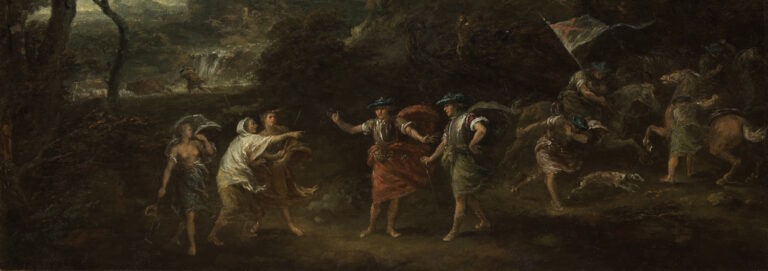
"All this he saw, for one moment breathless and intense, vivid on the morning sky; and still, as he looked, he lived; and still, as he lived, he wondered."

Pride Month 2025: Art of the Day

Swapped Lives, Eternal Forms: Visualising Gender Fluidity in the Torikaebaya Monogatari

Torikaebaya Monogatari (literally “If only I could exchange (them)!” often translated as “The Changelings”) is a 12th-century Japanese narrative that tells the story of two siblings: a boy raised as a girl and a girl raised as a boy, each excelling in their adopted roles within the imperial court. The tale delves into themes of gender identity, societal expectations, and personal fulfilment.

While original Heian-period illustrations are scarce (794 to 1185), Edo-period manuscripts and modern artistic interpretations have visualised this story, emphasising the fluidity and performative nature of gender. These artworks often portray the siblings in court attire appropriate to their adopted genders, engaging in activities and rituals that underscore their societal roles. For example, the artist Kubo Shumman (1757–1820) created a colour woodcut titled “Wakaki onokodomo warawabe nado to mari koyumi nado o mote asobitamau” (She played with little boys with balls and small bows), which is part of a portfolio series titled after the story.

The tale’s enduring relevance is evident in its adaptations across various media, including manga and theatre, where artists continue to explore and reinterpret its themes.
books and literature

Lolly Willowes

Sylvia Townsend Warner is one of the most interesting literary figures of the 21st century, and Lolly Willowes is one of her finest works, even more stunning if you think it was her debut novel. Self-supporting, intellectually independent, and consistently sceptical of social and religious

Read More »
books and literature

Fugitive Telemetry

This is book #6 in the Murderbot series (yes, I accidentally skipped #5, I’m circling back to that), and I’m afraid I didn’t like this as much as the others. The whole investigation felt a bit rushed and, though the final twist is interesting in

Read More »
architecture, engineering and construction

The Discipline of Inspiration: Valéry and the Algorithmic Mind

Paul Valéry rejected inspiration as miracle, seeing creativity as the discipline of thought in motion. This week, we parallel his notion of mental “operations” with computational procedures in design: iteration, optimisation, constraint, and recombination, and challenge the dichotomy between intuition and automation. Drawing on contemporary

Read More »
Share on LinkedIn
Throw on Reddit
Roll on Tumblr
Mail it
No Comments

Post A Comment

This site uses Akismet to reduce spam. Learn how your comment data is processed.

RELATED POSTS

Lolly Willowes

Sylvia Townsend Warner is one of the most interesting literary figures of the 21st century, and Lolly Willowes is one of her finest works, even more stunning if you think it was her debut novel. Self-supporting, intellectually independent, and consistently sceptical of social and religious

Read More

Fugitive Telemetry

This is book #6 in the Murderbot series (yes, I accidentally skipped #5, I’m circling back to that), and I’m afraid I didn’t like this as much as the others. The whole investigation felt a bit rushed and, though the final twist is interesting in

Read More

The Discipline of Inspiration: Valéry and the Algorithmic Mind

Paul Valéry rejected inspiration as miracle, seeing creativity as the discipline of thought in motion. This week, we parallel his notion of mental “operations” with computational procedures in design: iteration, optimisation, constraint, and recombination, and challenge the dichotomy between intuition and automation. Drawing on contemporary

Read More