
You don’t read me writing about the masters of architecture much, and those who’ve known me for a while will remember how critical I am of some of their contributions to the built environment, but I’ve always been partial to Piero Portaluppi, possibly because he always managed to leave his mark and stay respectful of the city he was operating within. And since you liked last week’s walk with Ignazio Gardella, let’s do this: this week, in our regular stroll through my city, I’d like to take you through some of the landmarks that were either designed or renovated by Portaluppi, remembering we’ve already been in some of the most significant: House of Atellani, currently – and disgracefully – closed, and some other buildings while we were chasing art déco around.

Portaluppi: Who Was This Guy?
Few architects embody the spirit of Milan in the first half of the twentieth century as completely as Piero Portaluppi (1888–1967). Born and trained in the city, Portaluppi’s career unfolded alongside Milan’s transformation from a nineteenth-century commercial capital to a modern metropolis. His work actively shaped this evolution, weaving refined formal experimentation into the fabric of everyday Milanese life.
Portaluppi was never content to inhabit a single stylistic territory; his early works, often imbued with the rich decorative textures of the Liberty style’s late phase, quickly absorbed the lessons of modernist rationality and the crisp geometries of Art Déco. Yet, even when engaging with the strict logic of modern architecture, he preserved a sense of play and wit, a quality that would become a subtle signature across both his grandest civic commissions and his most intimate domestic interiors.
Milan was more than a backdrop for Portaluppi: it was his laboratory. From the monumental elegance of Villa Necchi Campiglio to the functional sophistication of the Civico Planetario Hoepli, from the modern amenities hidden beneath Albergo Diurno Venezia to the monumental banking halls of the Banca Commerciale Italiana, his projects mapped directly onto the city’s evolving social, cultural, and economic networks. In residential quarters, he experimented with façades that combined historic references with new construction techniques; in public works, he translated technological optimism into urban form.
But Portaluppi’s legacy extends beyond the polite frontages of Milan’s boulevards: in the interwar years, the city was a hub for industrial innovation, from electrical infrastructure to manufacturing plants and — as an architect closely associated with a leading figure in the Italian energy sector, such as Ettore Conti — Portaluppi left a decisive mark on the image of industrial buildings. His designs for hydroelectric plants in Lombardy and the Alpine valleys informed his metropolitan work. These structures balanced monumental proportions with a stripped-down, precise language that made technical prowess visible and dignified.

This industrial sensibility was reflected in his Milanese commissions, where clean lines, robust materials, and rational planning echoed the clarity and discipline of factory architecture. Portaluppi was instrumental in demonstrating that utility and elegance were not mutually exclusive; a power station could be as well-crafted as a private villa, and a bank headquarters could project the same modern confidence as a machine hall.
By the mid-century, Portaluppi had become both a chronicler and a driver of Milan’s identity and capturing its spirit: a city of measured refinement, driven by industry, always looking forward while negotiating its historic layers. His portfolio, spanning opulent residences, meticulous restorations, civic landmarks, and discreet yet forward-thinking industrial facilities, offers a portrait not just of an architect, but of the Milan he helped author.
This itinerary through his works is therefore not simply an architectural tour: it is a journey through Milan’s own twentieth-century metamorphosis, seen through the eyes — and the drafting table — of one of its most agile interpreters.
1. New Constructions
1.1. Villa Necchi Campiglio
Address: Via Mozart 14
Date: 1932–35
Typology: Residential (luxury villa)
Patron / Client: Angelo Campiglio & sisters Necchi
Notable Features: rationalist volumes with Art Déco accents; first Milanese private villa with heated swimming pool, lift, and air conditioning
Current Use / Access: FAI heritage house museum, open to the public.
Villa Necchi Campiglio stands as Portaluppi’s most famous residential commission and a manifesto of his approach to modern comfort. Conceived for an entrepreneurial family tied to the Lombard textile industry, the house strikes a balance between monumental presence and domestic intimacy. Its austere geometry softens into rich interior finishes and finely crafted details. More than a villa, it became a stage for Milanese society in the 1930s, where technological innovation met discreet luxury.

1.2. Civico Planetario
Address: Corso Venezia 57
Date: 1929–30
Typology: Civic / Scientific
Patron / Client: Ulrico Hoepli (publisher and philanthropist, donor to the city)
Notable Features: a circular plan crowned by a domed roof, featuring a refined balance of neoclassical references and Art Deco detailing.
Current Use / Access: Planetarium, active with lectures and public astronomy events.
Set within the historic gardens in Porta Venezia, the Planetarium reflects Portaluppi’s ability to translate technical function into a civic monument. Its sober exterior, marked by a portico of granite columns, conceals the technological wonder of the domed projection hall. At once classical and modern, the building embodies the optimism of interwar Milan, eager to educate its citizens in the marvels of science under a sky recreated indoors.

1.3. Albergo Diurno Venezia (public baths)
Address: Piazza Guglielmo Oberdan (Porta Venezia)
Date: 1923–26
Typology: Civic / Service (public baths and amenities)
Patron / Client: Comune di Milano
Notable Features: subterranean plan beneath the square; mosaics, marble, and refined Art Déco fittings; included barbers, baths, travel agencies, and telephone services.
Current Use / Access: Occasionally open for cultural initiatives; not regularly accessible.
Hidden beneath the bustle of Porta Venezia, the Albergo Diurno was Portaluppi’s answer to the modern city’s need for public hygiene and leisure. Visitors descended into an underground world where utilitarian services were enveloped in elegance: mirrored barber stalls, polished marble baths, and mosaics that turned an everyday necessity into a ritual of refinement. More than a public amenity, it was a democratic experiment in luxury, offering Milan’s commuters and travellers an oasis of comfort in transit. It’s also a perfect setting for your Vampire: The Masquerade role-playing session. Just saying.

2. Interiors
2.1. Casa Crespi
Address: Corso Venezia 20–22
Date: 1927–30
Typology: Residential (urban palazzo)
Patron / Client: Crespi family, historic Milanese publishers and industrialists
Notable Features: rationalist refurbishments within an existing building; refined detailing in staircases and interiors; Portaluppi’s interplay between classical façade and modern interiors.
Current Use / Access: Private residence, occasionally opened during the design week.
Casa Crespi represents Portaluppi’s knack for transforming existing residences into spaces of modern elegance. Rather than demolish, he reinterpreted the building’s interiors with a clarity of circulation, geometric precision, and a taste for precious materials without ostentation. The Crespi commission shows him at ease with Milan’s elite patrons, able to respect traditional grandeur while injecting a clean, rationalist sensibility. It is a subtle work, which exemplifies his mastery of interiors as living environments.

2.2. Casa degli Omenoni
Address: Via degli Omenoni 3
Date: 1929–31
Typology: Club headquarters (Nuovo Circolo) within a Renaissance palazzo
Patron / Client: Circolo degli Industriali di Milano (Nuovo Circolo)
Notable Features: radical interior reconfiguration; bold staircases, woodwork, and decorative schemes balancing modern geometries with historic fabric.
Current Use / Access: still used as a private club, occasionally opened during the design week.
The Casa degli Omenoni, with its sixteenth-century façade sculpted by Leone Leoni, is one of Milan’s architectural quirks and a most beloved one (Omenoni meaning “big men” in the local vernacular). When the interiors were entrusted to Portaluppi for the exclusive Nuovo Circolo, he approached them with audacity. Behind the historic exterior, he introduced an entirely new sequence of spaces, characterised by angular geometries, dark woods, and striking decorative contrasts. The result is a dialogue between past and present, a Renaissance shell animated by a modernist interior. It captures Portaluppi’s ability to work in palimpsest, respecting heritage while leaving an unmistakable personal mark.

3. Renovations
3.1. Piazza Duomo (pavement)
Address: Piazza del Duomo (duh)
Date: 1926–29 (Portaluppi intervention; additional works 1964)
Typology: Civic / Public space
Patron / Client: Comune di Milano
Notable Features: a black-and-white geometric marble design spans the vast square, complemented by integration with cathedral steps and the surrounding urban axis.
Current Use / Access: Public square, always accessible except when there’s some shenanigan going on.
Portaluppi’s intervention at Piazza Duomo exemplifies his talent for architectural thinking on a city scale. Charged with redesigning the pavement, he imposed a bold geometric order that resonates with the Gothic verticality of the cathedral while disciplining the chaotic expanse of the piazza. The marble inlays turn the ground plane into a vast patterned carpet, a civic stage set for religious rituals, political gatherings, and daily life. Here, Portaluppi extended his architectural language beyond walls and façades, scripting urban choreography through stone.

3.2. Pinacoteca di Brera
Address: Via Brera 28
Date: 1946–50
Typology: Museum / Cultural institution
Patron / Client: Ministry of Education and Soprintendenza; collaboration with Fernanda Wittgens
Notable Features: careful rebuilding of war-damaged wings; reorganisation of exhibition spaces; integration of modern services within historic cloisters.
Current Use / Access: National Art Gallery, open to the public.
The Brera complex suffered serious damage during the bombings of 1943. Portaluppi was brought in to assist Fernanda Wittgens in restoring the Pinacoteca, one of Italy’s most important art collections. His intervention combined technical reconstruction with museographic sensitivity: the spaces were rebuilt to honour their historic character while providing modern display conditions. In Brera, Portaluppi showed how restoration could serve not only as repair but as an opportunity to rethink the dialogue between art, architecture, and public experience.

3.3. Museo Nazionale Scienza e Tecnologia
Address: Via San Vittore 21
Date: 1947–53
Typology: Museum (science and technology)
Patron / Client: Italian state; conversion of the former Olivetan monastery of San Vittore
Notable Features: transformation of monastic cloisters into exhibition halls; insertion of large-scale technical displays; integration of old masonry with new museographic structures.
Current Use / Access: major science museum, open to the public.
Transforming the former monastery of San Vittore into a museum of science and technology was a symbolic post-war act: reclaiming a space of contemplation for a new cult of progress. Portaluppi was part of the team charged with adapting cloisters and refectories to house locomotives, ships, and industrial machines. His architectural role was to mediate between heavy exhibits and fragile historic walls, ensuring the new program coexisted with the ancient complex. The result is a museum where stone and steel, silence and machinery, cohabit in a dialogue emblematic of Italy’s rebirth through innovation.
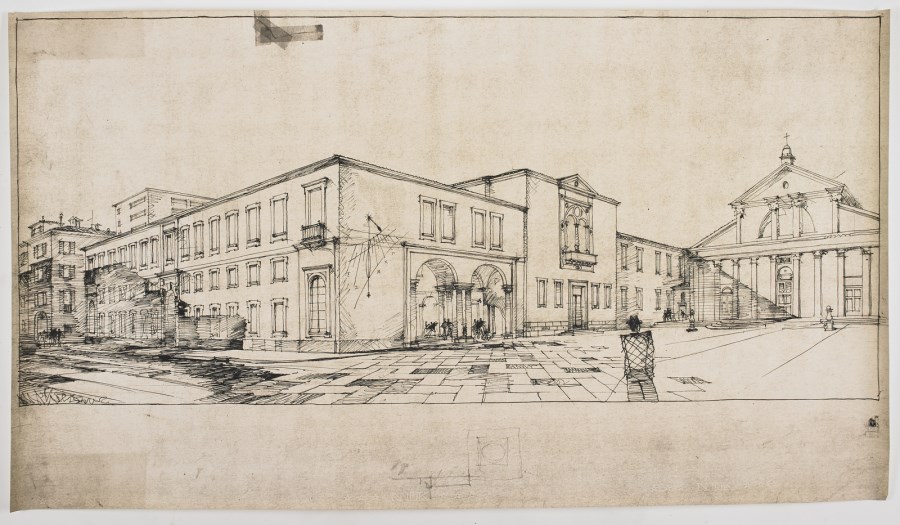
3.4. Università degli Studi di Milano
Address: Via Festa del Perdono 7
Date: 1949–70 (Portaluppi active in early phases)
Typology: Educational (university campus)
Patron / Client: Università degli Studi di Milano; collaboration with Annoni, Grassi, others
Notable Features: adaptation of the Renaissance Ospedale Maggiore by Filarete into university facilities; consolidation of bomb-damaged wings; introduction of modern lecture halls and services.
Current Use / Access: Active university campus, partly accessible to the public.
The Ca’ Granda, Milan’s monumental Renaissance hospital, was repurposed after the war as the new home of the Università degli Studi. Portaluppi, alongside other architects, oversaw both restoration of the bombed structures and their adaptation to a radically different program: from wards to classrooms, from cloisters of care to cloisters of study. His work here demonstrates his ability to reconcile monumental heritage with the functional demands of a growing modern university. The Ca’ Granda today remains a symbol of continuity: Renaissance civic pride reinvented for post-war education.

4. Quirky Stuff
4.1. Edicola Funebre Conti-Sayno
Address: Cimitero Monumentale, Necropoli spazio 28
Date: 1921–22
Typology: Funerary architecture / Chapel
Patron / Client: Ettore Conti, industrialist and Portaluppi’s key patron
Notable Features: compact brick and terracotta chapel with neo-Romanesque echoes; severe geometric massing softened by ornamental precision; Portaluppi’s earliest experiments with sacred symbolism.
Current Use / Access: private family chapel, visible within the Monumentale cemetery.
Some of us will never manage to have our house designed by our favourite architect, but others managed to have the house and the tomb. We’ve already been to Cimitero Monumentale when we were commemorating Arnaldo Pomodoro’s passing, and one week I promise I’ll take you there for a full stroll, but today we’re aiming at Space 28 within the necropolis, where Portaluppi’s patron (and father-in-law) Ettore Conti requested that he build a small temple in brick and terracotta. The inspiration from Renaissance architecture in Milan, like Santa Maria delle Grazie, would have been very familiar to the count, who was also behind the renovation of Casa degli Atellani.

4.2. The Sundials at Poldi Pezzoli
Address: Via Manzoni 12
Date: collection donated after Portaluppi’s death (1967; catalogued 1970s)
Typology: Scientific instruments / Decorative arts
Patron / Client: donated by the Portaluppi family to the Museo Poldi Pezzoli
Notable Features: over 200 sundials, portable dials, and gnomonic instruments; reflects Portaluppi’s lifelong fascination with geometry, time, and precision craftsmanship.
Current Use / Access: permanent collection at the Museo Poldi Pezzoli, open to visitors
If you think you can’t be quirky and a successful architect, think again: after his death, Portaluppi’s family donated to this beloved museum his personal collection of over 200 historic sundials and other tools for measuring time, collected since 1920. You might argue that this was research, as Portaluppi himself designed sundials for Casa degli Atellani and Villa Necchi Campiglio, but we all know the truth. He was one of us.
The collection features some remarkable pieces, and I invite you to read the full article on the museum’s webpage.

Anything to add? What’s your favourite architecture by Portaluppi?


No Comments