"All this he saw, for one moment breathless and intense, vivid on the morning sky; and still, as he looked, he lived; and still, as he lived, he wondered."

Nicholas de Monchaux – Spacesuits: Fashioning Apollo

All’interno dei percorsi che parlano di urbanistica digitale, includo spesso una pubblicazione apparentemente anomala, un libro di Nicholas de Monchaux in cui si parla delle tecnologie utilizzate per l’ingegnerizzazione delle tute spaziali durante la missione Apollo.

Nicholas de Monchaux
Spacesuits: Fashioning Apollo
MIT Press

Nicholas de Monchaux insegna al MIT dove è responsabile dell’architettura, è partner dello studio di architettura modem e fondatore della società di tecnologia del design Local Software, professore di architettura e design urbano, e Craigslist Distinguished Chair in New Media alla UC Berkeley, dove è stato anche direttore del Berkeley Center for New Media. Con i suoi lavori di progettazione ha partecipato alla Biennale delle Americhe, alla Biennale di Architettura di Venezia, alla Triennale di Architettura di Lisbona, al SFMOMA, allo Yerba Buena Center for the Arts, allo Storefront for Art and Architecture e al Museum of Contemporary Art di Chicago. È Fellow dell’Accademia Americana di Roma.

Il suo libro è “una storia architettonica e urbana” delle tute Apollo Spacesuit, ha vinto il premio Eugene Emme dell’American Astronautical Society ed è stato selezionato per l’Art Book Prize.

Nel 1968, l’allora vicepresidente degli Stati Uniti H.H. Humphrey nel tentativo di giustificare il denaro speso dall’amministrazione per la ricerca spaziale dichiarava:

«Le tecniche che porteranno l’uomo sulla Luna
saranno le stesse
di cui avremo bisogno
per ripulire le nostre città».
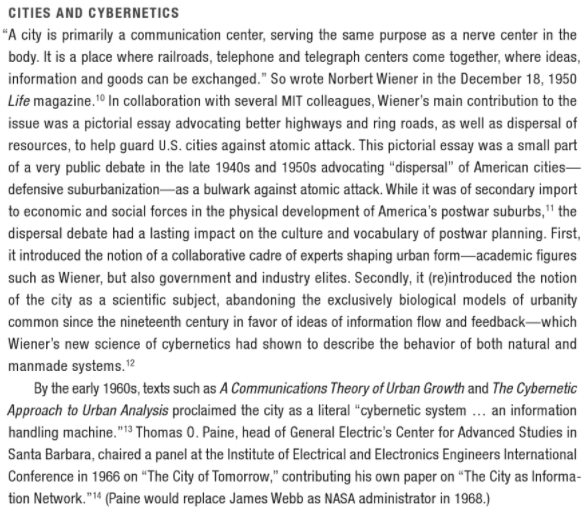
Le dinamiche che riguardano i tentativi di applicazione delle ricerche spaziali ad altri ambiti, sono oggetto del capitolo 19 del libro, intitolato “Cities and Cyborgs”. Ne ho scritto un pochino più nel dettaglio qui.
Per approfondire, dello stesso autore consiglio questo articolo, dal titolo “Space Suit And the City”.




Spooktober

Spooktober 28 – The Black Monk (3)

Chapter 5 Glad that he had been so successful in the part of peacemaker, Kovrin went into the park. Sitting on a garden seat, thinking, he heard the rattle of a carriage and a feminine laugh — visitors were arriving. When the shades of evening

Read More »
Spooktober

Spooktober 27 – The Black Monk (2)

Chapter 3 After supper, when the visitors had gone, he went to his room and lay down on the sofa: he wanted to think about the monk. But a minute later Tanya came in. “Here, Andryusha; read father’s articles,” she said, giving him a bundle

Read More »
Spooktober

Spooktober 26 – The Black Monk (1)

Anton Chekhov (1860–1904) was a Russian physician, short-story writer and playwright, and I’m not particularly fond of him, though he’s widely regarded as one of the greatest masters of modern short fiction and who am I to argue? His work is celebrated for its psychological

Read More »
Share on LinkedIn
Throw on Reddit
Roll on Tumblr
Mail it
No Comments

Post A Comment

This site uses Akismet to reduce spam. Learn how your comment data is processed.

RELATED POSTS

Spooktober 28 – The Black Monk (3)

Chapter 5 Glad that he had been so successful in the part of peacemaker, Kovrin went into the park. Sitting on a garden seat, thinking, he heard the rattle of a carriage and a feminine laugh — visitors were arriving. When the shades of evening

Read More

Spooktober 27 – The Black Monk (2)

Chapter 3 After supper, when the visitors had gone, he went to his room and lay down on the sofa: he wanted to think about the monk. But a minute later Tanya came in. “Here, Andryusha; read father’s articles,” she said, giving him a bundle

Read More

Spooktober 26 – The Black Monk (1)

Anton Chekhov (1860–1904) was a Russian physician, short-story writer and playwright, and I’m not particularly fond of him, though he’s widely regarded as one of the greatest masters of modern short fiction and who am I to argue? His work is celebrated for its psychological

Read More