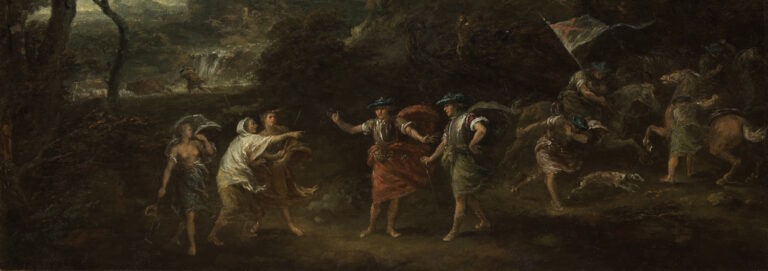
"All this he saw, for one moment breathless and intense, vivid on the morning sky; and still, as he looked, he lived; and still, as he lived, he wondered."

Mediterranée 2050: a Journey into the Future of the Sea

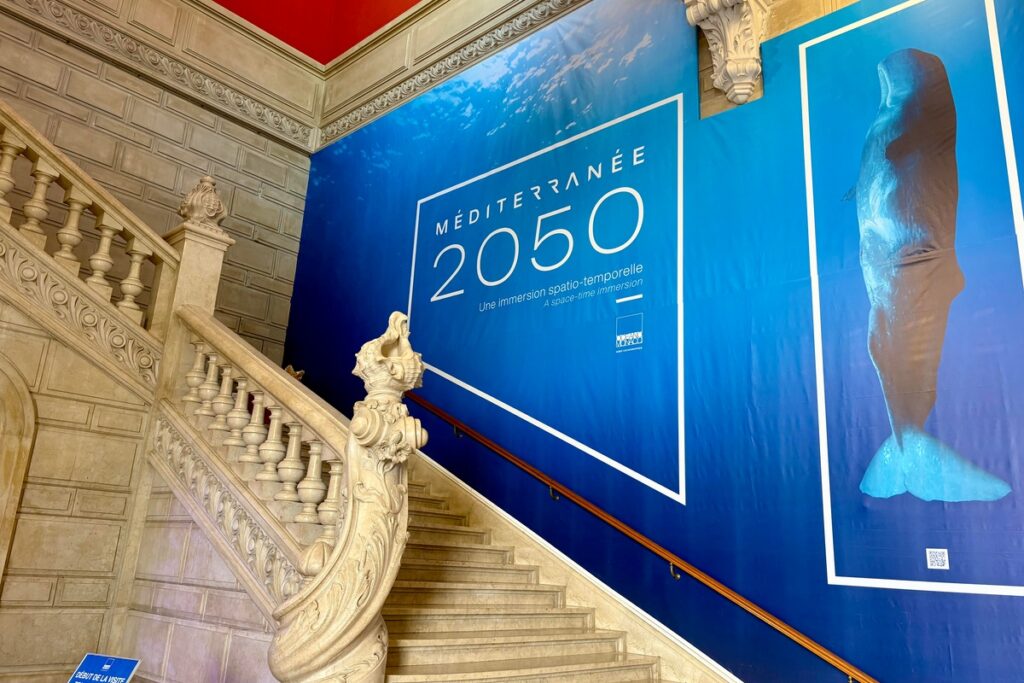
I first discovered the exhibition almost by chance, when a friend suggested we visit the aquarium in Monaco on our way back from a vacation and, as we approached the Musée Océanographique, your eyes might miss the towering poster on its facade: a luminous vision of a whale rising from a sea of electric blue.

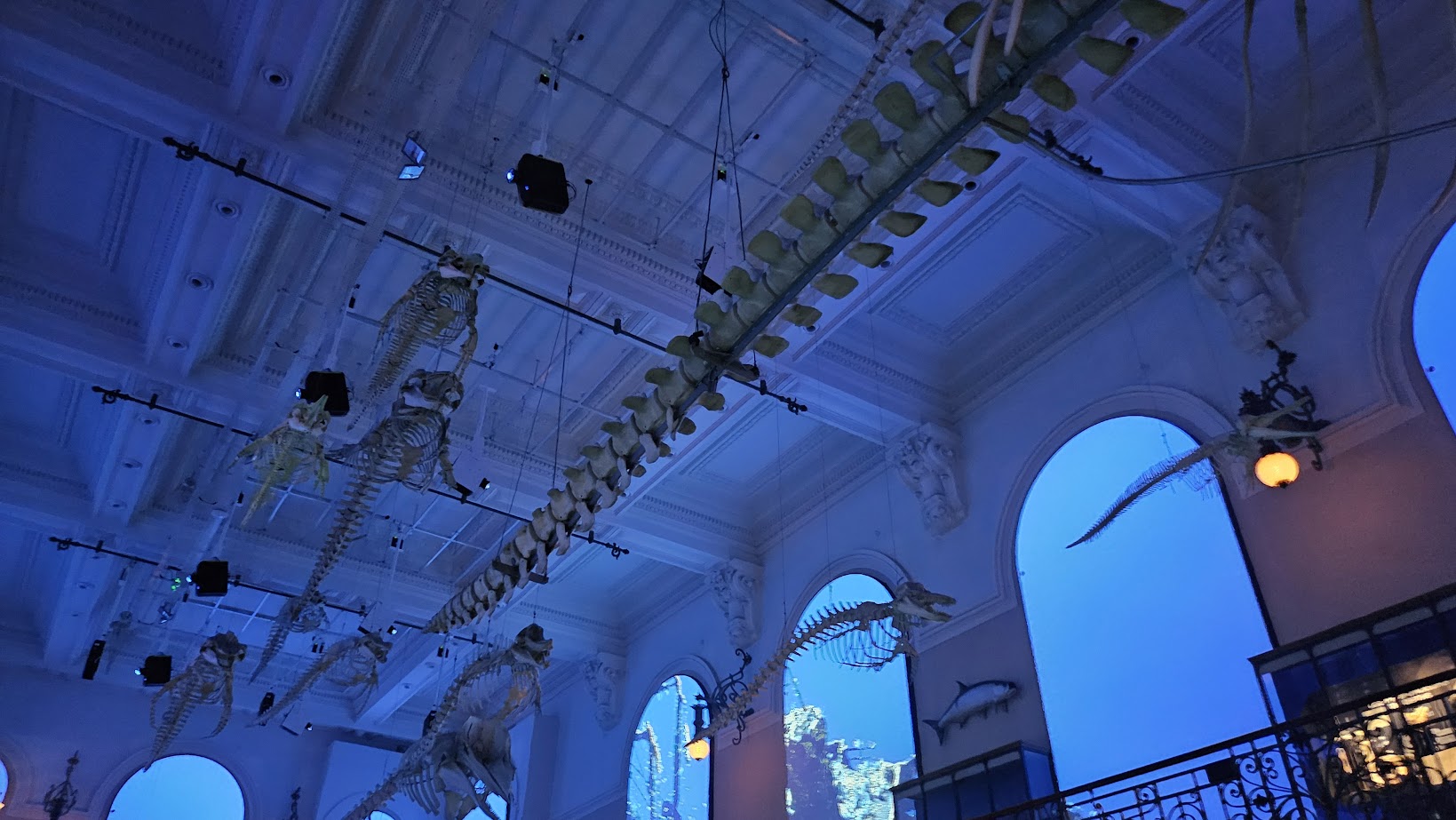
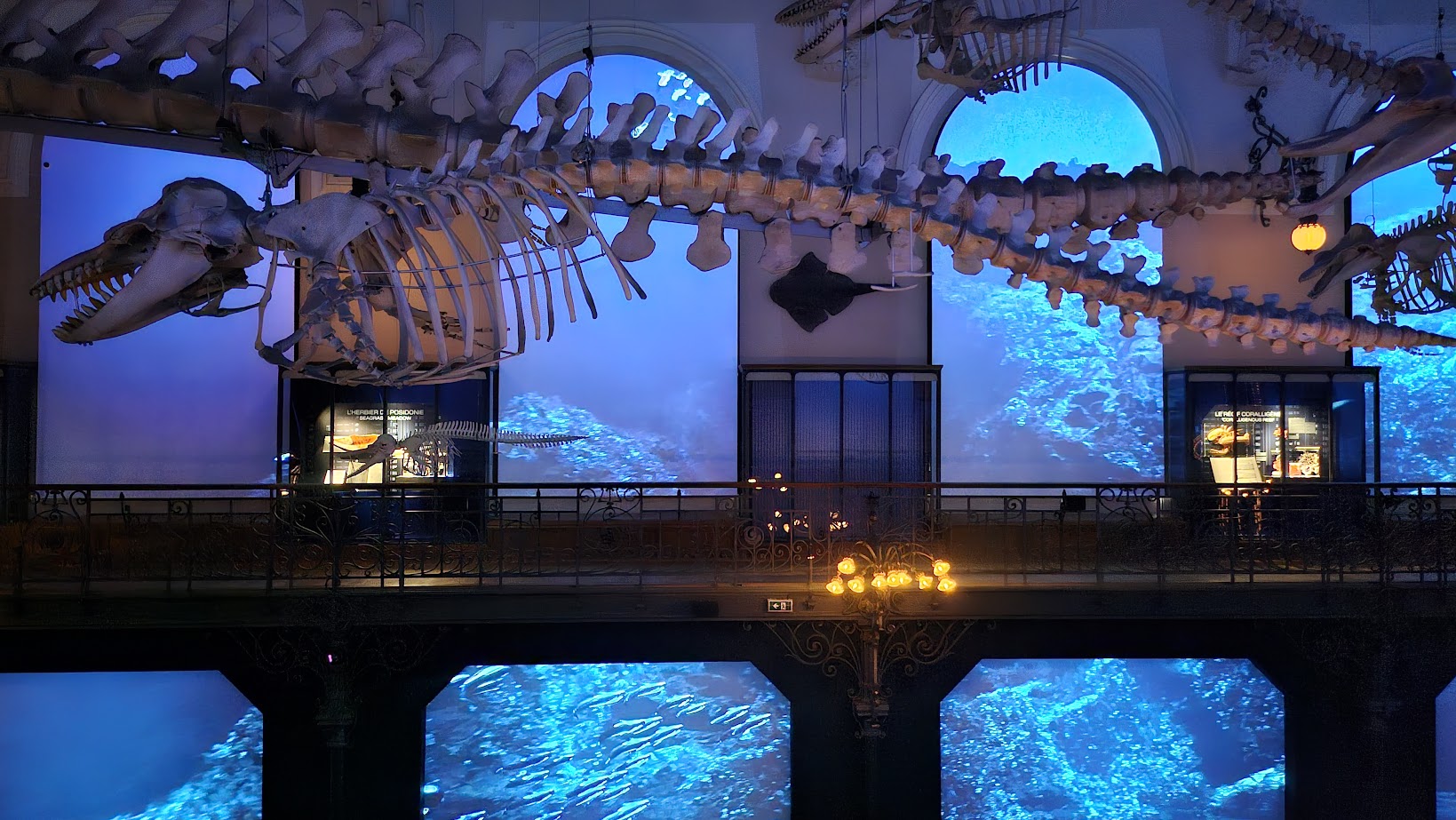
The experience is an immersive exhibition: you are welcomed by the crew of the voyage, whose faces and voices appear on sleek panels that prepare you for departure as a spaceship, and then you’ll cross the threshold into a historical wing of the museum that has been entirely transformed into the hull of a submarine. Through the journey, the Mediterranean reveals itself as if you were aboard a craft silently gliding beneath the waves, moving through an underwater universe that feels at once familiar and alien, scanning the wildlife with different instruments and suspended between beauty and dread. Looming from the ceiling, the room’s original exhibits: skeletons of whales, dolphins and other majestic creatures create a counterpoint to the live exemplars you see swimming from wall panel to wall panel.
What makes this voyage even more extraordinary is the setting itself: the aquarium’s historic building, with its ornate architecture and aura of timeless grandeur, provides a fascinating contrast to the futuristic narrative unfolding within its walls, and this tension between old and new makes every step feel like a crossing of thresholds, as if the very stones of the palace are whispering while the immersive rooms push you forward into the unknown.
The technology that brings this vision to life is combining cutting-edge projections, enveloping soundscapes and state-of-the-art sync between screens combine to create an environment that doesn’t just show you the Mediterranean as an environment that demands respect but allows you to feel it, as if you were truly submerged in a living, shifting ocean where whales pass overhead, schools of fish scatter at your approach, and the looming consequences of human action ripple across the waters in real time.

books and literature

Lolly Willowes

Sylvia Townsend Warner is one of the most interesting literary figures of the 21st century, and Lolly Willowes is one of her finest works, even more stunning if you think it was her debut novel. Self-supporting, intellectually independent, and consistently sceptical of social and religious

Read More »
books and literature

Fugitive Telemetry

This is book #6 in the Murderbot series (yes, I accidentally skipped #5, I’m circling back to that), and I’m afraid I didn’t like this as much as the others. The whole investigation felt a bit rushed and, though the final twist is interesting in

Read More »
architecture, engineering and construction

The Discipline of Inspiration: Valéry and the Algorithmic Mind

Paul Valéry rejected inspiration as miracle, seeing creativity as the discipline of thought in motion. This week, we parallel his notion of mental “operations” with computational procedures in design: iteration, optimisation, constraint, and recombination, and challenge the dichotomy between intuition and automation. Drawing on contemporary

Read More »
Share on LinkedIn
Throw on Reddit
Roll on Tumblr
Mail it
No Comments

Post A Comment

This site uses Akismet to reduce spam. Learn how your comment data is processed.

RELATED POSTS

Lolly Willowes

Sylvia Townsend Warner is one of the most interesting literary figures of the 21st century, and Lolly Willowes is one of her finest works, even more stunning if you think it was her debut novel. Self-supporting, intellectually independent, and consistently sceptical of social and religious

Read More

Fugitive Telemetry

This is book #6 in the Murderbot series (yes, I accidentally skipped #5, I’m circling back to that), and I’m afraid I didn’t like this as much as the others. The whole investigation felt a bit rushed and, though the final twist is interesting in

Read More

The Discipline of Inspiration: Valéry and the Algorithmic Mind

Paul Valéry rejected inspiration as miracle, seeing creativity as the discipline of thought in motion. This week, we parallel his notion of mental “operations” with computational procedures in design: iteration, optimisation, constraint, and recombination, and challenge the dichotomy between intuition and automation. Drawing on contemporary

Read More