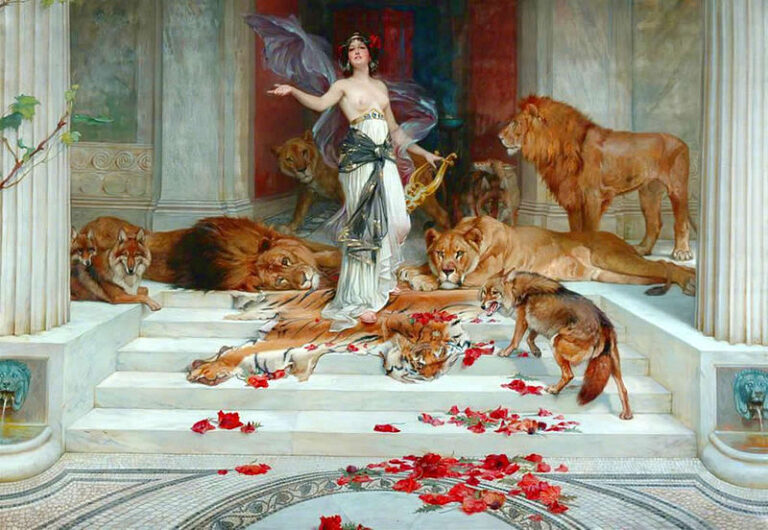
"All this he saw, for one moment breathless and intense, vivid on the morning sky; and still, as he looked, he lived; and still, as he lived, he wondered."

Madeleine de Scudéry’s Femmes Illustres – Volumnia

Volumnia was a noblewoman and the mother of the Roman general and rebel Gaius Marcius Coriolanus. According to Titus Livius, she disapproved of her son’s rebellion against Rome and was ultimately successful, aided by her daughter-in-law Volumnia, in visiting her son’s camp and convincing him to desist in his will to launch an attack against Rome.

Volumnia became a symbol of strength and diplomacy: she asked for no favours but requested that the Senate would build a temple to the Goddess Fortuna, to honour her and the other women who were successful in the diplomatic effort. In telling her tale, Titus Livius always calls her Veturia. Because he’s one of the worst historians ever.

She is one of the central characters in Shakespeare’s play Coriolanus, where she’s called Volumnia following Plutarch. In Titus Livius, Volumnia is Coriolanus’ wife, while Shakespeare gives her the name Virgilia.
Mademoiselle De Scudery follows Shakespeare’s names: Volumnia, the mother, is writing to Virgilia, the daughter-in-law. She’s writing to Virgil.

Among the paintings that depict her, Henry Singleton’s Volumnia and Virgilia pleading before Coriolanus.


books and literature

Lolly Willowes

Sylvia Townsend Warner is one of the most interesting literary figures of the 21st century, and Lolly Willowes is one of her finest works, even more stunning if you think it was her debut novel. Self-supporting, intellectually independent, and consistently sceptical of social and religious

Read More »
books and literature

Fugitive Telemetry

This is book #6 in the Murderbot series (yes, I accidentally skipped #5, I’m circling back to that), and I’m afraid I didn’t like this as much as the others. The whole investigation felt a bit rushed and, though the final twist is interesting in

Read More »
architecture, engineering and construction

The Discipline of Inspiration: Valéry and the Algorithmic Mind

Paul Valéry rejected inspiration as miracle, seeing creativity as the discipline of thought in motion. This week, we parallel his notion of mental “operations” with computational procedures in design: iteration, optimisation, constraint, and recombination, and challenge the dichotomy between intuition and automation. Drawing on contemporary

Read More »
Share on LinkedIn
Throw on Reddit
Roll on Tumblr
Mail it
No Comments

Post A Comment

This site uses Akismet to reduce spam. Learn how your comment data is processed.

RELATED POSTS

Lolly Willowes

Sylvia Townsend Warner is one of the most interesting literary figures of the 21st century, and Lolly Willowes is one of her finest works, even more stunning if you think it was her debut novel. Self-supporting, intellectually independent, and consistently sceptical of social and religious

Read More

Fugitive Telemetry

This is book #6 in the Murderbot series (yes, I accidentally skipped #5, I’m circling back to that), and I’m afraid I didn’t like this as much as the others. The whole investigation felt a bit rushed and, though the final twist is interesting in

Read More

The Discipline of Inspiration: Valéry and the Algorithmic Mind

Paul Valéry rejected inspiration as miracle, seeing creativity as the discipline of thought in motion. This week, we parallel his notion of mental “operations” with computational procedures in design: iteration, optimisation, constraint, and recombination, and challenge the dichotomy between intuition and automation. Drawing on contemporary

Read More