
Agrippina was the daughter of general Germanicus, a popular guy, and the youngest sister of future emperor Caligula, a far less popular guy, but she’s mostly famous for being the mother of emperor Nero. And we all know how that one went.
She’s given credit for several assassinations in order to grant his son the throne: aside from poisoning her second husband, she allegedly poisoned her third one as well, emperor Claudius. She killed Messalina and had her mother executed, and most famously forced Statilius Taurus to commit suicide because she wanted his gardens. They must have been really impressive gardens.
There are several accounts surrounding Agrippina’s death.
According to Tacitus, she was killed by her son Nero because her being alive made it impossible for him to divorce his first wife Octavia in order to marry Poppea. Ruling out poisoning and stabbing for being too difficult, Nero devised an overly complicated plot in which the mother was going to be killed by the sinking of a boat.
The ceiling of the boat crashed but missed Agrippina, and the boat failed to sink, so it had to be sunk manually by the crew: regardless of this, Agrippina swam ashore, where she was saved by the adoration of people who gathered and witnessed the accident.
Nero had to resolve to send three assassins to finish the job.
According to Svetonius, Nero tried poison her three times, and failed because the queen was taking antidotes in advance.
Also according to his account, he then tried to kill her by crushing her, this time under the ceiling in her bedroom.
And he failed again.
He then set her on a boat that would collapse and sink, but she survived again and Nero resorted to ordering her stabbing at court, covering it up as a suicide.
According to Cassius Dio, the marriage with Poppaea is again the reason behind the murder, and again the plot features a boat that’s supposed to sink. This time, instead of collapsing, the boat opened up and dropped the queen into the water, but again she swam ashore where she met an assassin sent by Nero.
Her last words to her assassin allegedly were the request to be stabbed in the same womb that had given birth to such a son.
Nero saw her mother’s ghost till he died and sent for Persian magicians to help scare her spirit away.
G.F. Handel dedicated her an opera in three acts, Agrippina, composed for the 1709 Carnival in Venice. It premiered in Venice at the Teatro San Giovanni Grisostomo on 26 December 1709 and it was an enormous success.
She’s also mentioned in Giovanni Boccaccio’s De Mulieribus Claris.
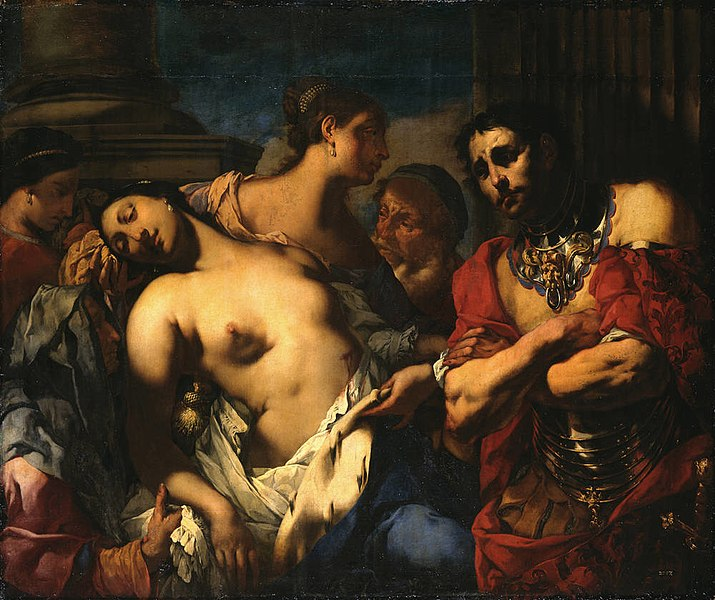
One of my favourite paintings of her is Pietro Negri‘s Nero Examining the Corpse of Agrippina (1674 – 679), as he probably would not believe she had finally agreed to die.
Pietro Negri (Venice, 1628 – Venice, 31 May 1679) was a Baroque Italian painter of the so-called “tenebrosi”. And that’s a very tenebrous painting indeed.
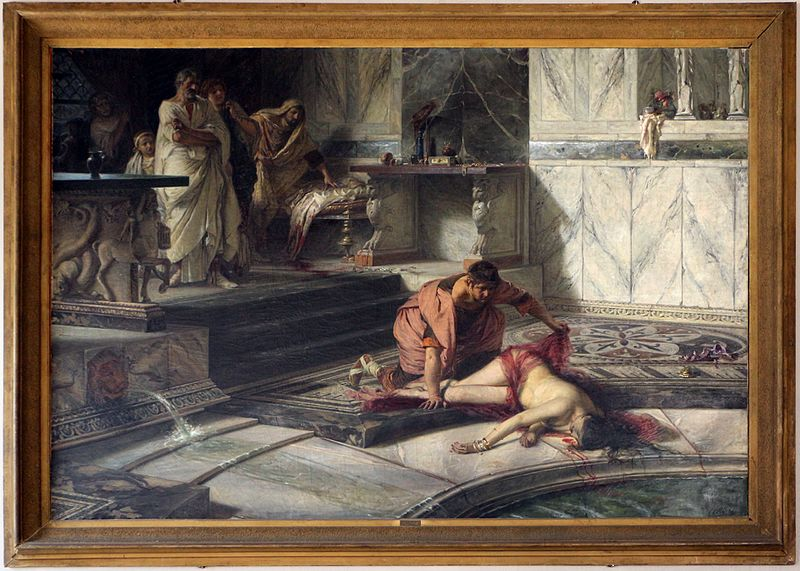
There’s also a very nice one by Antonio Rizzi, Nero Examining the Corpse of Agrippina, in which they kind of dropped her on the floor and ran away.
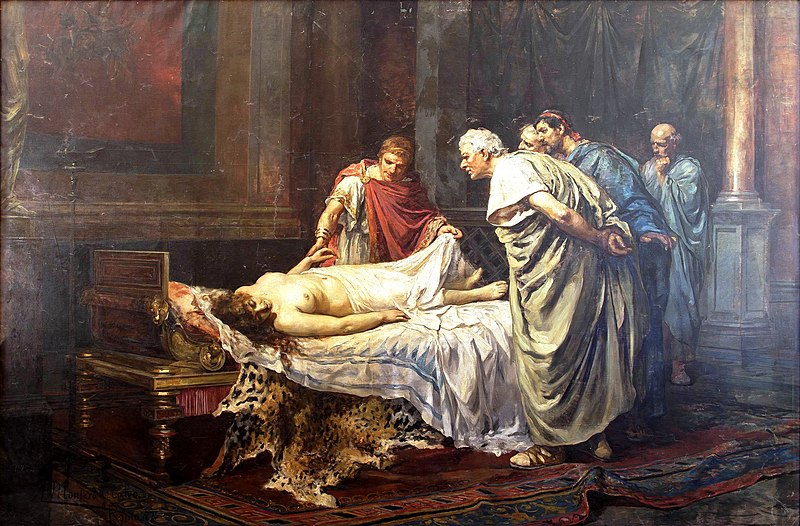
A more respectful one is by Arturo Montero Y Calvo, from 1887: Nero in front of the corpse of his mother, Agripina Minor. The painting is currently at the Museo del Prado.
If you’re looking for something depicting the infamous boat accident, however, I suggest you go for Gustav Wertheimer, an Austrian painter.



No Comments