"All this he saw, for one moment breathless and intense, vivid on the morning sky; and still, as he looked, he lived; and still, as he lived, he wondered."

Madeleine de Scudéry’s Femmes Illustres – Berenice of Cilicia

Berenice of Cilicia, also known as Julia Berenice, was a member of the Herodian Dynasty and appointed Queen of Judaea under the Roman Empire.

During the First Jewish-Roman War, she became the lover of the future emperor Titus Flavius Vespasianus, and she supported her lover’s father Vespasian greatly, both financially and politically, during his campaign.
When Vespasian became emperor, in 69, Titus stayed behind in Judaea and the Jewish-Roman war ended with the destruction of the Second Temple and the sack of Jerusalem, which meant the death of 1 million people and the capture of 97.000 Jews by the Romans.

Titus then returned Rome to his father and the lovers had to stay apart for four years, as some political advisors in Rome were averse to Berenice’s presence and the political message it might have sent.
Even when she eventually joined him, her stay was brief: the couple was publicly denounced in a theatrical piece and Titus sent her away.
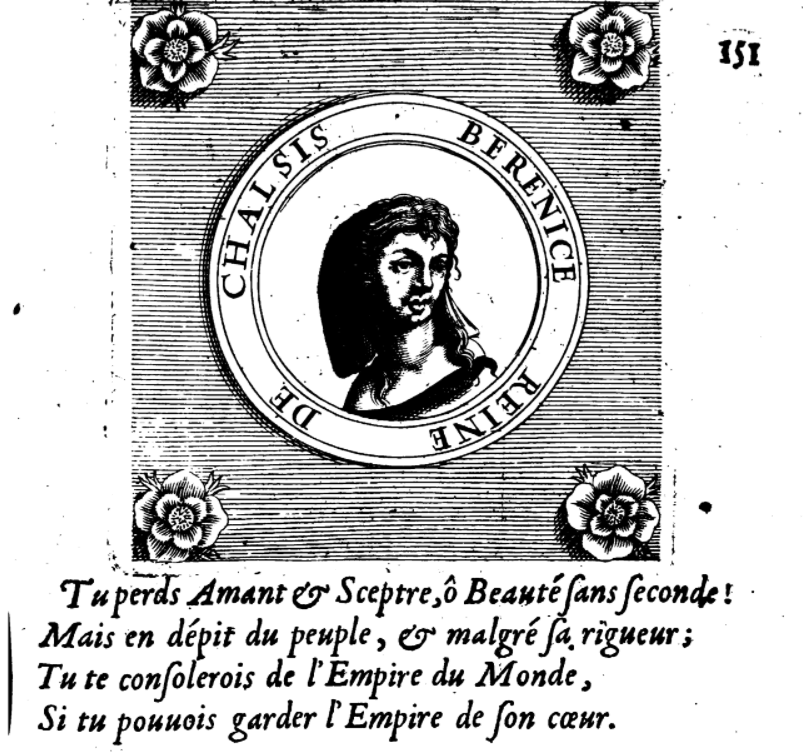
When he became Emperor, in 79, she returned to Rome, believing she could finally be with him, but Titus was quick to take measures to restore his reputation and, among those, he dismissed the queen. He died after only two years of reign and there’s no trace of what happened to Berenice.

On top of featuring her in Les Femmes Illustres, Madeleine de Scudéry dedicated her a whole novel in epistolary form, called Lettres de Bérénice à Titus (1642). De Scudery has her writing to Titus, of course.

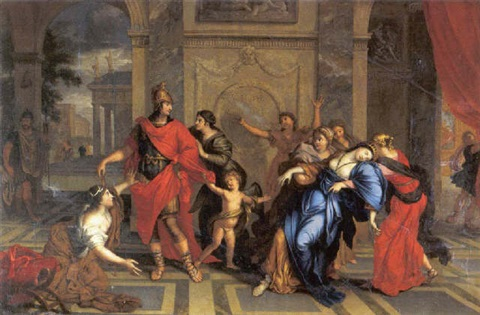
One of the most accomplished paintings featuring her is Cercle de Gérard de Lairesse‘s Titus se sépare de Bérénice (1680). She does not look happy.
books and literature

Snow Country

Sometimes you read a book with beautiful prose and well-constructed characters but, when you put it down, you couldn’t tell the plot if your life depended upon it. Kawabata Yasunari‘s Snow Country is one of these books. Born in 1899, the author won the Nobel

Read More »
books and literature

War and Peace

I’m satisfied.Satisfied and surprised.Satisfied because this book, since reading the Peanuts as a child, is the Ultimate Achievement. Once you’ve read it, you feel you can achieve everything. You could even be the first beagle to land on the moon.And satisfied because… by God, this

Read More »
architecture, engineering and construction

A New Vision for the Learning Crisis

The end of 2024 brought us no grand educational reckoning, no moment of consensus that we need to reimagine how adults learn. Instead, through 2025, we’ve settled into a peculiarly quiet collective exhaustion with the pandemic’s educational experiments, paired with a creeping anxiety that something

Read More »
Share on LinkedIn
Throw on Reddit
Roll on Tumblr
Mail it
No Comments

Post A Comment

This site uses Akismet to reduce spam. Learn how your comment data is processed.

RELATED POSTS

Snow Country

Sometimes you read a book with beautiful prose and well-constructed characters but, when you put it down, you couldn’t tell the plot if your life depended upon it. Kawabata Yasunari‘s Snow Country is one of these books. Born in 1899, the author won the Nobel

Read More

War and Peace

I’m satisfied.Satisfied and surprised.Satisfied because this book, since reading the Peanuts as a child, is the Ultimate Achievement. Once you’ve read it, you feel you can achieve everything. You could even be the first beagle to land on the moon.And satisfied because… by God, this

Read More

A New Vision for the Learning Crisis

The end of 2024 brought us no grand educational reckoning, no moment of consensus that we need to reimagine how adults learn. Instead, through 2025, we’ve settled into a peculiarly quiet collective exhaustion with the pandemic’s educational experiments, paired with a creeping anxiety that something

Read More