
Last season, Milan hosted at Palazzo Reale a long-overdue retrospective of what quickly became one of my favourite contemporary artists, alongside Niki de Saint-Phalle: Leonor Fini. I wrote about it here. Saint-Phalle herself had been hosted at MUDEC in the same period (see here).
This Autumn, the same venue hosts the personal exhibition of another surrealist artist who, being a woman, is still waiting to be celebrated for the impact she had. I’m talking about Leonora Carrington (1917–2011). The picture in the header of the blog, as I’m writing, is a detail from one of her paintings.

The Exhibition
From September 20, 2025 to January 11, 2026, Palazzo Reale in Milan hosts the first major retrospective in Italy dedicated to this extraordinary artist and her imagination, wit, and creative range.
- Where: Palazzo Reale, Piazza del Duomo 12, Milan
- Dates: September 20, 2025 – January 11, 2026
- Hours: Tuesday–Sunday 10:00–19:30 (Thursdays open until 22:30; last entry 1 hour before closing
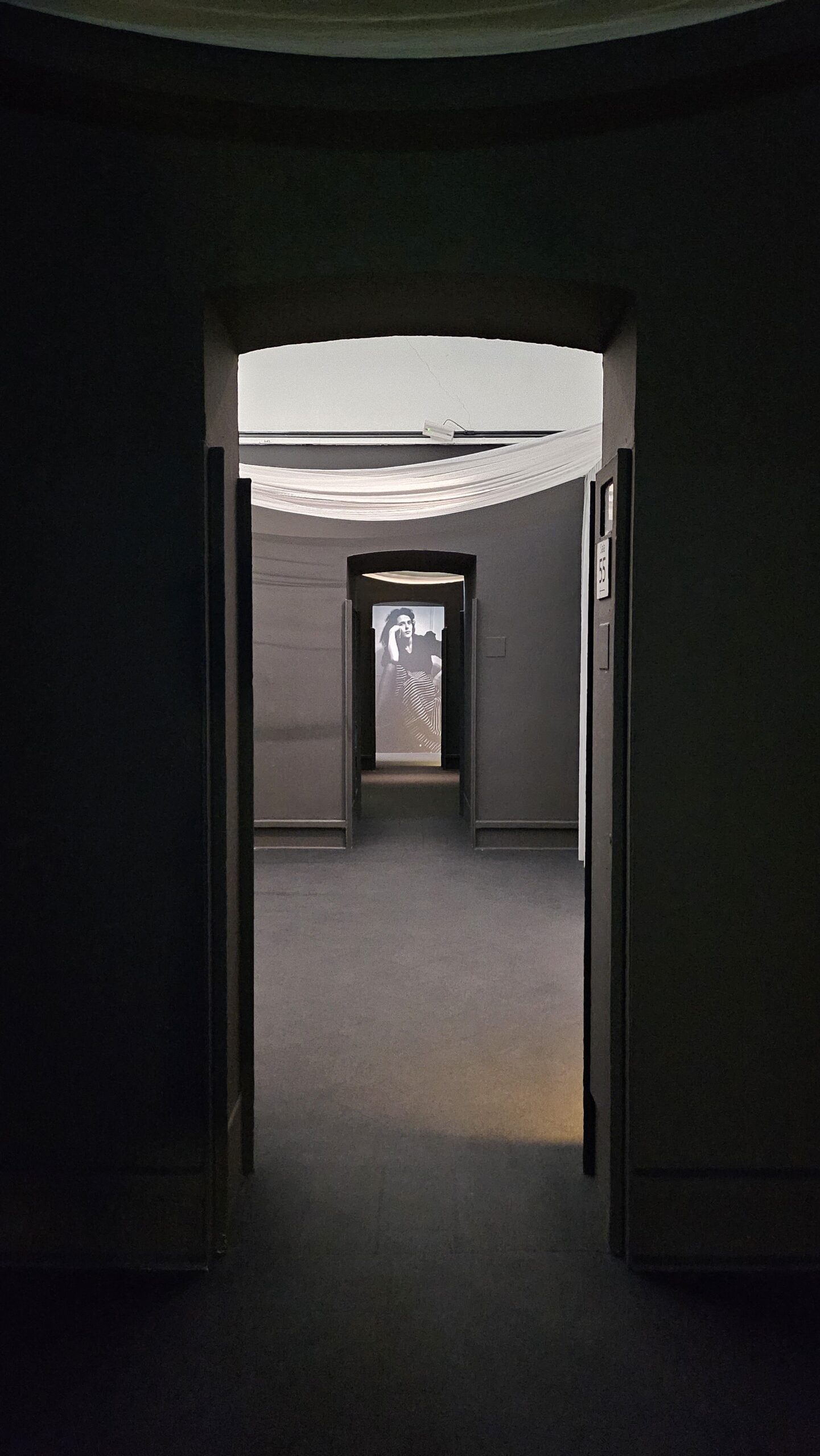
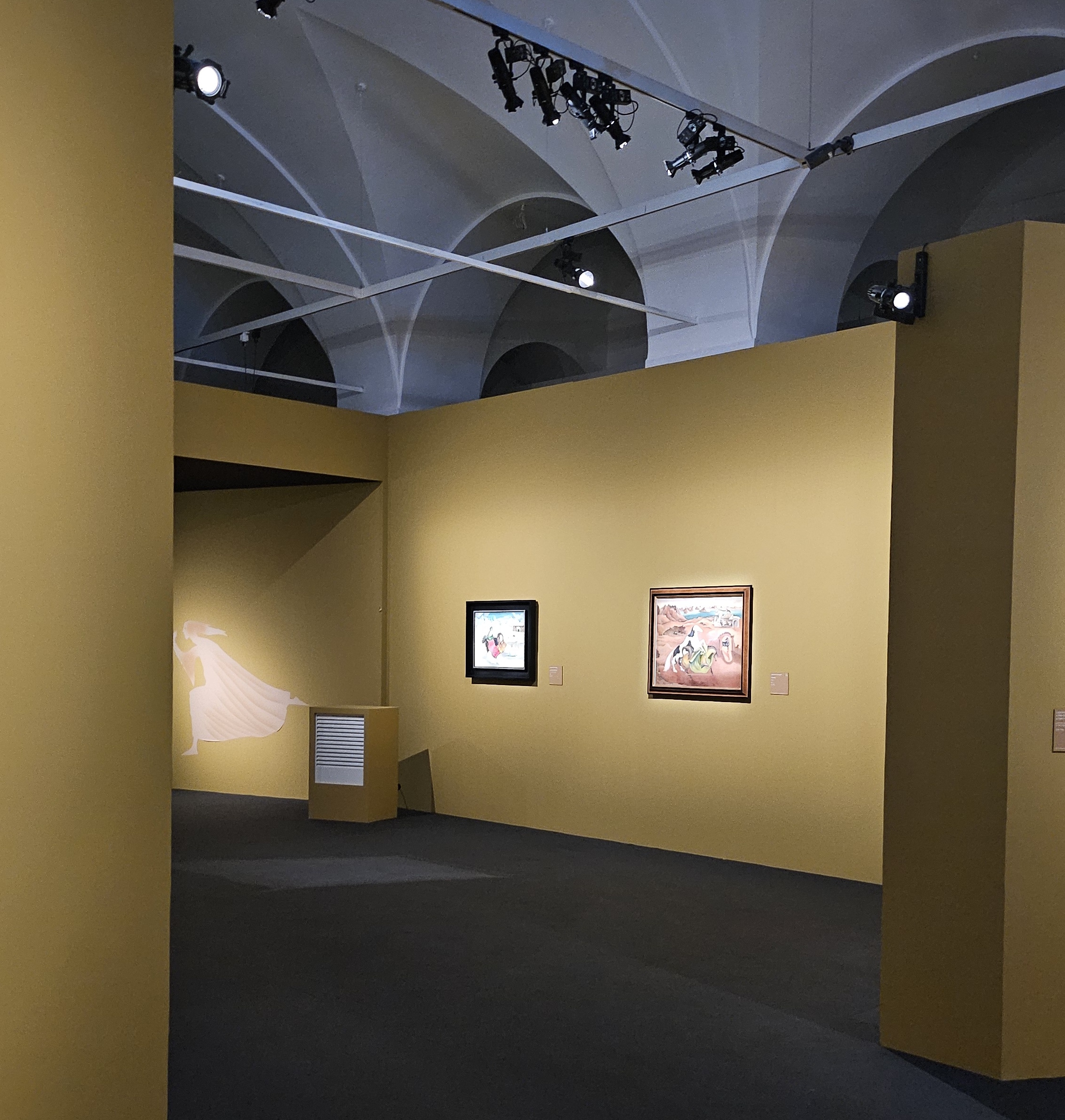
The exhibition is hosted at the lower level of the palace (where Goya used to be, if you remember that one), which means you can expect a smaller, more intimate installation compared to the grandeur of shows like the one on Art Deco. Six rooms, each in its own colour and either following a period of Leonora’s artistic production or focusing on one aspect. The setting is simple and yet effective, with drapes in ethereal white hanging above the paintings and resounding with her use of that same colour for details, spiritual figures, echoes.
My only negative remark is that, in the age of the fucking audioguides, written narration is reduced to the bare minimum, and sometimes you’re left staring at a complex picture, full of allusions and meaning, and all you’re left with is the audioguide icon. And I would be caught dead before I use an audioguide. Big no can do.
This means I had to do a lot of research and a lot of digging, which can’t be expected from anyone who goes to a museum to learn things. Here’s a bit of what I discovered, alongside a walkthrough on how the exhibition is structured. Enjoy.
The artist
For decades, Leonora Carrington remained one of surrealism’s unwilling secrets and was admired by few, largely overlooked in the canon dominated by her male contemporaries.
While the art world constantly celebrates names like Salvador Dalí, Max Ernst, and René Magritte, Carrington’s work unfolded in quieter spaces: private, domestic, and deeply subversive. Her surrealism was not a stage but a laboratory: a place where myth, memory, and transformation intertwined.
Carrington’s marginalisation was not due to a lack of vision or depth, but to a system that consistently treated women as muses rather than creators. “I was too busy making art, so I didn’t have the time to be anybody’s muse,” she jests.
She defied that role entirely. Her canvases reimagined the feminine as alchemical and sovereign — a trait she shares with Leonor Fini — and a creative force capable of reshaping the world.
In this, she shared an unspoken kinship with Remedios Varo and Dorothea Tanning, fellow artists who used surrealism not as a means of rewriting reality. Together, they built a visual language that challenged patriarchal mythologies, crafting spaces where women were no longer objects of desire but architects of new cosmologies.
Her life
Born in 1917 in Lancashire, England, Leonora Carrington grew up in an upper-class family that expected her to conform to society’s narrow definitions of femininity. Instead, she rebelled against her education, then against her family’s expectations, and finally against the entire system that sought to contain her imagination. At the age of fifteen, she was staying in Tuscany after having been expelled from yet another Catholic school. I can relate.
Her artistic awakening took further shape in London and Paris, where she joined the circle of the Surrealists and formed a close bond with Max Ernst, her mentor and lover. The outbreak of World War II shattered that world: Ernst was a German citizen, and this was enough to be imprisoned by the French authorities; Carrington’s own mental and emotional collapse led to her internment in a psychiatric hospital in Spain. Back in the days, particularly for a woman, this meant an endless string of abuses masked as treatments. That experience — brutal and hallucinatory — became a turning point: in her memoir Down Below, she transformed trauma into art, recounting her descent into hell as a visionary journey through fear, identity, and rebirth. Her approach to mental health is revolutionary for the time, and profoundly resonant with what we know we experience today.
After escaping the asylum with the help of friends and diplomats, Carrington found refuge first in New York and then in Mexico, where she settled permanently.
There — among a vibrant community of exiled artists and writers, including Remedios Varo, Kati Horna, and Luis Buñuel — she rebuilt her life and forged her most personal language. Mexico offered her both freedom and invisibility: a space where she could live, paint, and write beyond the constraints of European modernism.
Her art from this period pulses with the energy of survival and transformation. Creatures, hybrid beings, ritual gestures carry both the memory of displacement and the persistence of imagination.
Carrington, a refugee escaping from war and from conformity, made exile a form of creation.
Today, their recognition is finally catching up with their influence.
Carrington stands not beside her male peers, but beyond them as part of a constellation of women who turned the surreal into the radically real.
The Exhibition
1. A Grand Tour
The first room, in light-grey tones, opens to a stunning selection of earlier works.
As we were saying, Leonora Carrington’s journey as an artist began in the contradictions of post-Victorian England, where order, etiquette, and obedience left little room for wild imagination. Fortunately for art history, Leonora never quite learned to obey. Born in 1917 to a wealthy British father and an Irish mother with a gift for storytelling, she grew up on a steady diet of rebellion, fairy tales, and Celtic myths that would later brew into her own kind of magic.
Her imagination caught fire early, under that influence. Before she ever touched a canvas, she filled childhood notebooks with fantastical creatures and speculative worlds, including the remarkable Animals of a Different Planit, a visionary mix of science and pure imagination that reads like a proto-surrealist manifesto written by a precocious dreamer.
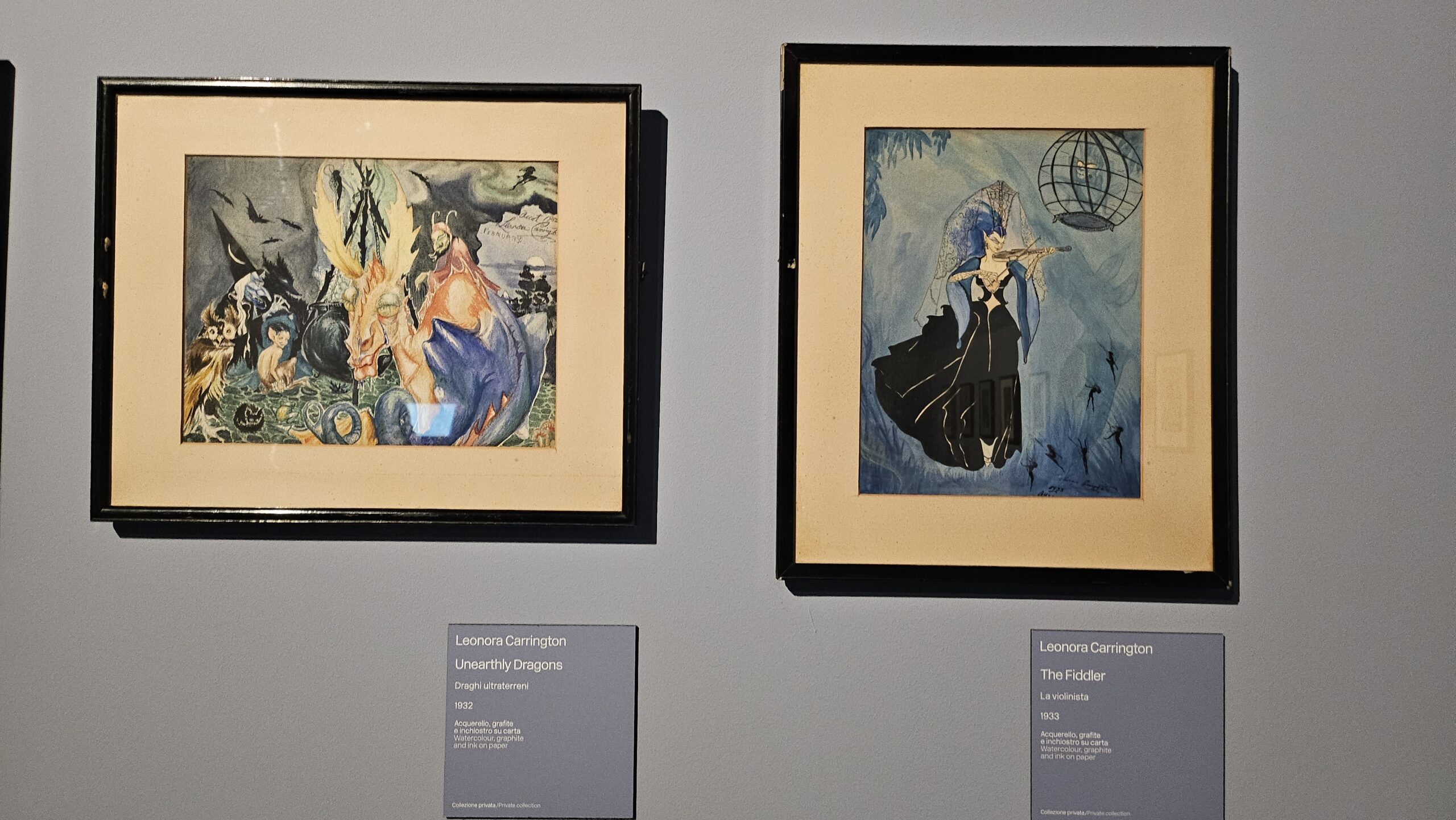
Expelled from one Catholic school after another for her “incorrigible imagination,” Carrington set out on what she later called her Grand Tour into life. In the early 1930s she landed in Florence, at the tender age of fifteen, supposedly to absorb the great Italian masters. The inspiration from Renaissance frescoes is clear, but I’m sure it wasn’t what people were expecting. Her Sisters of the Moon watercolours from that time already revealed an artist less interested in Tuscan saints than in powerful, enigmatic women conjuring alternative worlds.
These early works glowed with the essence of what would become her lifelong artistic signature: sisterhood, transformation, and myth-making. Her heroines were priestesses, shapeshifters, alchemists — women who refused to stay still, or silent. They moved through worlds filled with fantastic creatures that lived, spoke, and dreamed alongside them. Leonora was already rehearsing the themes that would define her entire career: the invention of mythologies, the alchemy of imagination, and the rebellion against social, religious, or artistic confinement. She didn’t want to fit into art history; she wanted to rewrite it in her own language, one populated by moons, horses, and half-forgotten gods.
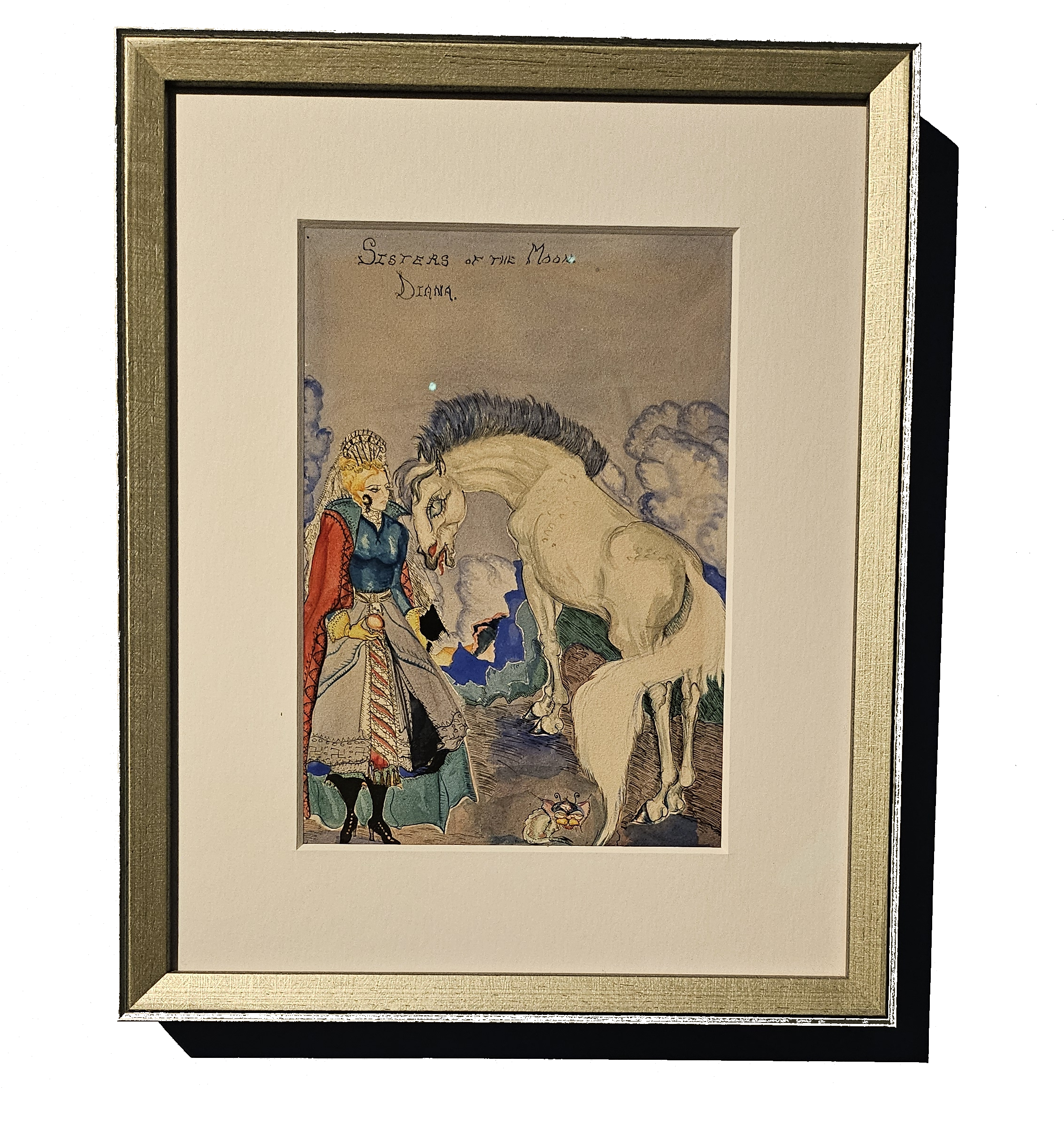
Take this Diana, for instance, part of her Sisters of the Moon cycle. At first glance and judging by the title alone, one might say that the painting presents the Moon herself, Diana, the Roman goddess of the hunt in all her power. Take a closer look, then. Diana stands in elaborate, almost courtly dress, yet she vibrates with the uncanny: her companion is a pale, sinewy horse which meets her gaze with a mixture of devotion and defiance. The landscape behind them, painted in soft blues, muted greens, and smouldering clouds, feels like an unstable dream.
The image is far removed from the idealised huntress of classical art and seems to be jumping out of one of Madame d’Aulnoy’s fairytales, where princesses sleep with serpents and winged frogs pull evil fairies’ carriages. Carrington’s Diana is a figure in dialogue with the animal, with nature, with something larger than herself. The horse, recurring throughout Carrington’s oeuvre, becomes here both alter ego and otherworldly witness. It’s as though the two mirror each other: one human, one animal, both touched by lunar light.
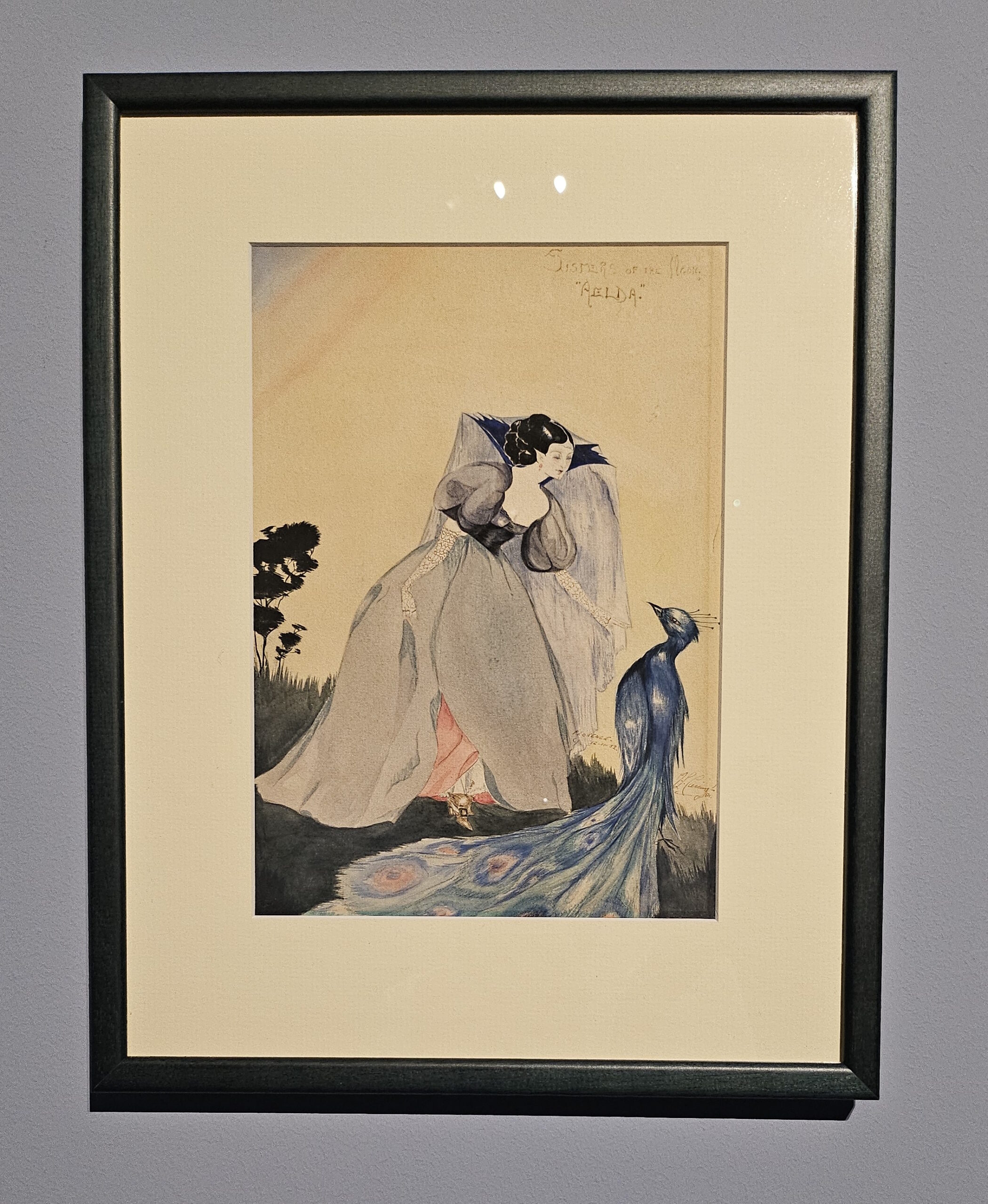
Take this Anida, where Carrington paints a poised young woman in a voluminous lavender gown, standing on the edge of a dusky landscape. Her companion is a peacock, and the two seem to share a silent dialogue between vanities. Look at it, and tell me it doesn’t remind you of Gustav Dulac’s illiustrations.
If Diana embodies lunar strength and fierce autonomy, Anida reveals another facet of Carrington’s early vision: femininity as reflection, as dialogue with the self and the natural world. The peacock isn’t just a traditional symbol of vanity, but traditionally embodies immortality, and in her hands it becomes almost an emblem of transformation. This gentle, almost reverent tone anticipates the quiet mysticism that would reappear in Carrington’s later works, such as The Inn of the Dawn Horse (a self-portrait) or And Then We Saw the Daughter of the Minotaur, where women exist in harmony with hybrid beings, mediating between worlds.
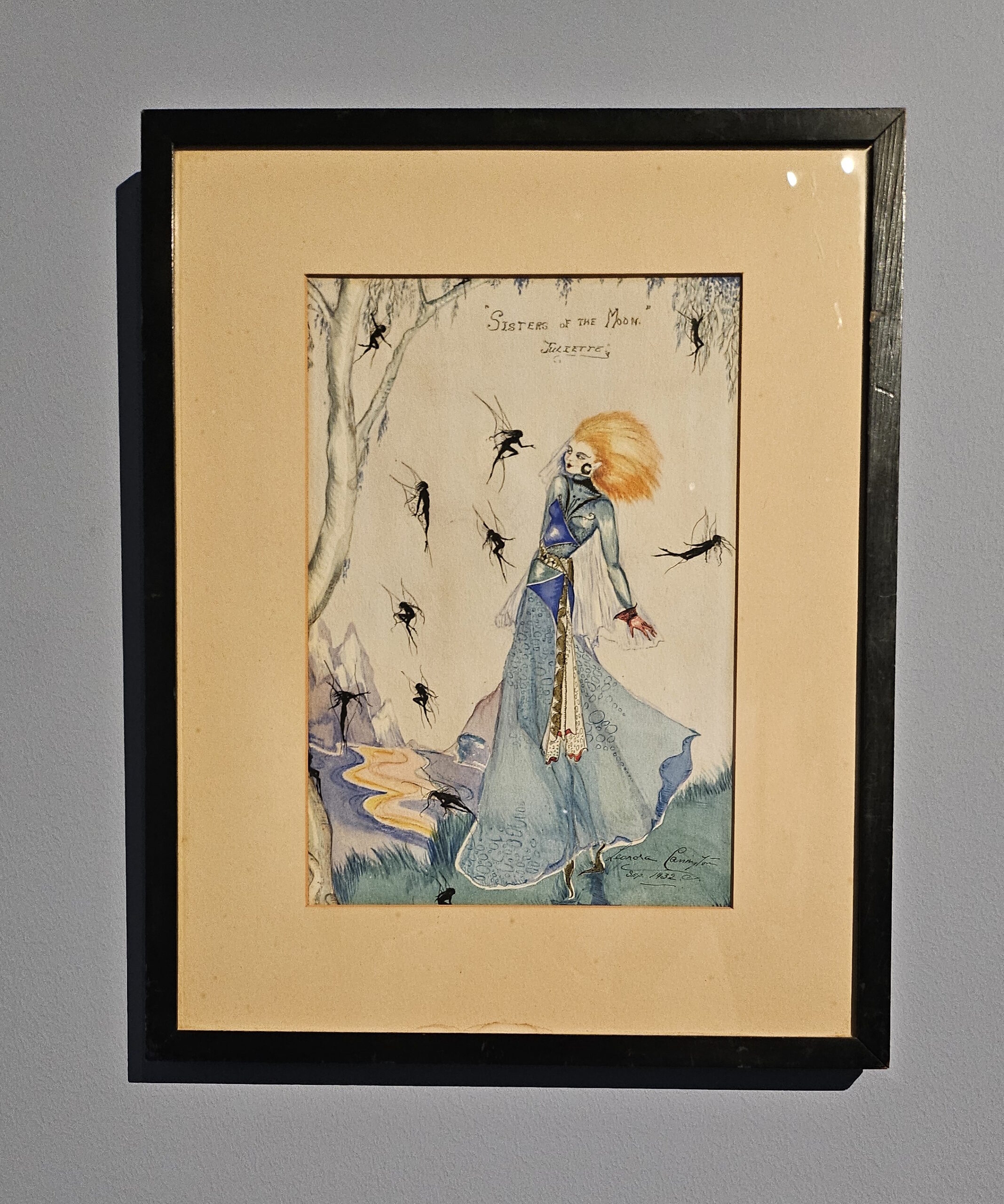
In Juliette, the titular figure stands luminous with copper hair and a cascading gown in shades of blue. Around her swarm a group of fairy-like creatures, black and angular, with forms midway between insects and spirits: they seem to dart and hover, unlike the docile sprites of children’s storybooks, and much more similar to the stories one can assume Carrington’s mother used to tell from her Irish tradition.
Formally, Juliette‘s fairies recalls the Art Nouveau refinement of Aubrey Beardsley and the jewel-toned fantasies of Edmund Dulac, artists whose illustrations populated the Edwardian imagination. Yet Carrington’s interpretation departs sharply from theirs. Where Beardsley’s figures inhabit erotic decadence and Dulac’s shimmer with fairy-tale escapism, Carrington’s vision is more psychological. Her Juliette is no passive nymph or ornamental dream, but stands in a charged relationship with her companions — neither commanding nor controlled by them — existing in a shared field of transformation. The fairies’ inky silhouettes anticipate the fluid, morphing figures that would populate Carrington’s later canvases, such as The Lovers or And Then We Saw the Daughter of the Minotaur again. Here, we glimpse the early seeds of her alchemy of metamorphosis, where creatures and women alike resist fixity and identity becomes a perpetual act of becoming.
And, if you pardon my mundanity, I can’t shake the feeling that some of the artists who later gave birth to Disney’s fairies in Fantasia had Carrington in mind, and it would make total sense. I wrote about some of them here a while ago.
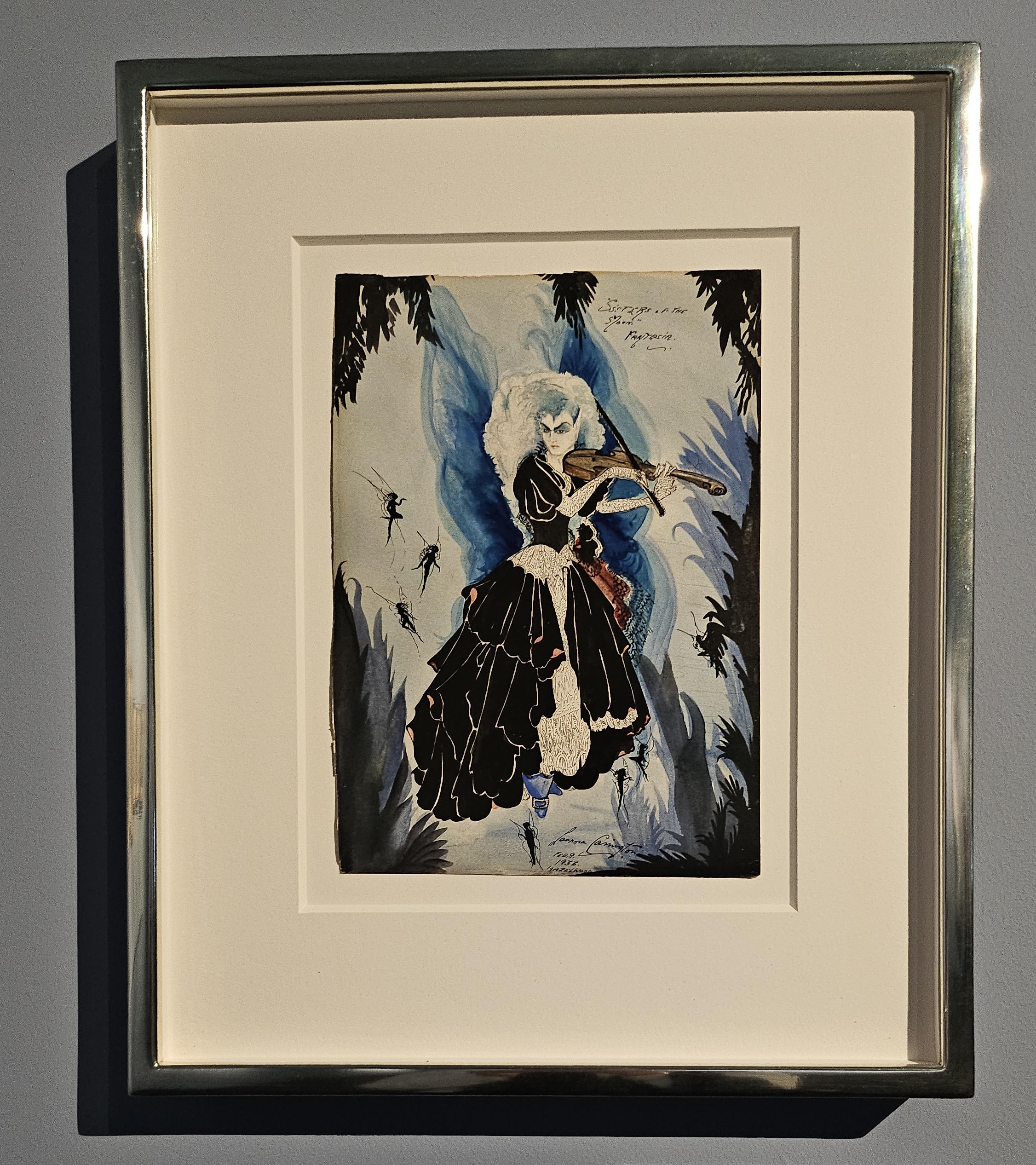
And Fantasia is precisely the title of possibly my favourite work in the whole series, featuring a figure at the centre with eyes wide and unyielding, silver-white hair haloed by wings of blue fire. She plays a violin, and Carrington’s choice is no coincidence. Historically, the instrument carried ambivalent associations: sensuality, mastery, and even the diabolical, from the legend of Paganini — whispered to have sold his soul for virtuosity — to anxieties about women performing in public. The violin has long been seen as a channel between the sacred and the forbidden. Women, in particular, were often discouraged or outright forbidden from playing it publicly through much of the 18th and 19th centuries. Its physicality — the way it nestles under the chin, the movement of arm and wrist — was considered indecorous, even erotic. You can see how many fucks fifteen-year-old Carrington already gives.
2. The Bride of the Wind
The second room of the exhibition deep dives into ochre colours and into Carrington’s relationship with Max Ernst (1891 – 1976). When Leonora Carrington met him in 1937, she was barely twenty and he was already a celebrated figure of European Surrealism, aged forty-six. Theirs was a collision of minds, and their relationship burned fiercely, briefly, and indelibly. He called her “the Bride of the Wind,” a name borrowed from the tempestuous energies of both nature and myth, but also a recognition of her own untamed spirit. The phrase itself feels prophetic: Carrington was never destined to belong to anyone or anything, like the wind itself.
Their encounter came at a time when Surrealism, having conquered Paris, was seeking new territories both geographical and psychological. Carrington, freshly captivated by the 1936 Surrealist Exhibition in London, entered this world not as an acolyte but as a provocateur. The movement’s fascination with the unconscious, the irrational, and the erotic resonated deeply with her imagination and yet, unlike many women who orbited the male surrealists as muses or companions, she entered it as an equal creative force.
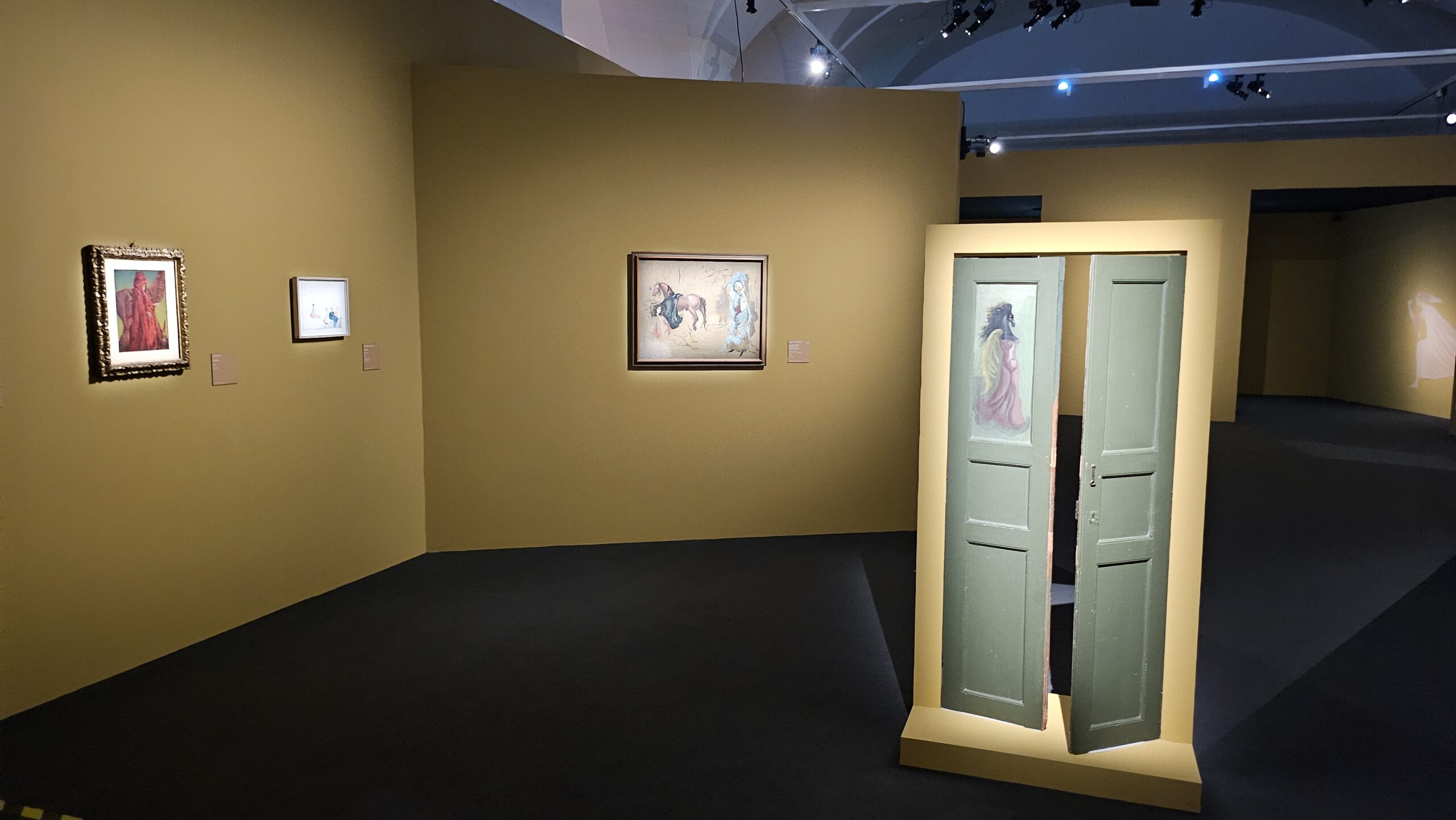
Together, Carrington and Ernst defied her father’s expectations and fled to Paris, and then to Saint-Martin-d’Ardèche, a small village in southern France where they turned an old farmhouse into a kind of Gesamtkunstwerk (a work of art composed of many artworks using many techniques). The lines between life and creation dissolved: walls became canvases, windows portals, domestic life a theatre of enchantment. The cabinet door displayed at the exhibition, right in the centre of the room, is significant in its own right.
Ernst adorned the exterior with his fantastical creatures, half-bird, half-human, while Carrington filled the interior with symbols drawn from Celtic myth, alchemy, and her own dream language. The house became their laboratory of love and imagination, an experiment in merging art and life. They formed a partnership of visions, though not of equals in the eyes of the world: Ernst, already canonised; Carrington, still learning to resist the gravitational pull of his fame.
“I realized how necessary it was to release all the characters that lived within me. I had to get rid of everything my illness had brought me, to cast out these personalities, and thus begin my liberation. I felt that, through the power of the Sun, I was an androgyne, the Moon, the Holy Spirit, a gypsy, an acrobat, Leonora Carrington, and a woman.”
But even then, she was carving her own mythology. Her paintings from this period — such as The Inn of the Dawn Horse and The Horses of Lord Candlestick — reveal her fascination with transformation, sexuality, and the porous boundaries between human and animal. The horse, as we have seen, will often be her personal totem, and it gallops through these canvases as a symbol of freedom and spiritual metamorphosis, a stand-in for herself: restless, impossible to domesticate.
Their idyll ended abruptly with the outbreak of World War II. As a German national in France, Ernst was arrested and imprisoned as an enemy alien, first by the French authorities because he was German, then by the Gestapo because he was anything but sympathetic. Carrington was left behind. The devastation of the war and the loss of their shared sanctuary marked the beginning of her descent into one of the darkest chapters of her life.
In 1940, overwhelmed by isolation and fear, she fled to Spain, where she suffered a severe mental breakdown. Her ensuing incarceration in a psychiatric institution in Santander exposed her to the brutal “treatments” of the time, like injections of Cardiazol to induce violent convulsions, forced feedings, and total loss of autonomy. These experiences, lived between lucidity and unconsciousness, reshaped her art forever.
Her later text Down Below — a haunting prose memoir — transforms this trauma into myth. She recounts her ordeal not as victimhood but as initiation, descending into the underworld of her own psyche and emerging with new, mystical insight. The world that had shattered around her was reassembled through alchemy, surrealism, and imagination.
After her release and escape from Spain, Carrington sought refuge in New York, where she briefly reconnected with the exiled Surrealist circle including Ernst, now partnered with Peggy Guggenheim. The balance had shifted and Carrington’s voice was now forged in suffering.
In New York, and later in Mexico, she expanded the iconography she had begun in Europe, blending the European Surrealist vocabulary with Mesoamerican cosmologies, feminism, and esoteric philosophy. The personal and the political converged: exile, gender, and imagination became intertwined themes. Her later paintings, as we’ll see, are darker and more hermetic, and they carry the scars of her wartime experience, but also a hard-won autonomy. Works like The House Opposite and The Giantess present the female figure not as muse or object, but as creator, magician, and prophetess. The “bride of the wind” had become the wind itself, infinite and unpossessable.
3. Displacement, Memory of Origins, and Nostalgia
Leonora Carrington arrived in Mexico, in 1942, as washed ashore by history. The war had torn apart her old world: Europe was a landscape of ghosts, and she herself carried more than a few within. Yet Mexico, with its brilliant light and ancient shadows, offered her a new home and a new mythology to inhabit. It was here that Carrington stopped running and began to root in paint, in family, and in the boundless alchemy of her imagination.
Mexico, in turn, welcomed Carrington as it did so many European exiles: artists, writers, and visionaries who found in its syncretic culture a mirror for their own fragmented identities. She settled among fellow surrealists like Remedios Varo and Kati Horna, forming a sisterhood that looked a lot like a coven, and together they discussed Jung — as witches usually do — alongside alchemy as ritual subjects that, in Carrington’s hands, became a complete cosmology.
Her early Mexican paintings show a softer palette and a quieter rhythm than her European works. Gone are the convulsions of war; in their place, dreamlike domestic interiors, pastoral visions, and enchanted rituals. The spectres of her English childhood — that sprawling Lancashire mansion filled with formality and folklore — return, but transformed. The ghosts now dance instead of haunting.
In paintings like The House Opposite (1945) or The Temptation of St Anthony (1947), domestic space becomes sacred space, peopled with half-human creatures, saints, and kitchen alchemists. If her earlier art wrestled with mental turmoil, these works perform a slow exorcism and melancholy turns into grace.
Motherhood deepened that transformation. Her children, Gabriel and Pablo, appear in her art not as sentimental portraits but as part of the natural and mystical continuum she painted. In And Then We Saw the Daughter of the Minotaur (1953), two children stand before a mythical creature, calmly accepting the strangeness around them. In Carrington’s world motherhood stands apart from domestic confinement, and resists as another form of creation.
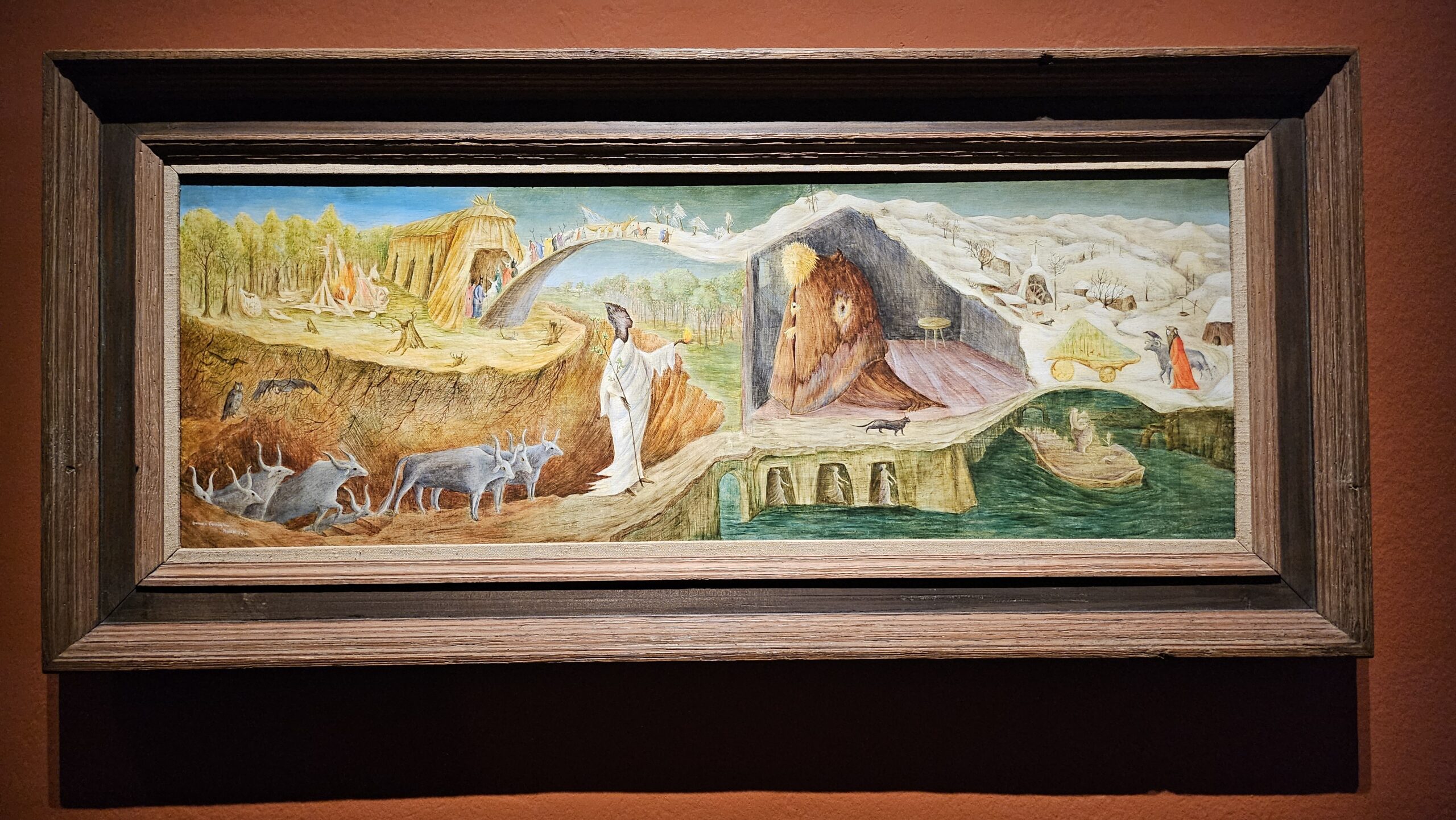
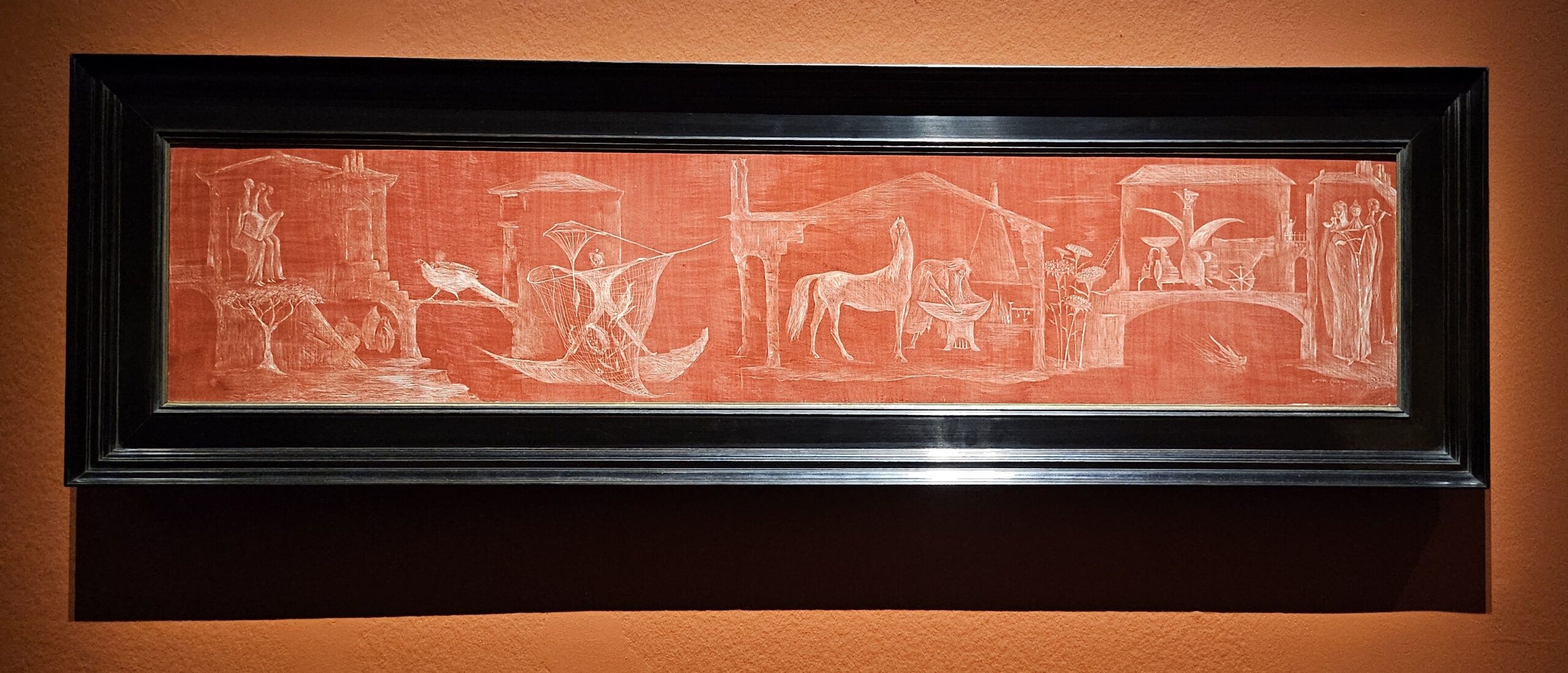
This period also saw her experimenting with new media and formats. Carrying in her heart the resounding influence of Italian Renaissance painting, she embraced tempera on panel and the predella format, those narrow narrative panels that once sat beneath altarpieces. Carrington’s use of this structure gave her stories a gentle rhythm, a visual unfolding more akin to storytelling than spectacle.
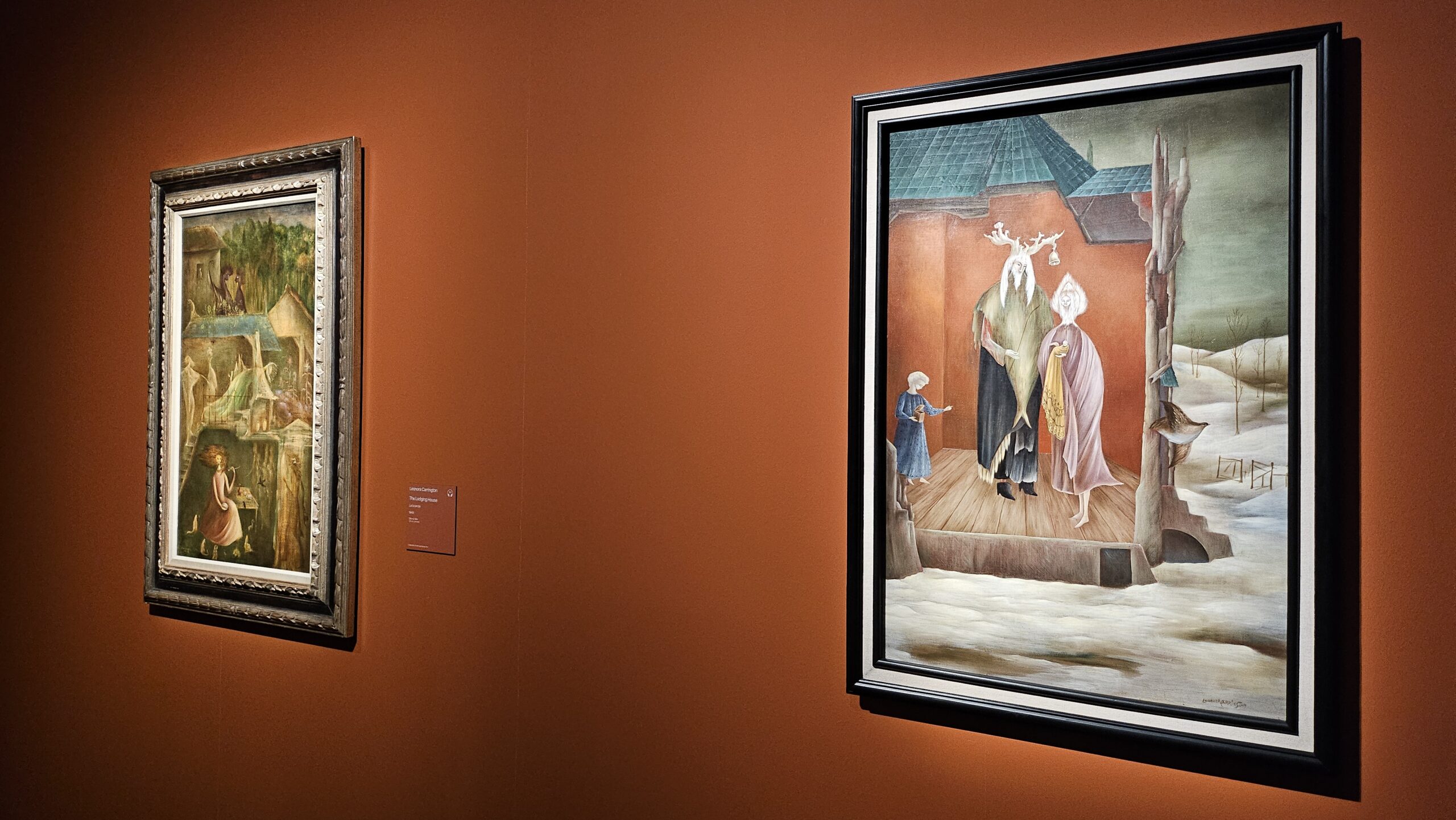
Yet her nostalgia for England never vanished. You can almost feel it in works like The Magdalens or Adieu Ammenotep (both from the late 1940s), where the architecture of her memories blends with Mexican landscapes, creating hybrid worlds that feel simultaneously ancient and modern, pagan and domestic. Carrington’s sense of displacement became her engine of invention: she painted to rebuild the geography of belonging, even if that meant building it out of clouds, animals, and moonlight.
Her friend and patron Edward James called her art “dreamlike power distilled in the underground caves of libido.” He wasn’t wrong, but Carrington’s libido wasn’t erotic in the Freudian sense her male peers adored; it was creative energy in its purest form, the vital impulse that animates both cosmos and kitchen.
The late 1940s and early 1950s mark the point where Carrington truly became herself. Her art grew less frantic, more hermetic and tender, filled with domestic altarpieces to the everyday and the divine. In tone, one might compare her transformation to Marc Chagall’s postwar paintings, where nostalgia and myth intermingle in glowing, weightless scenes. Yet Carrington’s universe is less sentimental, more subversive. Her figures are not suspended in longing but actively remaking their worlds.
4. The Heroine’s Journey
If Joseph Campbell mapped the Hero’s Journey — the archetypal path of departure, ordeal, and return — then Leonora Carrington rewrote it in her own lunar ink. Her version was not about conquering dragons or claiming thrones but descending inward, dismantling illusions, and discovering the self as multiple, fluid, and sacred. The true adventure was never external conquest but the alchemy of consciousness. Her life — as much as her art — embodies this inversion. From the dissolution of identity in the asylum to her rebirth in Mexico, Carrington’s trajectory reads like a mystical initiation: each stage stripping away a former self, each ordeal revealing another facet of her being.
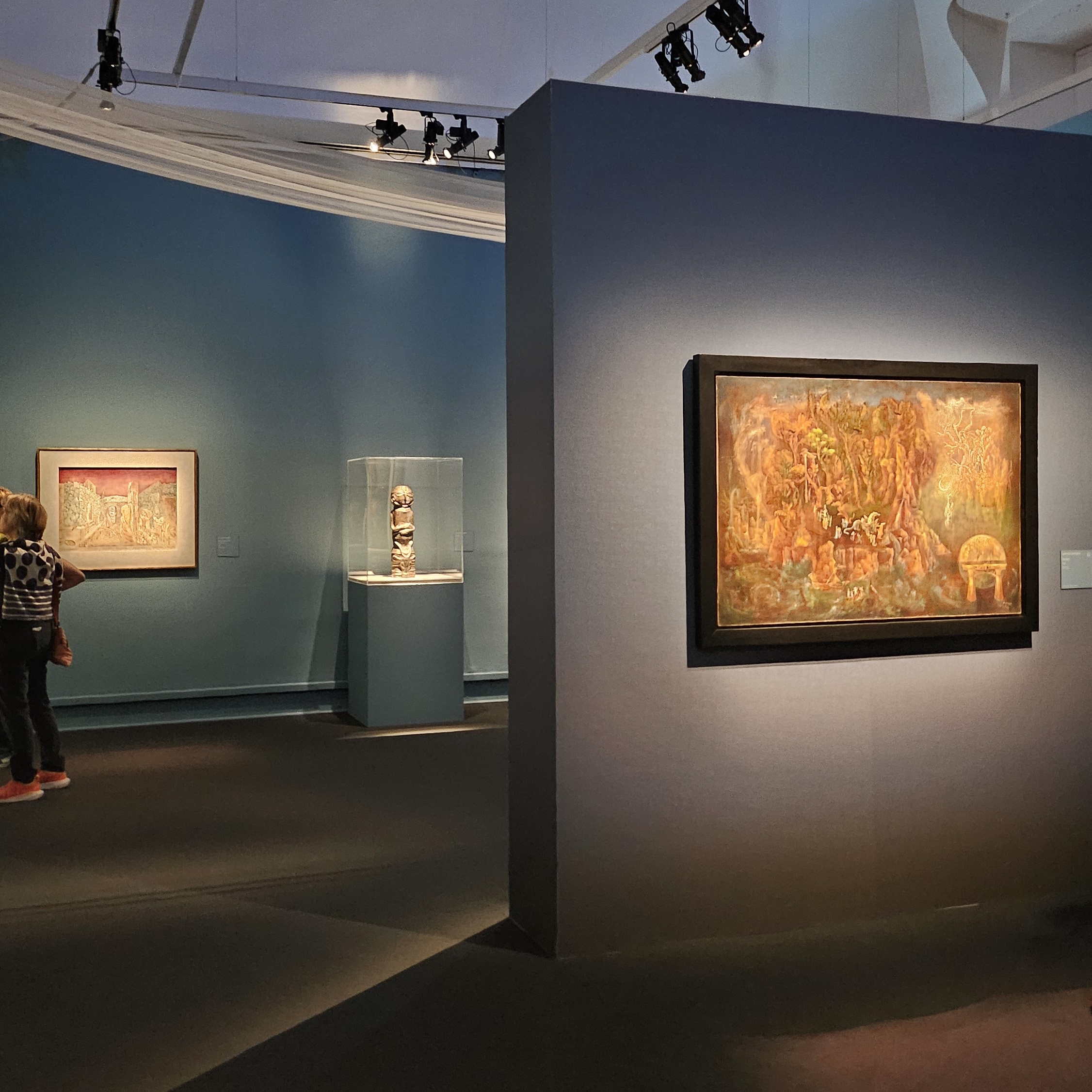
Her son Gabriel once said she was “always in search of inner maps to navigate her visionary life and inner demons.” This is perhaps the truest description of her practice. Every painting, every story, is a constellation of myth, psychology, and intuition, and she moved through archetypes with grace, interpreting them as energies to be inhabited.
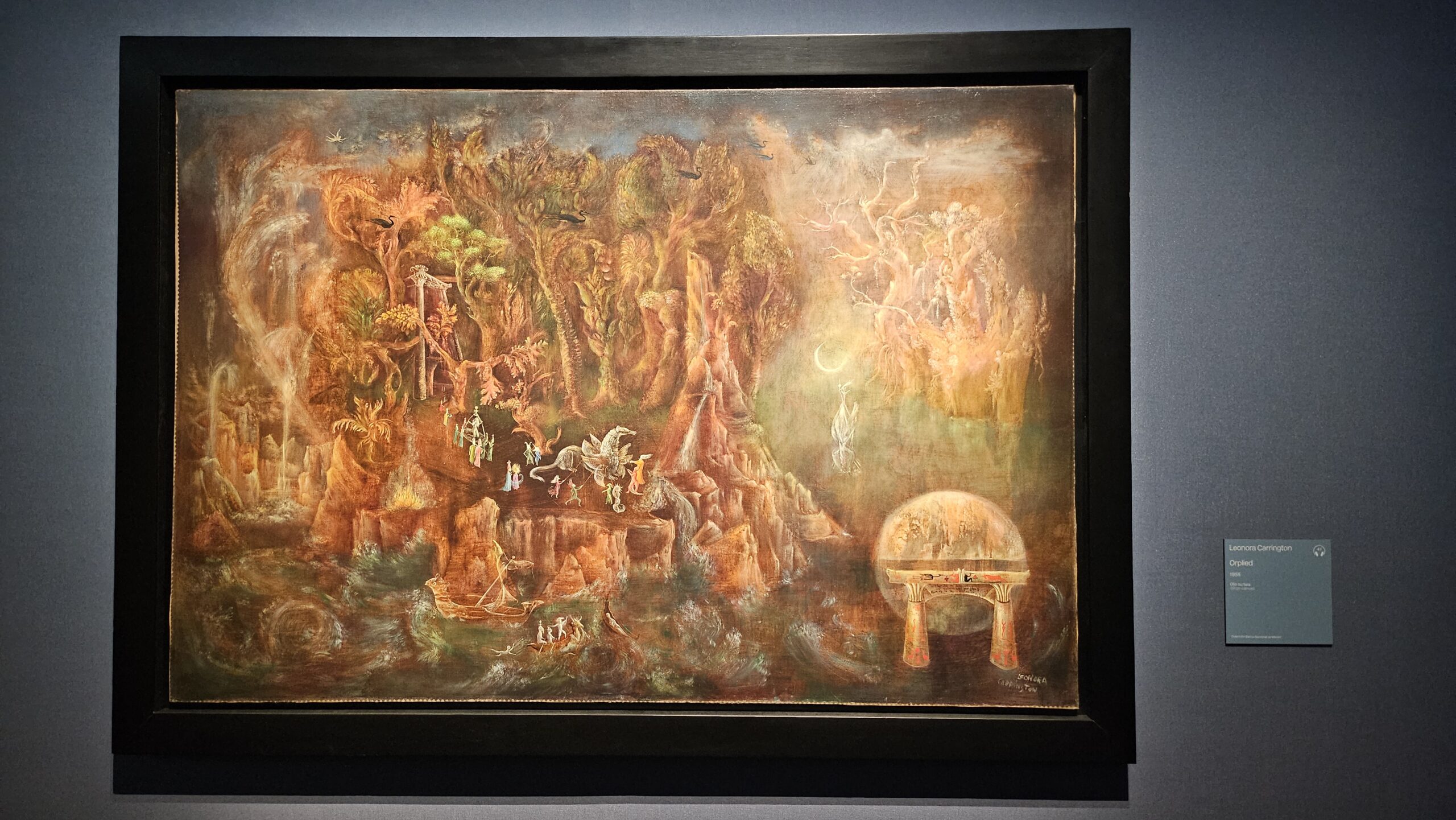
In works such as The Giantess (The Guardian of the Egg) or again the capital And Then We Saw the Daughter of the Minotaur, Carrington presents not heroic triumph but metamorphosis of female figures who mediate between worlds, carrying wisdom that defies reason. Her art suggests that to be whole, one must embrace multiplicity: to be the Sun and the Moon, as she wrote, an androgyne, a wandering seer, an acrobat, and a woman. Her spiritual pantheon spanned from Hermes and Orpheus to Buddha, Moses, and Zoroaster; her references moved effortlessly between Gnosticism, Kabbalah, and Buddhism. Each myth was a mirror. From Hermes, she borrowed the idea of the messenger — the soul moving between realms. From Orpheus, she inherited the musician’s descent, the courage to look back and lose everything for the sake of vision. From Buddha, she found compassion as cosmic balance. These fragments became her personal scripture, a language of liberation written across cultures and centuries.
Her encounters in Mexico with the followers of P.D. Ouspensky and G.I. Gurdjieff further expanded her search. Their teachings on the evolution of consciousness — the idea that self-knowledge is a lifelong, disciplined awakening — resonated deeply with her. Art was a form of spiritual exercise through which one could refine perception and expand awareness.
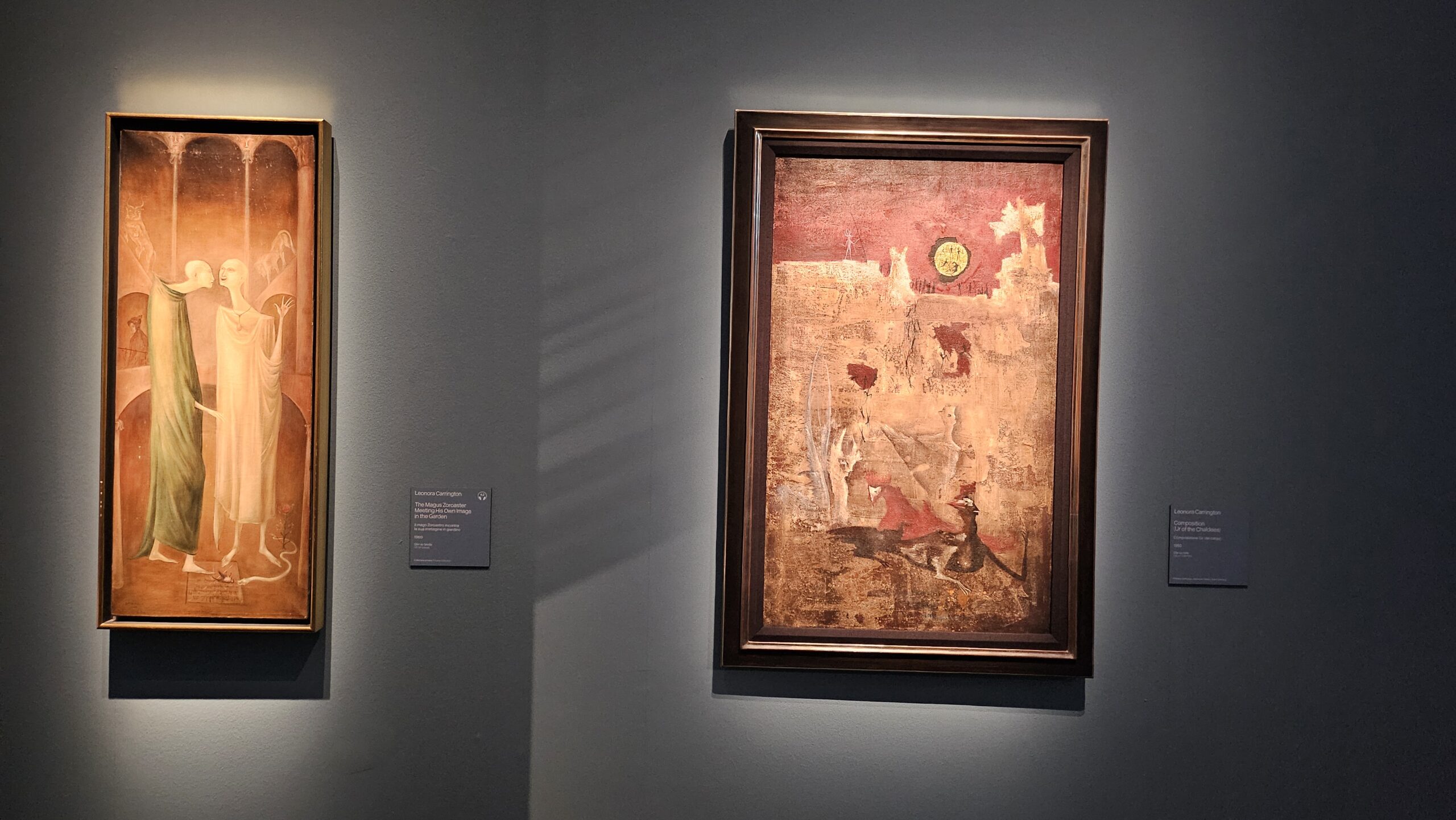
What distinguishes Carrington’s journey from her male surrealist contemporaries is her refusal to separate the mystical from the material. Her heroines cook, tend, fly, and dream with equal cosmic weight. The domestic table becomes an altar; the egg, a symbol of creation; the act of painting itself, a ritual of invocation. While André Breton spoke of the “marvellous” as a break from reason, Carrington lived it as a state of being. Her mythic women do not reject the world but re-enchant it. As women do.
Her Heroine’s Journey aligns more closely with the Buddhist cycle of awakening than with Campbell’s masculine quest. Her art is circular, not linear; its goal is not mastery but balance. She dissolves the self, only to reconstitute it as something fluid that’s human, animal, divine, and everything in between.
5. The Luminous Dark
André Breton once described Leonora Carrington as “an enchantress with a smooth, mocking gaze”. Breton, the self-appointed “pope” of Surrealism, likely meant it as both admiration and warning. For Carrington, in turn, enchantment was a philosophy. She was not a muse draped in mystery, but a seer who painted the machinery of mystery itself.
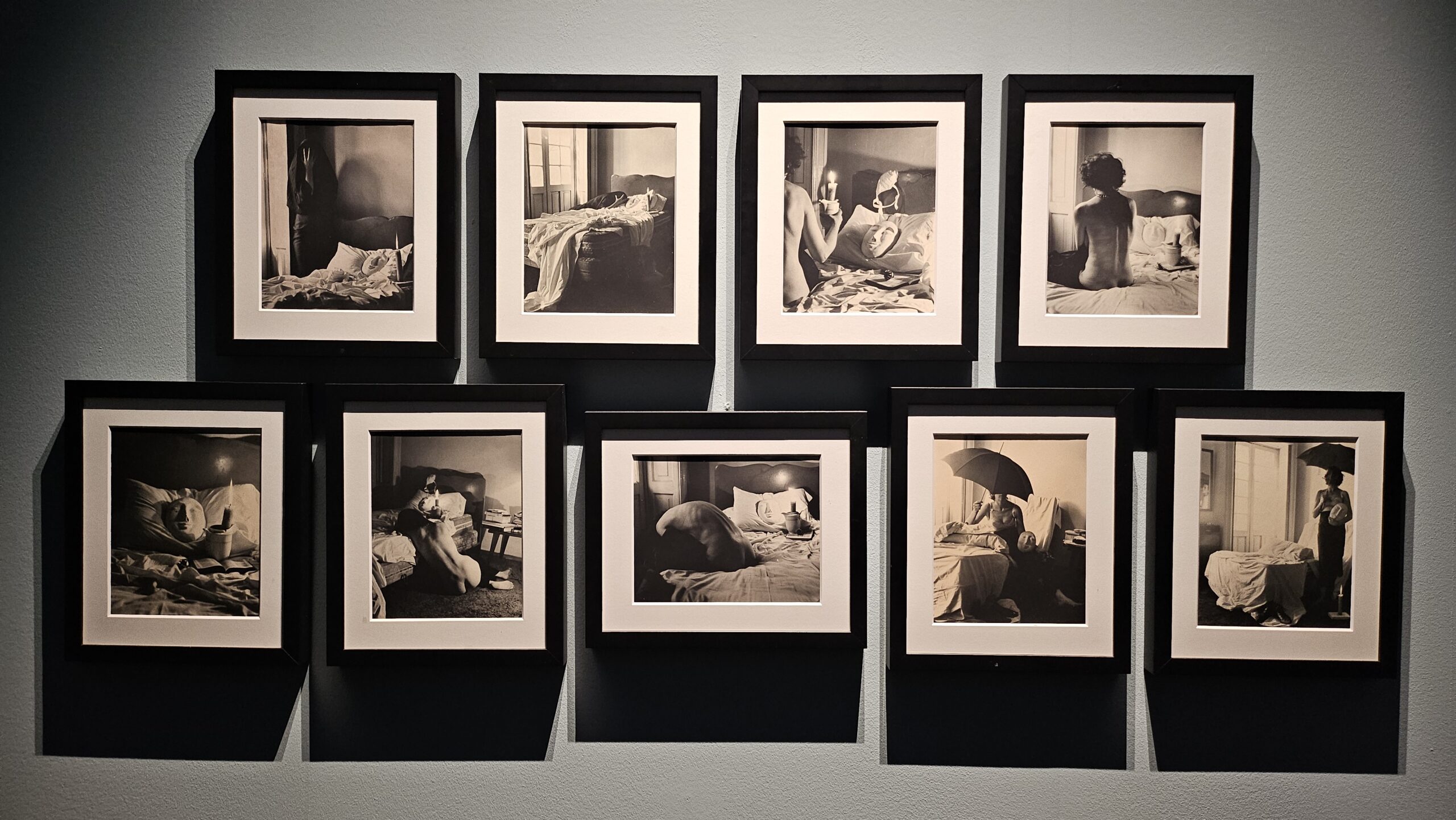
The Surrealists were famously drawn to the occult — alchemy, tarot, astrology, spiritism — and Carrington wasn’t an unicum in this, but her approach was singular. Where her male contemporaries often treated mysticism as metaphor, she treated it as method. Magic, for her, was neither ornament nor fantasy but a framework for understanding transformations that could be psychological, spiritual, and artistic. In this sense, her approach could very well be more similar to that of the original witches, before male fantasies stepped in to describe their aim and approach.
Carrington’s world was a theatre of correspondences: suns and moons, birds and spirits, circles and spirals, all participating in an intricate cosmology of becoming. Yet she resisted explanation. “To name,” she seemed to believe, “is to reduce.” Her paintings, dense with sigils, codes, and ritual diagrams, are less puzzles to be solved than doors to be opened.
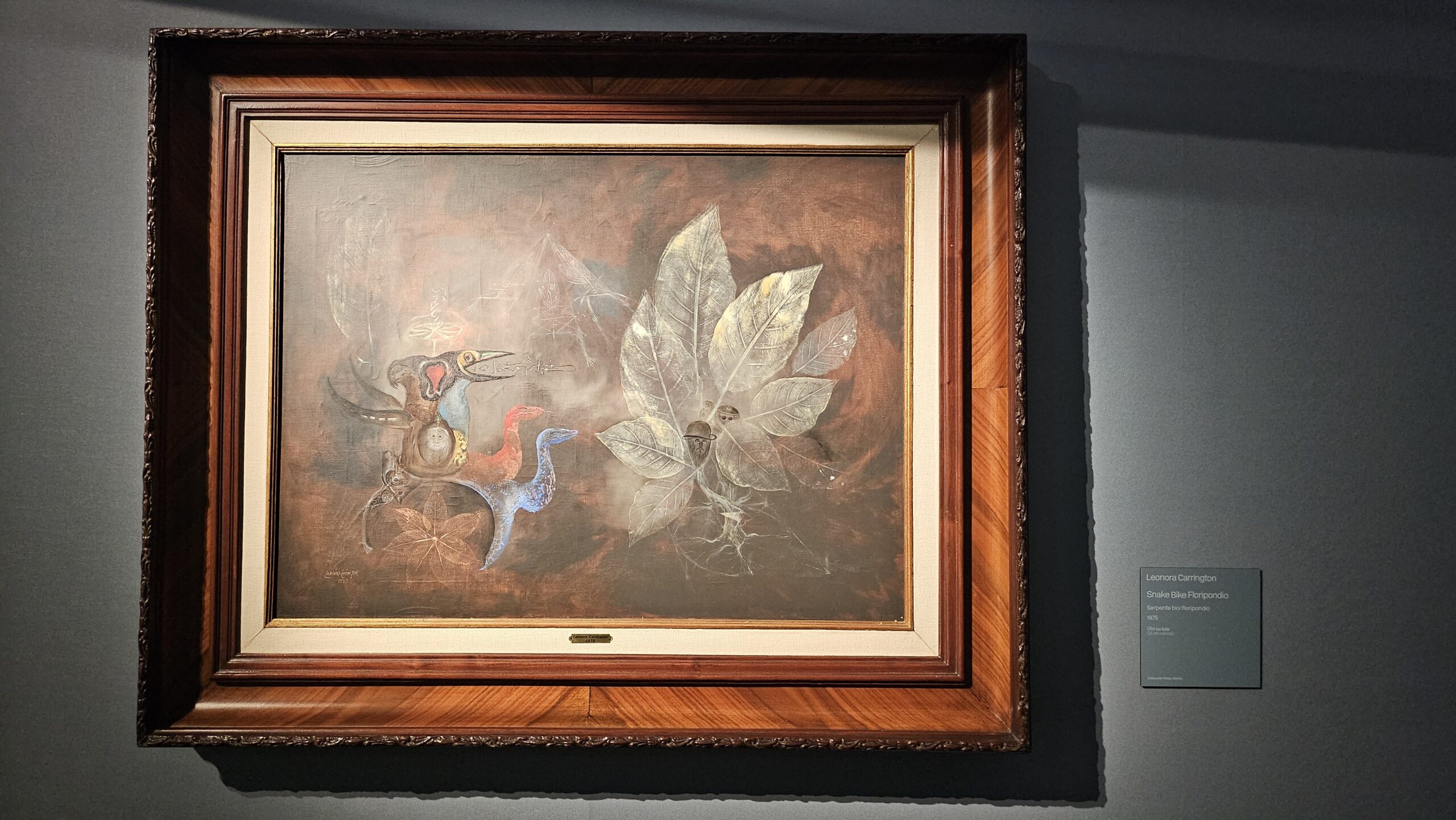
The title of this exhibition section — The Luminous Dark — captures her paradox perfectly. Drawing on Joseph Campbell’s idea of the Dark Night of the Soul, it evokes that liminal space where clarity emerges only through descent. Carrington inhabited that threshold. Her “dark” was never sinister but fertile, shimmering, like a womb of revelation.
Unlike Breton, who sought the marvellous as disruption, Carrington sought it as integration, as the seamless coexistence of the visible and the invisible: the occult was not an escape from reason but its expansion. Carrington’s secrecy, on the other hand, was part defence, part design. The esoteric, after all, thrives on layers: truths half-veiled, symbols half-revealed. She embedded incantations, sigils, and astrological maps into her compositions, knowing they would baffle those who demanded tidy meaning. In doing so, she turned the act of looking into an initiation of its own: the viewer must surrender certainty to perceive, as it happens in every good Mystery.
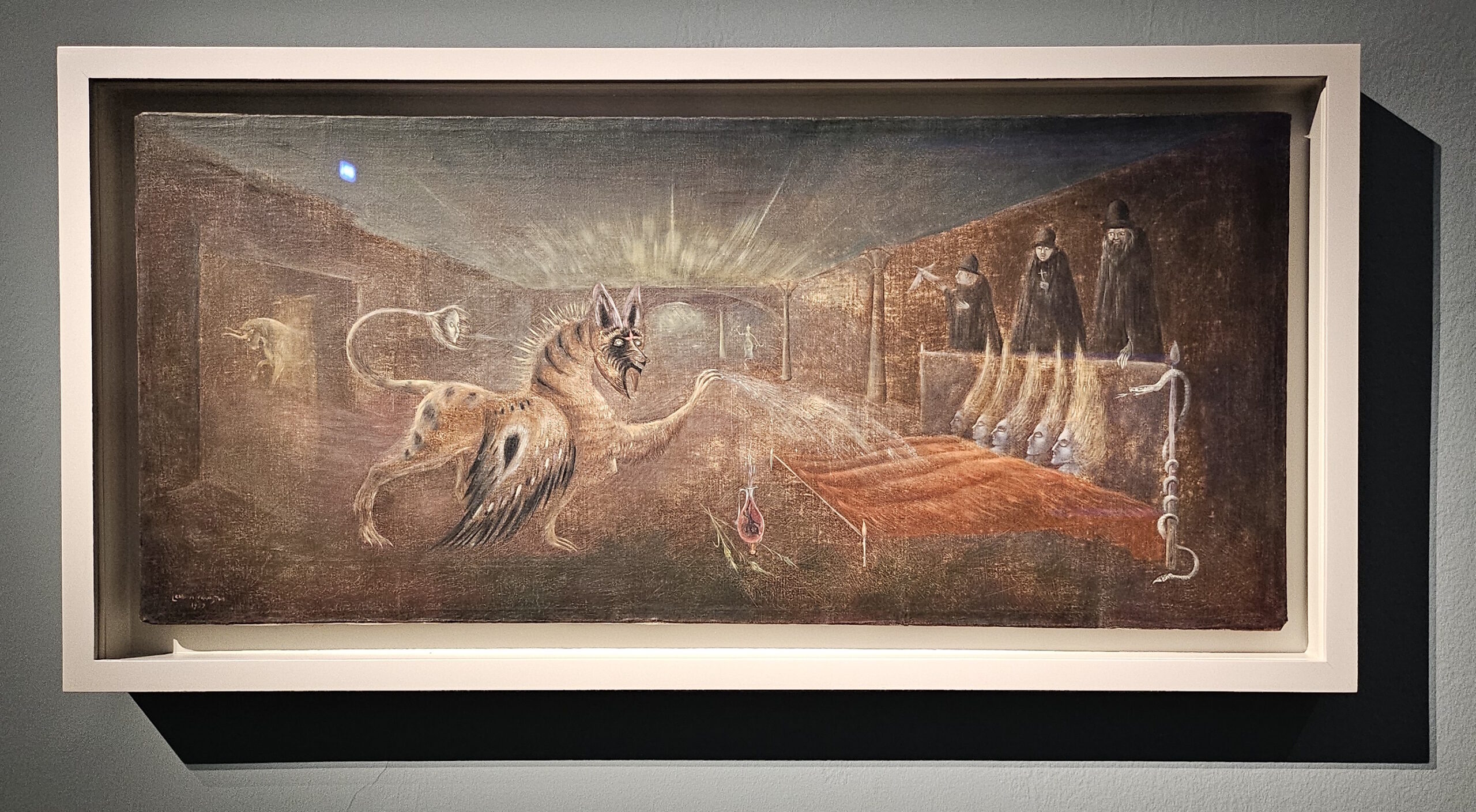
To call Carrington’s art “occult” is not to relegate it to superstition but to recognise its political and spiritual defiance. In a century defined by systems — aesthetic, social, and psychological — she painted the spaces that refused to be systematised. The luminous dark became her territory: a realm where knowledge and intuition, male and female, human and animal, matter and spirit, all coexist.
In this sense, her work anticipates later feminists and artists like Ana Mendieta and Kiki Smith who would explore the reclamation of ritual, the body, and myth as sites of power. Yet, Carrington’s vision remains uniquely hers: cosmic yet domestic, playful yet profound, as if every spell she cast was also a joke on anyone trying too hard to decipher it.
6. The Alchemical Kitchen
The kitchen was never just a domestic space for Leonora Carrington but a laboratory, a site of transformation, creation, and quiet rebellion. While Surrealism’s men conjured their dreams in cafés and studios, Carrington worked her magic over pots, pigments, and herbs. For her, the kitchen was an alchemical crucible, where matter and spirit, art and life, feminine labour and mystical power fused into one continuous act of becoming.
Art historian Susan Aberth coined the term The Alchemical Kitchen to describe how Carrington wove together cooking, painting, and esoteric ritual into a single symbolic practice. It’s an idea that captures the essence of her creative philosophy: that every true act of making — whether a meal, a story, or a painting — is an operation of transformation.
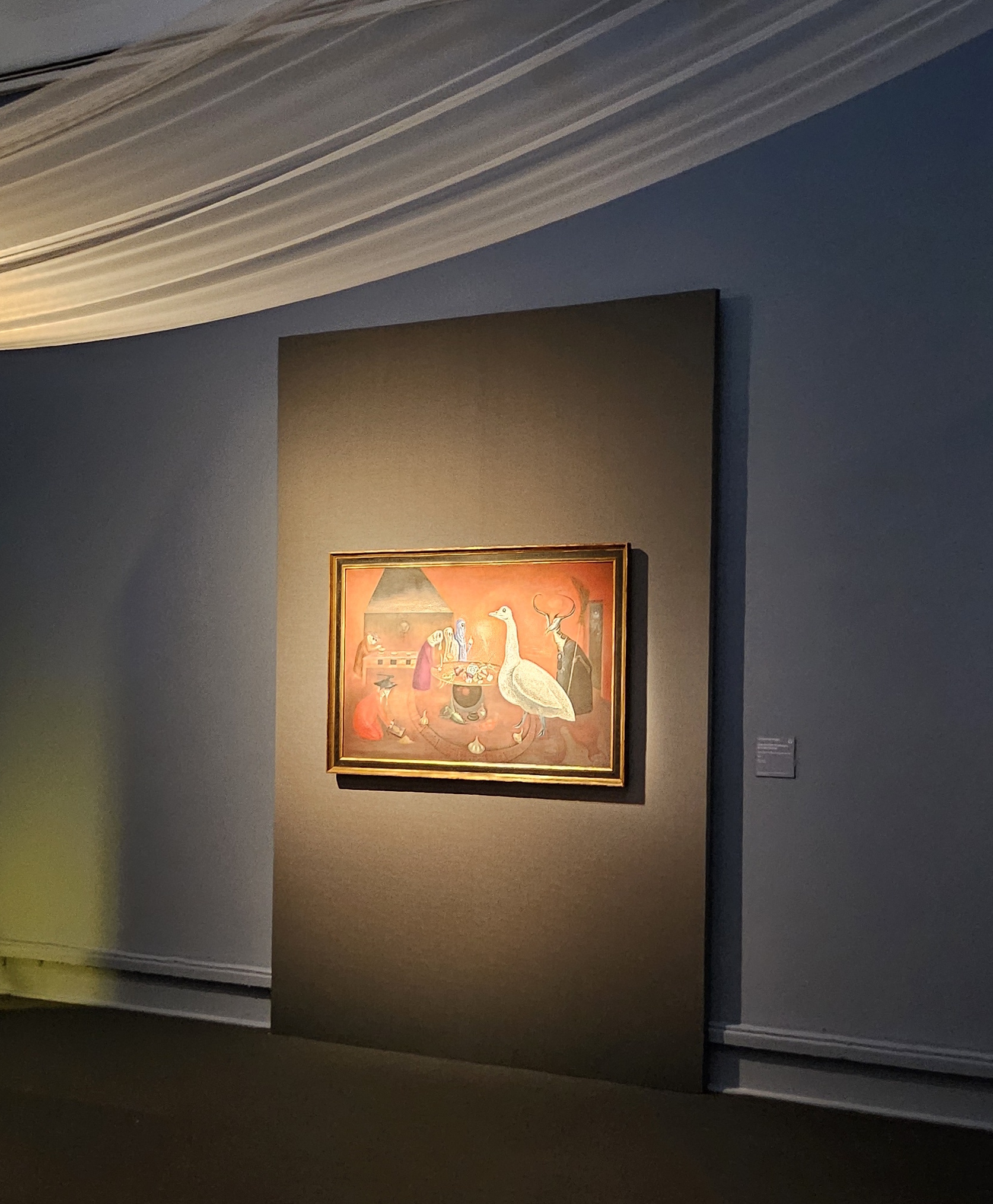
Cooking becomes, in her world, hermetic art. Ingredients stand in for primal elements; recipes echo magical formulae; fire is the medium through which both sustenance and enlightenment are achieved. The traditionally feminine space of the kitchen — so often associated with confinement and invisibility — becomes, in Carrington’s hands, a site of sovereignty, a realm where women reclaim power through creation and mystery.
Carrington’s interest in alchemy was not merely thematic but technical. In the mid-1940s, she began experimenting with egg tempera, a medieval medium used by early Renaissance masters and alchemists alike. Mixing pigment with egg yolk — itself a symbol of life and cosmic unity — she produced the distinctive luminous sheen that defines her paintings.
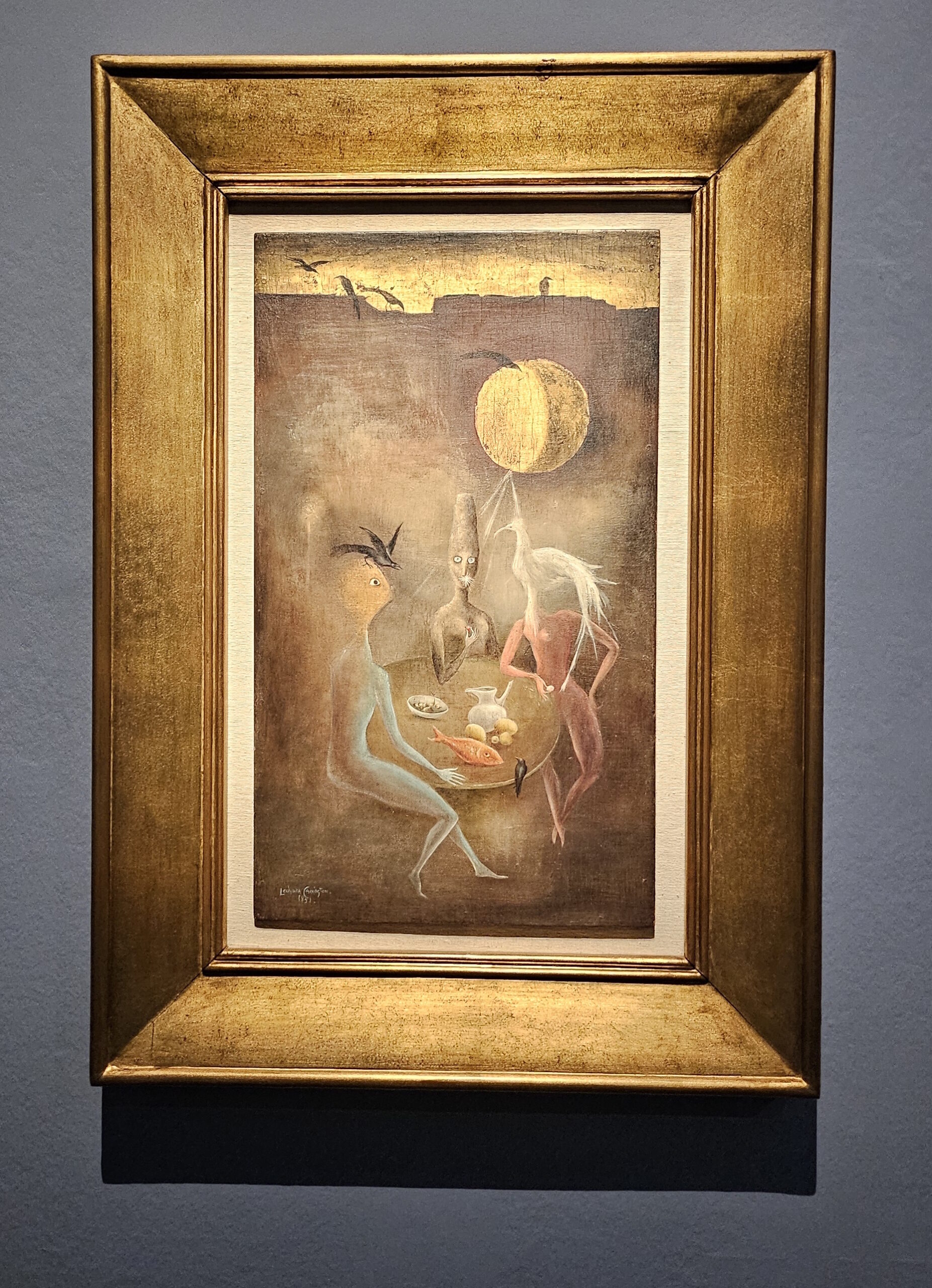
Her patron and friend Edward James once remarked that Carrington’s works were “not merely painted; they are brewed.” Indeed, her paintings seem to emerge from some metaphysical cauldron, simmering with layers of symbol and spirit rendered in colour and form. Carrington’s technique was a direct continuation of her philosophy: transformation through fusion. Her brush became a stirring spoon; her palette, a vessel of creation. The artist, like the alchemist, transmuted raw materials — pigment, yolk, intuition — into revelation.
Her fascination with food and ritual dates way back to her years in Saint-Martin-d’Ardèche, where she and Max Ernst turned their home into a total work of art. But it was in Mexico that this fascination deepened and took on new meaning. There, she discovered a vibrant culture of herbalism, traditional medicine, and ritual markets, most famously, the Sonora Witches’ Market in Mexico City, where she explored stalls filled with dried plants, potions, and talismans. These encounters enriched her visual vocabulary. She painted kitchens that were also sanctuaries, cauldrons that doubled as planets, and tables that transformed into altars. The domestic became divine.
Her imagery from this period blends Mexican folklore with her Celtic heritage: a meeting of North and South, earth and moonlight. One can imagine her at work — grinding pigments beside the stove, a cat at her feet, laughter from her children in the background — stirring both soup and symbolism with the same hand.
It’s the ultimate sincretism.
Further Readings
To better prepare for this hermetic exhibition, I can only recommend you do a little bit of studying beforehand, and what better way than to read the artist herself?
Leonora Carrington’s art does not end on the canvas but spills into language and her writing, just like her painting, dissolves the boundary between sense and enchantment, showing that imagination is not a retreat from reality but a way of inhabiting it more fully. She wrote with the same precision and unruly energy with which she painted, crafting stories where logic unravels and the marvellous takes root.
By Leonora Carrington
- The Hearing Trumpet (written 1950, published 1974)
Carrington’s only full-length novel and her most beloved work is a surreal, witty, and deeply subversive tale about ninety-two-year-old Marian Leatherby, who discovers a world of alchemy, anarchism, and cosmic rebirth inside a sinister retirement home. At once absurdist comedy and feminist prophecy, it’s a manifesto for joyful resistance. Take the best parts from The Master and Margarita, and make them better. - Down Below (1944)
A harrowing yet luminous memoir of Carrington’s internment in a Spanish psychiatric hospital. Not for the faint of heart. It reads like a descent into the underworld, written in the language of revelation. Part autobiography, part alchemical text, it is both testimony and transfiguration, and the record of a mind that refused to break. - The Oval Lady and Other Stories (1939–1945)
A collection of short stories written during her Surrealist years. Dreamlike, feral, and funny, these tales dismantle patriarchal fairy-tale tropes and rebuild them into something entirely her own. Horses speak, goddesses plot, and logic politely leaves the room. - The Stone Door (1977)
A visionary prose work written decades after her European period, dense with esoteric imagery and spiritual inquiry. It reads like a codex — elliptical, alchemical, and profoundly personal. - The Debutante and Other Stories (compiled posthumously)
This later collection gathers much of Carrington’s fiction, including the wickedly humorous “The Debutante,” where a young woman sends a hyena in her place to a society ball. A perfect entry point for those who enjoy her mix of surreal horror and dry British wit.
Biographies and Critical Studies
- Joanna Moorhead – The Surreal Life of Leonora Carrington (2017)
Written by Carrington’s cousin, this biography is both intimate and illuminating. It balances family insight with cultural history, tracing her journey from rebellious debutante to visionary artist. - Susan Aberth – Leonora Carrington: Surrealism, Alchemy and Art (2004)
The definitive monograph on Carrington’s visual art. Aberth connects her paintings to esoteric traditions and feminist theory without reducing their mystery. Essential for understanding her symbolic language. - Gloria Orenstein – The Reflowering of the Goddess (1990)
A pioneering feminist reading of women Surrealists, including Carrington, that situates their work within mythic and ecological consciousness. - Catriona McAra – A Surrealist Stratigraphy of Dorothea Tanning and Leonora Carrington (2017)
A scholarly but deeply readable comparison between two of Surrealism’s most independent women, showing how both used myth and domesticity to reinvent the modernist canon.
Context and Companions
- Remedios Varo – Letters, Dreams, and Other Writings
To read Carrington without Varo is to miss half the conversation. Their friendship in Mexico was an artistic dialogue about transformation, ritual, and the feminine imagination. - Ithell Colquhoun – The Living Stones (1957)
Another British Surrealist who fused magic and art, Colquhoun’s travel memoir about Cornwall reads like a kindred spirit to Carrington’s visionary landscapes. - Joséphin Péladan – The Supreme Vice (1890)
A Symbolist precursor whose writings on the occult and aesthetics anticipated many of the ideas Carrington later explored. For readers curious about her esoteric lineage.


No Comments