
Ascoli Piceno, 1600 – Roma, 1670
Considered the most prominent miniaturist of the Baroque Era, Giovanna Garzoni distinguishes herself for the production of still lives, parchments painted in a particular style called “a guazzo” and swift impressions in guache that almost seem to come out of another era. Her style alone would make her interesting material for my WIP novel.

Giovanna Garzoni, “Tray with Cherries and a Carpenter Bee” (1642-51)
She was born from a family of Venetian crafters, and studied in Venice: she attended a school of calligraphy founded by Giacomo Rogni and the workshop of painters such as Jacopo Palma the Younger, impressing both with her fresh talent. She quickly broke away from traditional painting, pursuing less traditional forms of art and “minor” disciplines such as miniatures.
Between 1618 and 1621 she moved to Florence, where she tried to find a place at court with Maria Maddalena d’Austra, Grand Duchess of Tuscany, and met with the greatest painter of this time: Artemisia Gentileschi. She would move to Naples with Artemisia herself, where they both will work for Viceroy Fernando Alfan de Ribera, Duke of Alcalà.
When the Duke was recalled to Spain, Giovanna turned to an acquaintance she had met during their travels with Artemisia: Cassiano Dal Pozzo. Cassiano was a collector and mecenate, and had introduced her to the naturalistic studies of the recently funded Accademia dei Lincei: he introduced her to several patrons and Giovanna turned to portraits, a subject that was likely to pay your bills. She produced several of them during her stay in Rome, and this work earned her enough fame to be called at the court of Cristina di Francia, Duchess of Savoy, in Turin. She painted several portraits, there, but also indulged in the production of mythological subjects and, of course, her beloved miniatures.
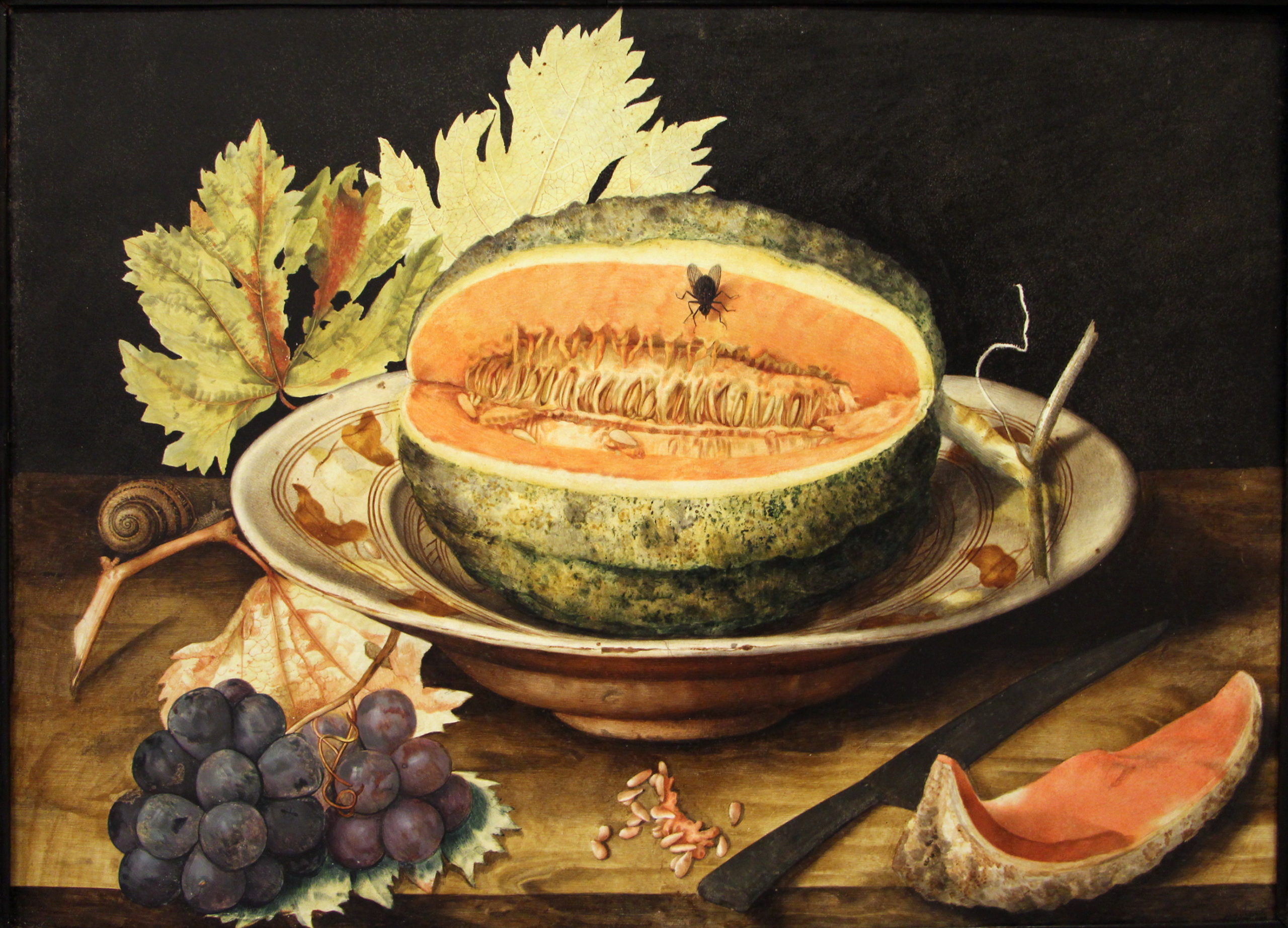
Giovanna Garzoni, “Still life with popone, grapes, a fly and a snail” (1642-51)
In Turin, however, she discovered what was going to be her favourite subject: naturalistic still lives. She met with artists such as Fede Galizia, Panfilo Nuvolone, Lodewijck Susi, Isaak Soreau and Peter Benoit.
When Vittorio Amedeo di Savoia died in 1637, she briefly visited England where her friend Artemisia was working, and eventually moved to Paris, where she counted as her patrons prominent figures such as Cardinal de Richelieu and King Louis XIII himself. Her fame brought her back to Rome and Florence, where she studied natural sciences through the drawings of Jacopo Ligozzi and could consult the Medici collection of natural wonders. Grand Duke Ferdinando II commissioned her several paintings, and she became close friends with his wife Vittoria della Rovere.

Giovanna Garzoni, “Chinese Vase with Flowers, a Fig and a Bean”
She moved to Rome in 1651 and never moved again. She would paint miniatures and still lives, execute commissioned portraits and pursue natural studies, regularly giving parts of her work to the local Accademia di San Luca, but she would never be admitted to the scientific lectures. Three hundred years later, Beatrix Potter would share the same fate.
She died in 1670 and left everything to the Academy, which would build her a monument in the Church of Saint Luca and Martina.



1 Comment
Pingback:Fede Galizia, the child prodigy – Shelidon
Posted at 10:19h, 29 September[…] still lives didn’t have the same naturalistic attention as works from her contemporary Giovanna Garzoni, and are more akin to paintings such as those produced by the masters of Nothern Europe. These […]