
When the rumours first began, I can’t tell you. They must have had a beginning: but no one recollected when the beginning was. It was said that curious noises were heard in the neighbourhood of Sandstone Torr. One spoke of it, and another spoke of it, at intervals of perhaps a month apart, until people grew accustomed to hearing of the strange sounds that went shrieking round the Torr on a windy night. Dovey, the blacksmith, going up to the Torr on some errand, declared he had heard them at mid-day: but he was not generally believed.
The Torr was so remote from the ordinary routes of traffic, that the noises were not likely to be heard often, even allowing that there were noises to hear. Shut in by trees, and in a lonely spot, people had no occasion to pass it. The narrow lane, by which it was approached from Church Dykely, led to nowhere else; on other sides it was surrounded by fields. Stephen Radcliffe was asked about these noises; but he positively denied having heard any, except those caused by time wind. That shrieked around the house as if so many witches were at work, he said, and it always had as long as he could remember. Which was true.
Stephen’s inheritance of all the money on the death of his young half-brother Francis–young, compared with him–seemed to have been the only signal for him and his wife to become more unsociable, and they were bad enough before. They shut themselves up in the Torr, with that sister of hers, Eunice Gibbon, who acted as their servant, and saw no one. Neither visitors nor tradespeople were encouraged there; they preferred to live without help from any one butcher or baker or candlestick maker. The produce of the farm supplied ordinary daily needs, and anything else that might be wanted was fetched from the village by Eunice Gibbon–as tall and strapping a woman as Mrs. Stephen, and just as grim and silent. Even the postman had orders to leave any letters that might arrive, addressed to the Torr, at Church Dykely post-office to be called for. Possibly it was a sense of their own unfitness for society that caused them to keep aloof from it. Stephen Radcliffe had always been a sullen, boorish man, in spite of his descent from the ancient Druids–or whatever the high-caste tribes might be, that he traced back from; and as to his wife, she was just as much like a lady as a pig’s like a windmill.
The story of the queer noises gained ground, and in the course of time it coursed about pretty freely. One evening in the late spring–but the report had been abroad then for months and months–a circumstance caused it to be discussed at Dyke Maner. Giles, our groom, strolling out one night to give himself an airing, chanced to get near the Torr, and came home full of it. “Twere exactly,” he declared, “like a lot o’ witches howling in the air.” Just as Stephen Radcliffe had said of the wind. The Squire told Giles it must be the owls; the servants thought Mr. Radcliffe might be giving his wife a beating; Mrs. Todhetley imagined it might be only the bleating of the young lambs. Giles protested it could come from neither owls nor lambs: and as to Radcliffe’s beating ‘Becca, he’d be hardly likely to try it on, for she’d beat back again. Tod and I were at school, and heard nothing of it till we got home in summer.
“Johnny! There’s the noise!”
We two had been over to the Court to see the Sterlings; it was only the second day of our holidays; and were taking the cross-cut home through the fields, which led us past Sandstone Torr. It was the twilight of a summer’s evening. The stars were beginning to show themselves; in the north-west the colours were the most beautiful opal conceivable; the round silver moon sailed in the clear blue sky. Crossing the stile by the grove of trees that on three sides surrounded the Torr, we had reached the middle of the next field, when a sort of faint wailing cry, indescribably painful, brought us both to a standstill.
“It must be the noise they talk of,” repeated Tod.
Where did it come from? What was it? Standing on the path in the centre of the open field, we turned about and gazed around but could see nothing to produce or cause it. It seemed to be overhead, ever so far up in the air an unearthly, imploring cry, or rather a succession of cries faint enough, as if the sound spent itself before it reached us, but still distinct; and just as much like what witches might be supposed to make, witches in pain, as any cries could be. I’d have given a month’s pocket-money not to have heard it.
“Is it in the Torr?” exclaimed Tod, breaking the silence. “I don’t see how that could be, though.”
“It is up in the air, Tod.”
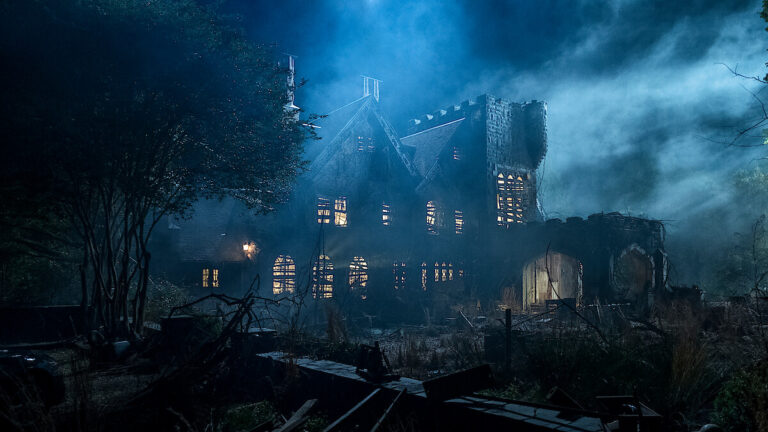
We stood utterly puzzled; and gazing at the Torr. At as much of it, at least, as could be seen–the tops of the chimneys, and the sugar-loaf of a tower shooting up to its great height amidst them. The windows of the house and its old stone walls, on which the lichen vegetated, were hidden by the clustering old trees, in full foliage then.
“Hark There it is again!”
The same horrible, low, distressing sound, something between a howl and a wail; enough to make a stout man shiver in his shoes.
“Is it a woman’s cry, Tod?”
“I don’t know, lad. It’s like a person being murdered and crying out for help.”
“Radcliffe can’t be tanning his wife.”
“Not he, Johnny. She’d take care of that. Besides, they’ve never been cat-and-dog. Birds of a feather that’s what they are. Oh, by Jove! there it comes again! Just listen to it! I don’t like this at all, Johnny. It must be witches, and nothing else.”
Decidedly it must be. It came from the air. The open fields lay around, white and still under the moonlight, and nothing was on their surface of any kind, human or animal. Now again! that awful cry, rising on the bit of breeze there was, and dying away in pain to a faint echo.
“Let us go to the Torr, Johnny, and ask Radcliffe if he hears it!”
We bounded forward under the cry, which rose again and again incessantly; but in nearing the house it seemed to get further off and to be higher than ever in the air. Leaping the gate into the lane, we reached the front-door, and seized the bell-handle. It brought Mrs. Radcliffe; a blue cap and red roses adoring her straggling hair. Holding the candle above her head, she peered at us with her small, sly eyes.
“Oh, is it you, young gentlemen? Do you want anything? Will you walk in?”
I was about to say No, when Tod pushed me aside and strode up the damp stone passage. They did not make fires enough in the house to keep out the damp. As he told me afterwards, he wanted to get in to listen. But there was no sound at all to be heard; the house seemed as still as death. Wherever the cries might come from, it was certainly not from inside the Torr.
“Radcliffe went over to Wire-Piddle this afternoon, and he’s not back yet,” she said; opening the parlour-door when we got to the hall. “Did you want him? You must ha’ been in a hurry by the way you pulled the bell.”
She put the candle down on the table. Her work lay there–a brown woollen stocking about half-way knitted.
“There is the most extraordinary noise outside that you ever heard, Mrs. Radcliffe,” began Tod, seating himself without ceremony on the old-fashioned mahogany sofa. “It startled us. Did you hear it in here?”
“I have heard no noise at all,” she answered quietly, taking up the stocking and beginning to knit standing. “What was it like?”
“An awful shrieking and crying. Not loud; nearly faint enough for dying cries. As it is not in your house–and we did not think it was, or could be–it must be, I should say, in the air.”
“Ay,” she said, “just so. I can tell you what it is, Mr. Joseph: the night-birds.”
Tod looked at her, plying the knitting-needles so quickly, and looked at me, and there was a silence. I wondered what was keeping him from speaking. He suddenly bent his head forward.
“Have you heard any talk of these noises, Mrs. Radcliffe? People say they are to be heard almost any night.”
“I’ve not heard no talk, but I have heard the noise,” she answered, whisking out a needle and beginning another of the three-cornered rows. “One evening about a month ago I was a-coming home up the lane, and I hears a curious kind o’ prolonged cry. It startled me at the moment, for, thinks I, it must be in this house; and I hastens in. No. Eunice said she had heard no cries: as how should she, when there was nobody but herself indoors? So I goes out again, and listens,” added Mrs. Radcliffe, lifting her eyes from the stocking and fixing them on Tod, “and then I finds out what it really was–the night-birds.”
“The night-birds?” he echoed.
“‘Twas the night-birds, Mr. Joseph,” she repeated, with an emphatic nod. “They had congregated in these thick trees, and was crying like so many human beings. I have heard the same thing many a time in Wiltshire when I was a girl. I used to go there to stay with aunt and uncle.”
“Well, I never heard anything like it before,” returned Tod. “It’s just as though some unquiet spirit was in the air.”
“Mayhap it sounds so afore you know what it is. Let me give you young gentlemen a drop o’ my home-made cowslip wine.”
She had taken the decanter of wine and some glasses off the sideboard with her long arms, before we could say Yes or No. We are famous for cowslip wine down there, but this was extra good. Tod took another glass of it, and got up to go.
“Don’t be frighted if you hear the noise again, now that you know what it is,” she said, quite in a motherly way. “For my part I wish some o’ the birds was shot. They don’t do no good to nobody.”
“As there is not any house about here, except this, the thought naturally arises that the noise may be inside it–until you know to the contrary,” remarked Tod.
“I wish it was inside it–we’d soon stop it by wringing all their necks,” cried she. “You can listen,” she added, suddenly going into the hall and flinging wide every door that opened from it and led to the different passages and rooms. “Go to any part of the house you like, and hearken for yourselves, young gentlemen.”
Tod laughed at the suggestion. The passages were all still and cold, and there was nothing to hear. Taking up the candle, she lighted us to the front-door. Outside stood the woman-servant Eunice, a basket on her arm, and just about to ring. Mrs. Radcliffe inquired if she had heard any noise.
“Only the shrieking birds up there,” she answered readily. “They be in full cry to-night.”
“They’ve been startling these gentlemen finely.”
“There bain’t nothing to be startled at,” said the woman, roughly, turning a look of contempt upon us. “If I was the master I’d shoot as many as I could get at; and if that didn’t get rid of ’em, I’d cut the trees down.”
“They make a queerer noise than any birds I ever heard before,” said Tod, standing his ground to say it.
“They does,” assented the woman. “That queer, that some folks believes it’s the shrieks o’ the skeleton on the gibbet.”
Pleasant! When I and Tod had to pass within a few yards of its corner. The posts of the old gibbet were there still, but the skeleton had mouldered away long ago. A bit of chain, some few inches long, adhered to its fastening in the post still, and rattled away on windy nights.
“What donkeys we were, Johnny, not to knew birds’ cries when we heard them!” exclaimed Tod, as we tumbled ever the gate and went flying across the field. “Hark! Listen! There it is again!”
There it was. The same despairing sort of wail, faintly rising and dying on the air. Tod stood in hushed silence.
“Johnny, I believe that’s a human cry!–I could almost fancy,” he went on, “that it is speaking words. No bird, that ever I met with, native or foreign, could make the like.”
It died away. But still occurred the obvious question, What was it, and where did it come from? With nothing but the empty air above and around us, that was difficult to answer.
“It’s not in the trees–I vow it,” said Tod; “it’s not inside the Torr; it can’t rise up from under the ground. I say, Johnny, is it a case of ghost?”
The wailing arose again as he spoke, as if to reprove him for his levity: I’d rather have met a ghost; ay, and a real ghost than have carried away that sound to haunt me.
We tore home as fast as our heels could take us, and told of the night’s adventure. After the pater had blown us up for being late, he treated us to a dose of ridicule. Human cries, indeed? Ghosts and witches? I might be excused, he said, being a muff; but Joe must be just going back to his childhood. That settled Tod. Of all disagreeable timings he most hated to be ridiculed.
“It must have been the old birds in those trees, after all, Johnny,” said he, as we went up to bed. “I think the moon makes people fanciful.”
And after a sound night’s rest we woke up to the bright sunshine, and thought no more of the cries.
That morning, being close to Pitchley’s Farm, we called in to see Mrs. Frank Radcliffe. But she was not to be seen. Her brother, David Skate, just come in to his mid-day dinner, came forward to meet us in his fustian suit. Annet had been hardly able to keep about for some time, he said, but this was the first day she had regularly broken down so as to be in bed.
“It has brought on a touch of fever,” said he, pressing the bread-and-cheese and cider upon us, which he had ordered in.
“What has?” asked Tod.
“This perpetual torment that she keeps her mind in. But she can’t help it, poor thing, so it’s not fair to blame her,” added David Skate. “It grows worse instead of better, and I don’t see what the end of it is to be. I’ve thought for some time she might go and break up to-day.”
“Why to-day?”
“Because it is the anniversary of her husband’s death, Master Johnny. He died twelve months ago to-day.”
Back went my memory to the morning we heard of it. When the pater was scolding Dwarf Giles in the yard, and Tod stood laughing at the young ducks taking to the water, and Stephen Radcliffe loomed into sight, grim and surly, to disclose to us the tidings that the post had brought in–his brother Frank’s death.
“Has she still that curious fancy in her, David?–that he did not come by his death fairly.”
“She has it in her, and she can’t get it out of her,” returned David. “Why, Master Johnny, it’s nothing but that that’s killing her. Ay, and that’s not too strong a word, sir, for I do believe she’ll die of it, unless something can be done to satisfy her mind, and give her rest,” he added earnestly. “She thinks there was foul play used in some way, and that Stephen Radcliffe was at the bottom of it.”
We had never heard a word about the fancy since that night when Annet first spoke of it at the stile, and supposed she had forgotten it long ago. The Squire and Mrs. Todhetley had often noticed how ill she looked, but they put it down to grief for Francis and to her anxiety about the farm.
“No, she has said no more since then,” observed David.
“She took up an idea that the Squire ascribed it to a wandering brain; and so has held her peace since.”
“Is her brain wandering, do you think?” asked Tod.
“Well, I don’t know,” returned David, absently making little cuts at the edge of the cheese with the knife. “In all other respects she is as sane as sane can be; there’s not a woman of sounder sense, as to daily matters, anywhere. But this odd fancy has got held of her mind; and it’s just driving her crazy. She says that her husband appears to her in her dreams, and calls upon her to help and release him.”
“Release him from what? From his grave in Finchley Cemetery?”
“From what indeed!” echoed David Skate. “That’s what I ask her. But she persists that, sleeping or waking, his spirit is always hovering near her, crying out to her to avenge him. She declares that it is no fancy. Of course it is, though.”
“I never met with such a case,” said Tod, forgetting the good cider in his astonishment. “Frank Radcliffe died up at Dr. Dale’s in London. Stephen could not have had anything to do with his death: he was down here at the time.”
“Well, Annet has the notion firmly fixed in her mind that he had, and there’s no turning her,” said David. “There will be no turning her this side the grave, unless we can free her from it. Anyway, the fancy has come to such a pitch now, and is telling upon her so seriously, that something must be done. If it were not that just the busiest time has set in; the hay cut, and the wheat a’most ready to cut, I’d take her to London to Dr. Dale’s. Perhaps if she heard the account of Frank’s death from his own lips, and that it was a natural death, it might help her a bit. “
We went home full of this. The Squire was in a fine way when he heard it, and brimming ever with pity for Annet. He had grown to like her; and he had always looked on Francis as in some degree belonging to him.
“Look here,” said he, in his impulsive good nature, “it will never do to let this go on: we shall have her in a mad-house too. That’s not a bad notion of David Skate’s; and if he can’t leave to take her up to London just now, I’ll take her.”
“She could not go,” said Tod. “She is in bed with low fever.”
“Then I’ll go up by myself,” stamped the Squire in his zeal. “And get Dr. Dale to write out all the particulars, and hurry down again with them to her as fast as the train will bring me. Poor thing! her disease must be a sort of mania.”
“Now, Johnny, mind you don’t make a mistake in the omnibus. Use your eyes; they are younger than mine.”
We were standing at Charing Cross in the hot afternoon sun, looking out for an omnibus that would take us westward. The Squire had lost no time in starting for London, and we had reached it an hour before. He let me come up with him, as Tod had gone to Whitney Hall.
“Here it is, sir. ‘Kensington,–Hammersmith,–Richmond.’ This is the right one.”
The omnibus stopped, and in we got; for the Squire said the sun was too fierce for the outside; and by-and-by, when the houses became fewer, and the trees and fields more frequent, we were set down near Dr. Dale’s. A large house, standing amidst a huge grass-plat, shut in by iron gates.
“I want to see Dr. Dale,” said the pater, bustling in as soon as the door was opened, without waiting to be asked.
The servant looked at him and then at me; as if he thought the one or the other of us was a lunatic about to be left there. “This way, sir,” said he to the Squire and put us into a small square room that had a blue and drab carpet, and a stand of plants before the window. A little man, with deep-set dark eyes, and the hair all gone from the top of his head, soon made his appearance–Dr. Dale.
The Squire plunged into explanations in his usual confusing fashion, mixing up many things together. Dr. Dale knitted his brow, trying to make sense of it.
“I’m sure I should be happy to oblige you in any way,” said he–and he seemed to be a very pleasant man. “But I do not quite understand what it is you ask of me.”
“Such a dreadful thing, you know, if she has to be put in a mad-house too!” went on the pater. “A pretty, anxious, hard-working little woman she is, as ever you saw, Dr. Dale! We think the account in your handwriting might ease her. I hope you won’t mind the trouble.”
“The account of what?” asked the doctor.
“Only this,” explained the Squire, laying hold, in his zeal, of the doctor’s button-hole. “Just dot down the particulars of Francis Radcliffe’s death. His death here, you know. I suppose you were an eye-witness to it.”
“But, my good sir, I–pardon me–I must repeat that I do not understand. Francis Radcliffe did not die here. He went away a twelvemonth ago, cured.”
“Goodness bless me!” cried the Squire, staggering back to a chair when he had fully taken in the sense of the words, and staring about him like a real maniac. “It cannot be. I must have come to the wrong place.”
“This is Dale House, and I am Dr. Dale. Mr. Francis Radcliffe was under my charge for some months: I can’t tell exactly how many without referring to my books; seven or eight, I think; and he then left, cured, or nearly so.”
“Johnny, hand me my handkerchief; it’s in my hat. I can’t make top or tail of this.”
“I did not advise his removal,” continued Dr. Dale, who, I do believe, thought the Squire was bad enough for a patient. “He was very nearly, if not quite well, but another month here would have established his recovery on a sure basis. However, his brother insisted on removing him, and I had no power to prevent it.”
“What brother?” cried the Squire, rubbing his head helplessly.
“Mr. Radcliffe, of Sandstone Torr.”
“Johnny, I think we must all be dreaming. Radcliffe of the Torr got a letter from you one morning, doctor–in June, I think; yes, I remember the hay-making was about–saying Francis had died; here in this house, with you: and bidding him come up to see you about it.”
“I never wrote any such letter. Francis Radcliffe did not die here.”
“Well, it was written for you by one of your people. Not die! Why, you held a coroner’s inquest on him! You buried him in Finchley Cemetery.”
“Nothing of the sort, Mr. Todhetley. Francis Radcliffe was taken from this house, by his brother, last June, alive and well.”
“Well I never–this beats everything. Was he not worn away to a skeleton before he went?–had he not heart disease?–did he not die of effusion on the brain?” ran on the Squire, in a maze of bewilderment.
“He was thin certainly: patients in asylums generally are; but he could not be called a skeleton. I never knew that he had heart disease. As to dying, he most assuredly did not die here.”
“I do think I must be lost,” cried the Squire. “I can’t find any way out of this. Can you let me see Mr. Pitt, your head assistant, doctor? Perhaps he can throw some light on it. It was Pitt who wrote the letter to Mr. Radcliffe.”
“You should see him with pleasure if he were still with me,” replied the doctor. “But he has left.”
“And Frank did not die here!” commented the Squire. “What can be the meaning of it?”
The meaning was evidently not to be found there. Dr. Dale said he could tell us no more than he had told, if he talked till night–that Francis Radcliffe was taken out by his brother. Stephen paid all charges at the time, and they went away together.
“And of course, Johnny, he is to be believed,” quoth the pater, turning himself round and round on the grass-plot, as we were going away, like a teetotum. “Dale would not deceive us: he could have no object in doing that. What in the world does it all mean?–and where is Francis? Ste Radcliffe can’t have shipped him off to Canada with the wheelbarrows!”
How the Squire whirled straight off to the train, finding one on the point of starting, and got down home again, there’s no space to tell of. It was between eight and nine, as the station clock told him, but he was in too much excitement to let the matter rest.
“Come along, Johnny. I’ll have it out with Stephen before I sleep.”
And they had it out in that same gloomy parlour at the Torr, where Tod and I had been a night or two before; frightfully gloomy to-night, for the dusk was drawing on, and hardly a bit of light came in. The Squire and Stephen, sitting opposite each other, could not see the outline of one another’s faces. Ste brazened it out.
“You’re making a hullabaloo for nothing,” said he, doggedly. “No, it’s true he didn’t die at the mad-house; he died within a week of coming out of it. Why didn’t I tell the truth about it? Why, because I knew I should get a heap o’ blame thrown back at me for taking him out–and I wished I hadn’t took him out but ’twas no good wishing then. How was I to know that the very self-same hour he’d got his liberty, he would begin drinking again?–and drink himself into a furious fever, and die of it? Could I bring him to life again, do you suppose?”
“What was the meaning of that letter you brought to me, purporting to come from Dr. Dale? Answer that, Stephen Radcliffe.”
“I didn’t bring you a letter from Dr. Dale. ‘Twas from Pitt; Dr. Dale’s head man. You read it yourself. When I found that Frank was getting unmanageable at the lodgings, I sent to Pitt, asking if he’d be good enough to come and see to him–I knew no other doctor up there; and Pitt was the best I could have, as he understood his case. Pitt came and took the charge; and I left Frank under him. I couldn’t afford to stay up there, with my grass waiting to be cut, and all the fine weather wasting itself away. Pitt stayed with him; and he died in Pitt’s arms; and it was Pitt that wrote the letter to tell me of it. You should ha’ gone up with me, Squire,” added Stephen, with a kind of sneer, “and then you’d have seen where he was for yourself, and known as much as I did.”
“It was an infamous deceit to put upon me, Stephen Radcliffe.”
“It did no harm. The deceit only lay in letting you think he died in the mad-house instead of out of it. If I’d not thought he was well enough to come out, I shouldn’t have moved him. ‘Twas his fault,” sullenly added Stephen. “He prayed me to take him away from the place; not to go away without him.”
“And where was it that he did die?”
“At my lodgings.”
“What lodgings?”
“The lodgings I stayed at while I was shipping off the things to Tom. I took Frank there, intending to bring him down home with me when I came, and surprise you all. Before I could come he was drinking, and as mad again as a March hare. Pitt had to strap him down to his bed.”
“Are you sure you did not ship him off to Tom also, while you were shipping the things?” demanded the Squire. “I believe you are crafty enough for it, Stephen Radcliffe–and unbrotherly enough.”
“If I’d shipped him off, he could have shipped himself back again, I take it,” returned Stephen, coolly.
“Where are those lodgings that he died at?”
“In London.”
“Whereabouts in London? I didn’t suppose they were in New York.”
“‘Twas near Cow Cross.”
“Cow Cross! Where in the name of wonder is Cow Cross?”
“Up towards Smithfield. Islington way.”
“You give me the address, Stephen Radcliffe. I insist upon knowing it. Johnny, you can see–take it down. If I don’t verify this to my satisfaction, Mr. Radcliffe, I’ll have you up publicly to answer for it.”
Stephen took an old pocket-book out of his coat, went to the window to catch what little light came in, and ran his finger down the leaves.
“Gibraltar Terrace, Islington district,” read he. “That was all the address I ever knew it by.”
“Gibraltar Terrace, Islington district,” repeated the pater. “Take it down, Johnny–here’s the back of an old letter. And now, Mr. Radcliffe, will you go with me to London?”
“No. I’ll be hanged if I do.”
“I mean to come to the bottom of this, I can tell you. You shan’t play these tricks on honest people with impunity.”
“Why, what do you suspect?” roared Stephen. “Do you think I murdered him?”
“I’m sure I don’t know what you did,” retorted the pater. “Find out a man in one lie, and you may suspect him of others. What was the name of the people, at these lodgings?”
Stephen Radcliffe, sitting down again, put his hands on his knees, apparently considering; but I saw him take an outward glance at the Squire from under his grey eyebrows–very grey and bushy they were now. He could see that for once in his life the pater was resolute.
“Her name was Mapping,” he said. “A widow. Mrs. Mapping.”
“Put that down, Johnny. ‘Mrs. Mapping, Gibraltar Terrace, Islington district.’ And now, Mr. Radcliffe, where is Pitt to be found? He has left Dale House.”
“In the moon, for aught I can tell,” was the insolent answer. “I paid him for his attendance when we came back from the funeral–and precious high his charges were!–and I know nothing of him since.”
We said good-night to Stephen Radcliffe with as much civility as could be called up under the circumstances, and went home in the fly. The next day we steamed up to London again to make inquiries at Gibraltar Terrace. It was not that the Squire exactly doubted Stephen’s word, or for a moment thought that he had dealt unfairly by Frank: nothing of that sort: but he was in a state of explosion at the deceit Stephen Radcliffe had practised on him; and needed to throw the anger off. Don’t we all know how unbearable inaction is in such a frame of mind?
Well. Up one street, down another, went we, in what Stephen had called the Islington district, but no Gibraltar Terrace could we see or hear of. The terrace might have been in Gibraltar itself, for all the sign there was of it.
“I’ll go down to-morrow, and issue a warrant against Ste Radcliffe,” cried the Squire, when we got in, tired and heated, to the Castle and Falcon–at which inn, being convenient to the search, he had put up. “I will, Johnny, as I’m a living man. It is infamous to send us up here on a wild-goose chase, to a place that has no name, and no existence. I don’t like the aspect of things at all; and he shall be made to explain them.”
“But I suppose we have not looked in all parts of Islington,” I said. “It seems a large place. And–don’t you think, sir–that it might be as well to ascertain where Pitt is? I dare say Dr. Dale knows.”
“Perhaps it would, Johnny.”
“Pitt would be able to testify to the truth of what Stephen Radcliffe says. We might hear it all from him.”
“And need not bother further about this confounded Gibraltar Terrace. The thought did not strike me before, Johnny. We’ll go up to Dale’s the first thing after breakfast.”
The Squire chartered a cab: he was in too much of a fever to look out for an omnibus: and by ten o’clock Dr. Dale’s was reached. The doctor was not at house, but we saw some one that the servant called Mr. Lichfield.
“Pitt?” said Mr. Lichfield–who was a tall, strong young man in a tweed suit of clothes, and had black hair parted down the middle–“Oh, he was my predecessor here. He has left.”
“Where’s he gone?” asked the Squire.
“I don’t know, I’m sure. Dr. Dale does not know; for I have once or twice heard him wonder what had become of Pitt. Pitt grew rather irregular in his habits, I fancy, and the doctor discharged him.”
“How long ago?”
“About a year, I think. I have not the least idea where Pitt is now: would be happy to tell you if I knew.”
So, there we were again–baffled. The Squire went back in the cab to the Castle and Falcon, rubbing his face furiously, and giving things in general a few hard words.
Up to Islington again, and searching up and down the streets and roads. A bright thought took the pater. He got a policeman to show him to the district sorting-house, went in, and inquired whether such a place as Gibraltar Terrace existed, or whether it did not.
Yes. There was one. But it was not in Islington; only on the borders of it.
Away we went, after getting the right direction, and found it. A terrace of poor houses, in a quiet side-street. In nearly every other window hung a card with “Lodgings” on it, or “Apartments.” Children played in the road: two men with a truck were crying mackerel.
“I say, Johnny, these houses all look alike. What is the number we want?”
“Stephen Radcliffe did not give any number.”
“Bless my heart! We shall have to knock at every one of them.”
And so he did. Every individual door he knocked at, one after the other, asking if Mrs. Mapping lived there. At the very last house of all we found her, A girl, whose clothes were dilapidated enough to have come down from Noah’s Ark, got up from her knees, on which she was cleaning the door-flag, and told us to go into the parlour while she called Mrs. Mapping. It was a tidy threadbare room, not much bigger than a closet, with “Lodgings” wafered to the middle pane of the window.
Mrs. Mapping came in: a middle-aged, washed-out lady, with pink cheeks, who looked as if she didn’t have enough to eat. She thought we had come after the lodgings, and stood curtsying, and rubbing her hands down her black-silk apron–which was in slits. Apparently a “genteel” person who had seen better days. The Squire opened the ball, and her face took a puzzled look as she listened.
“Radcliffe?–Radcliffe?” No, she did not recollect any lodger of the name. But then, nine times out of ten, she did not know the names of her lodgers. She didn’t want to know them. Why should she? If the gentlemen’s names came out incidental, well and good; if not, she never presumed to inquire after them. She had not been obliged to let lodgings always.
“But this gentleman died her–died, ma’am,” interrupted the Squire, pretty nearly beside himself with impatience. “It’s about twelve months ago.”
“Oh, that gentleman,” she said. “Yes, he did die here, poor young man. The doctor–yes, his name was Pitt, sir–he couldn’t save him. Drink, that was the cause, I’m afeard.”
The Squire groaned–wishing all drink was at the bottom of the Thames. “And he was buried in Finchley Cemetery, ma’am, we hear?”
“Finchley? Well, now yes, I believe it was Finchley, sir,” replied Mrs. Mapping, considering–and I could see the woman was speaking the truths according to her recollection. “The burial fees are low at Finchley, sir.”
“Then he did die here, ma’am–Mr. Francis Radcliffe?”
“Sure enough he did, sir. And a sad thing it was, one young like him. But whether his name was Radcliffe, or not, I couldn’t take upon myself to say. I don’t remember to have heard his name.”
“Couldn’t you have read it on the coffin-plate?” asked the Squire, explosively. “One might have thought if you heard it in no other way, you’d see it there.”
“Well, sir, I was ill myself at the time, and in a good deal of trouble beside, and didn’t get upstairs much out of my kitchen below. Like enough it was Radcliffe: I can’t remember.”
“His brother brought him–and lodged here with him–did he not?”
“Like enough, sir,” she repeated. “There was two or three of ’em out and in often, I remember. Mr. Pitt, and others. I was that ill, myself, that some days I never got out of bed at all. I know it was a fine shock to me when my sister came down and said the young man was dead. She was seeing to things a bit for me during my illness. His rantings had been pitiful.”
“Could I see your sister, ma’am?” asked time Squire.
“She’s gone to Manchester, sir. Her husband has a place there now.”
“Don’t you recollect the older Mr. Radcliffe?” pursued the Squire. “The young man’s brother? He was staying up in London two or three times about some shipping.”
“I should if I saw him, sir, no doubt. Last year I had rare good luck with my rooms, never hardly had ’em empty. The young man who died had the first-floor apartments. Well, yes, I do remember now that some gentleman was here two or three times from the country. A farmer, I think he was. A middle-aged man, sir, so to say; fifty, or thereabouts; with grey hair.”
“That’s him,” interrupted the Squire, forgetting his grammar in his haste. “Should know the description of him anywhere, shouldn’t we, Johnny? Was he here at the time of the young man’s death, ma’am?”
“No, sir. I remember as much as that. He had gone back to the country.”
Mrs. Mapping stood, smoothing down the apron, waiting to hear what we wanted next, and perhaps not comprehending the drift of the visit yet.
“Where’s that Mr. Pitt to be found?”
“Law, sir! as if I knew!” she exclaimed. “I’ve never set eyes on him since that time. He didn’t live here, sir; only used to come in and out to see to the sick young man. I never heard where he did live.”
There was nothing more to wait for. The Squire slipped half-a-crown into the woman’s hand as we went out, and she curtsied again and thanked him–in spite of the better days. Another question occurred to him.
“I suppose the young man had everything done for him that could be? Care?–and nourishment?–and necessary attendance?”
“Surely, sir. Why not? Mr. Pitt took care of that, I suppose.”
“Ay. Well, it was a grievous end. Good-morning, ma’am.”
“Good-day to you, gentlemen.”
The Squire went looming up the street in the dumps; his hands in his pockets, his steps slow.
“I suppose, Johnny, if one tried to get at Pitt in this vast London city, it would be like looking for a needle in a bottle of hay.”
“We have no clue to him, sir.”
“No. And I don’t know that it would answer any purpose if we did get at him. He could only confirm what we’ve heard. Well, this is fine news to take back to poor Annet Radcliffe!”
“I should think she had better not be told, sir.”
“She must know it some time.”
The Squire sent for David Skate when we got home, and told him what we knew; and the two marched to the Torr in the blazing June sun, and held an interview with Stephen Radcliffe. Ste was sullen and reserved, and (for him) haughty. It was a mistake, of course, as things turned out, his having taken Frank from the asylum, he admitted that, admitted he was sorry for it, but he had done it for the best. Frank got drinking again, and it was too much for him; he died after a few days of delirium, and Pitt couldn’t save him. That was the long and the short of the history; and the Squire and Skate might make the best and the worst of it.
The Squire and Skate were two of the simplest of men; honest-minded themselves, and unsuspicious of other people. They quitted the Torr for the blazing meadows, on their road home again.
“I shall not say anything about this to Annet,” observed David Skate. “In her present frame of mind it would not do. The fever seems better, and she is up, and about her work again. Later perhaps we may tell her of it.”
“I wish we could have found Pitt,” said the Squire.
“Yes, it would be satisfactory to hear what he has to say,” replied David. “Some of these days, when work is slack, I’ll take a run up to London and try and search him out. Though I suppose he could not tell us much more than the landlady has told.”
“There it is,” cried the Squire. “Even Johnny Ludlow, with his crotchets about people and his likes and dislikes, says he’s sure Mrs. Mapping might be trusted; that she was relating facts.”
So matters subsided, and the weeks and our holidays went on together. Stephen Radcliffe, by this act of deceit, added another crooked feather to his cap of ills in the estimation of the neighbourhood; though that would not be likely to trouble him. Meeting Mr. Brandon one day in the road, just out of Church Dykely, Stephen chanced to say that he wished to goodness it was in his power to sell the Torr, so that he might be off to Canada to his son: that was the land to make money at, by all accounts.
“You and your son might cut off the entail, now poor Francis is gone,” said old Brandon, thinking what a good riddance it would be if Stephen went.
“I don’t know who’d buy it–at my price.” growled Stephen. “I mean to got shut o’ them birds, though,” he added, as an afterthought. “They’re not entailed. They’ve never cried and shrieked as they do this summer. I’d as soon have an army of squalling cats around the place.”
“The noise is becoming a subject of common talk,” said old Brandon.
Ste Radcliffe bit his lips and turned his face another way, and emitted sundry daggers from his looks. “Let folks concern themselves with their own business,” said he. “The birds is nothing to them.”
Four weeks had gone by, and the moon was nearly at the full again. Its light streamed on the hedges, and flickered amidst the waving trees, and lay on the fields like pale silver. It was Sunday evening, and we had run out for a stroll before supper, Tod and I.
On coming out of church, Duffham had chanced to get talking of the cries. He had heard them the previous night. They gave him the shivers, he said, they were so like human cries. This put it into our heads to go again ourselves, which we had not done since that first time. How curiously events are brought about!
Leaping the last stile, the Torr was right before us at the opposite side of the large field, the tops of its chimneys and its towering sugar-loaf tower showing out white in the moonlight. The wind was high, blowing in gusts from the south-west.
“I say, Johnny, it’s just the night for witches. Whirr! how it sweeps along! They’ll ride swimmingly on their broomsticks.”
“The wind must have got up suddenly,” I answered. “There was none to-day. It was too hot for it. Talking of witches and broomsticks, Tod, have you read–“
He put his arm out to stop my words and steps, halting himself. We had been rushing on like six, had traversed half the field.
“What’s that, Johnny?” he asked in a whisper. “There”–pointing onwards at right angles. “Something’s lying there.”
Something undoubtedly was–lying on the grass. Was it an animal?–or a man? It did not look much like either. We stood motionless, trying to make the shape out.
“Tod! It is a woman.”
“Gently, lad! Don’t be in a hurry. We’ll soon see.”
The figure raised itself as we approached, and stood confronting us. The last puff of wind that went brushing by might have brushed me down, in my surprise. It was Mrs. Francis Radcliffe.
She drew her grey cloak closer round her and put her hand upon Tod’s arm. He went back half a step: I’m not sure but he thought it might be her ghost.
“Do not think me quite out of my mind,” she said–and her voice and manner were both collected. “I have come here every evening for nearly a week past to listen to the cries. They have never been so plain as they are to-night. I suppose the wind helps them.”
“But–you–were lying on the grass, Mrs. Francis,” said Tod; not knowing yet what to make of it all.
“I had put my ear on the ground, wondering whether I might not hear it plainer,” she replied. “Listen!”
The cry again! The same painful wailing sound that we heard that other night, making one think of I know not what woe and despair. When it had died away, she spoke further, her voice very low.
“People are talking so much about the cries that I strolled on here some evenings ago to hear them for myself. In my mind’s tumult I can hardly rest quiet, once my day’s work is done: what does it matter which way I stroll?–all ways are the same to me. Some people said the sounds came from the birds, some said from witches, some from the ghost of the man on the gibbet: but the very first night I came here I found out what they were really like–my husband’s cries.”
“What!” cried Tod.
“And I believe from my very soul that it is his spirit that cries!” she went on, her voice taking as much excitement as any voice, only half raised, can take. “His spirit is unable to rest. It is here, hovering about the Torr. Hush! there it comes again.”
It was anything but agreeable, I can assure you, to stand in that big white moonlit plain, listening to those mysterious cries and to these ghostly suggestions. Tod was listening with all his ears.
“They are the very cries he used to make in his illness at the farm,” said Mrs. Radcliffe. “I can’t forget them. I should know them anywhere. The same sound of voice, the same wail of anguish: I could almost fancy that I hear the words. Listen.”
It did seem like it. One might have fancied that his name was repeated with a cry for help. “Help! Frank Radcliffe! Help!” But at such a moment as this, when the nerves are strung up to concert pitch, imagination plays us all sorts of impossible tricks.
“I’ll be shot if it’s not like Frank Radcliffe’s voice!” exclaimed Tod, breaking the silence. “And calling out, too.”
“Thank you,” said Mrs. Francis. “I shall not be able to bear this long: I shall have to speak of it to the world. When I say that you have recognized his voice also, they will be less likely to mock at me as a lunatic. David did, when I told him. At least, I could make no impression on him.”
Tod was lying down with his ear to the ground. But he soon got up, saying he could not hear so well.
“Did Stephen kill him do you think?” she asked, in a dread whisper, drawing closer to us. “Why, else, should his poor unquiet spirit haunt the region of the Torr?”
“It is the first time I ever heard of spirits calling out in a human voice,” said Tod. “The popular belief is, that they mostly appear in dumb show.”
He quitted us, as he spoke, and went about the field with slow steps, halting often to look and listen. The trees around the Torr in particular seemed to attract his attention, by the lengths of time he stared up at them. Or, perhaps, it might be at the tops of the chimneys: or perhaps at the tapering tower. We waited in nearly the same spot, shivering and listening. But the sounds never came so distinctly again: I think the wind had spent itself.
“It is a dreadful weight to have to carry about with me,” said poor Annet Radcliffe as we walked homewards. “And oh! what will be the ending? Will it be heard always?”
I had never seen Tod so thoughtful as he was that night. At supper he put down his knife and fork perpetually to fall into a brown study; and I am sure he never knew a word of the reading afterwards.
It was some time in the night, and I was fast asleep and dreaming of daws and magpies, when something shook my shoulder and awoke me. There stood Tod, his nightshirt white as snow in the moonlight.
“Johnny,” said he, “I have been trying to get daylight out of that mystery, and I think I’ve done it. “
“What mystery? What’s the matter?”
“The mystery of the cries. They don’t come from Francis Radcliffe’s ghost, but from Francis himself. His ghost! When that poor soft creature was talking of the ghost, I should have split with laughter but for her distress.”
“From Francis himself! What on earth do you mean?”
“Stephen has got him shut up in that tower.”
“Alive?”
“Alive! Go along, Johnny! You don’t suppose he’d keep him there if he were dead. Those cries we heard to-night were human cries; words; and that was a human voice uttering them, as my ears and senses told me; and my brain has been in a muddle ever since, all sleep gone clean out of it. Just now, turning and twisting possibilities about, the solution of the mystery came over me like a flash of lightning. Ste has got Frank shut up in the Torr.”
He, standing there upright by the bed, and I, digging my elbow into the counterpane and resting my cheek on my hand, gazed at one another, the perplexity of our faces showing out strongly in the moonlight.

No Comments