
Last week, I wrote a brief piece mostly intended for my domestic market and we were commenting the draft for the new standard on the professions of BIM, disciplining tasks, knowledge and skills for BIM Managers, BIM Coordinators, BIM Specialists of each discipline, the CDE Manager and two new figures: the BIM/GIS Specialist and the BIM Tendering Specialist. The technical standards, as intended by the committee drafting them, aren’t a snapshot of what professionals know and do, but they aim to be a benchmark of excellence for the categories. As such, you’ll be a seasoned BIM Manager, look at some of the tasks, and think “heck, even I don’t know what that is.” I’m not saying I agree with the approach: I’m just stating this as a fact. That being said, one particular detail struck my fellow countrymen’s imagination: the CDE Manager needs to be able to create Data Lakes. And a question resonated through hills and valleys:
What the fuck’s a data lake?
I did a bit of digging, and this week we answer that question, because it all started as a pun and I eventually discovered that it’s worth talking about this.

1. Here There Be Data Lakes
Do you remember a few weeks ago, when we talked about maps and how ancient cartographers used to place monsters to signal no one had gone there before? Well, those same monsters appeared last week in a training session where someone raised their hand and asked me to address the elephant in the room: the new skills listed as arrows in the quiver of a CDE Manager. Aside from anxiety connected to KPIs and Data Analysis, the butt of everyone’s joke was a data lake, ’cause no one could explain what that was. Including me. Me being me, I promised I’d do some research and come back with an answer. And boy oh boy, it wasn’t what I expected.
Let’s start with what the draft actually says. The CDE Manager is defined as a professional “with Data Science skills” (3.14). Among their tasks, they must “create, where necessary, Data Lakes and Data Warehouses for the purpose of predictive activities” (T111). They must “know Data Lakes and Data Warehouses” (K15) and “be able to manage” them (S15). And, while they’re at it, they “could contribute to formulating predictive analyses on processes and products”. (The translations are mine: there’s no official English version, of course, and I tried to be faithful).
Note the “where necessary”. To be fair, nobody is asking every CDE Manager to dig a lake on their first Monday. But the standard does ask them to know what one is, to be able to run one, whatever that means, and to build one when the time comes. Which brings us back to the question from the back of the room: what is that thing we’re talking about?
Here’s the twist I didn’t see coming: the reason nobody in that room could explain what a data lake is isn’t that we’re old people behind the times; it’s that, outside our industry, people have been arguing about it for fifteen years. The term was (1) born in a blog post, (2) adopted by vendors who couldn’t agree on what it meant, (3) declared a fallacy by Gartner four years later, and has since (4) spawned swamps, lakehouses and a whole vocabulary of water metaphors that would make a hydraulic engineer weep. The joke, it turns out, was on solid ground. Or rather, on very wet ground.

So, what I’m offering here is a field guide, cryptozoologist style. We’ll go back to the original sighting of the creature, learn to tell the different bodies of water apart (tools included, because if the standard wants professionals to manage these things, we’d better know what they’re made of), check the few confirmed sightings in AEC, and then wade into the swamps where most of these projects end up. And along the way I’ll argue something that surprised me more than anything else: a CDE and a data lake aren’t two steps on the same path. They’re almost opposite ideas about what to do with information. Asking one person to be the guardian of the first and the builder of the second says something.
Grab your boots and your binoculars.

2. Into the Wild: the original sighting
Every cryptid villain has an origin story, and this one is surprisingly well documented. October 2010, Hadoop World, New York. Pentaho, a business intelligence company, announces its first Hadoop release, and its CTO, James Dixon, writes a short blog post to go with it. That’s it. That’s the habitat where the creature was first spotted: not a peer-reviewed paper, not a standard, but a product launch where a guy comes up with a term to try and illustrate an idea.
The post itself is modest: Dixon had been talking to companies using Hadoop, and he lists what they had in common: most of them (80–90%, he says) were dealing with structured or semi-structured data, not unstructured; the data typically came from a single application or system; there were some known questions to ask of it; there were many unknown questions that would come up in the future, and several groups of people who’d want to ask them. And there was simply too much of it to fit, technically or economically, into a traditional relational database. It was 2010. Relational databases were still the centre of the universe, and I was significantly happier for it.
The usual way to handle this, he explains, was to pick the most interesting attributes and aggregate them into what he calls a data mart. That has two problems: you only look at a subset of the attributes, so you can only answer the questions you predicted, and you lose sight of the lowest levels of detail ’cause the data is aggregated.
Hence the image. If a data mart is “a store of bottled water – cleansed and packaged and structured for easy consumption”, the data lake is a large body of water in its natural state, fed by a source, where different users can come to examine it, dive in or take samples.

Let’s try and read that again with AEC eyes. The data mart might contain the schedule someone exported from the model with the twelve attributes they thought you’d need, or the dashboard built on them. It works perfectly, right up until the day someone asks question number thirteen. The lake, in Dixon’s original sense, is keeping the full detail of that one model, raw, so that question number thirteen can still be answered. One source. Mostly structured data. No promise of magic.
That’s not what we got.
By the end of 2013, consulting firms and vendors like Booz Allen Hamilton, Capgemini and Pivotal had started using the term for their own proprietary solutions, and the lake grew deeper with each telling. Then Gartner weighed in, in July 2014, with a report titled “The Data Lake Fallacy: All Water and Little Substance”: by that point, data lakes were being marketed as “enterprise-wide data management platforms for analyzing disparate sources of data in its native format”. Note the shift: from one source to disparate sources, from one system’s detail to the whole enterprise. Gartner’s verdict was that vendors didn’t even share a common view of what a data lake was. Their main concern, which we’ll come back to when we wade into the swamps, was that without descriptive metadata and someone maintaining it, a lake would turn into a swamp. Their advice: focus on semantic consistency upstream, rather than consolidating everything downstream in a lake.
Dixon himself, a couple of years later, tried to rein it in: the idea, he said, had always been to put only what you need into Hadoop. Too late. The creature had already changed shape, and every sighting since then has looked slightly different from the last.
Which is why, before we go looking for one in AEC, we need to learn to tell the waters apart.

3. Know your waters
Before we go hunting for our lake creature, we need a field guide, and we need to understand words that data people use as if they were obvious. To be fair, once you see them side by side, they mostly are. The trick is understanding one question: when do you decide what your data looks like? Before you store it, or when you read it? Everything else follows from that.
So, let’s map how water flows, starting from the origin.
The spring: the operational database. This is where data is born and lives day to day: the system that records a transaction, an issue, a timesheet entry. It’s built to write and update small things very quickly and very reliably, not to answer big questions across years of history. Think of the database behind your issue tracker.
The reservoir: the data warehouse. Data is pulled from the spring, cleaned, reshaped and loaded into carefully designed tables, all before anyone is allowed to query it. This is called schema-on-write: you decide the structure first, and data that doesn’t fit doesn’t get in. It’s reliable and fast for the questions it was designed for, and expensive to change when the questions change. The classic tools were on-premises databases. Today, the names you’ll hear are cloud warehouses like Snowflake, Google BigQuery and Amazon Redshift. In AEC terms: a company-wide dashboard of project costs, hours and milestones, fed every night from accounting and project control.
The bottle: the data mart. A small, curated slice of the warehouse for one department or one purpose. It’s Dixon’s bottled water, and in our world it’s every report and dashboard built on twelve carefully chosen parameters.
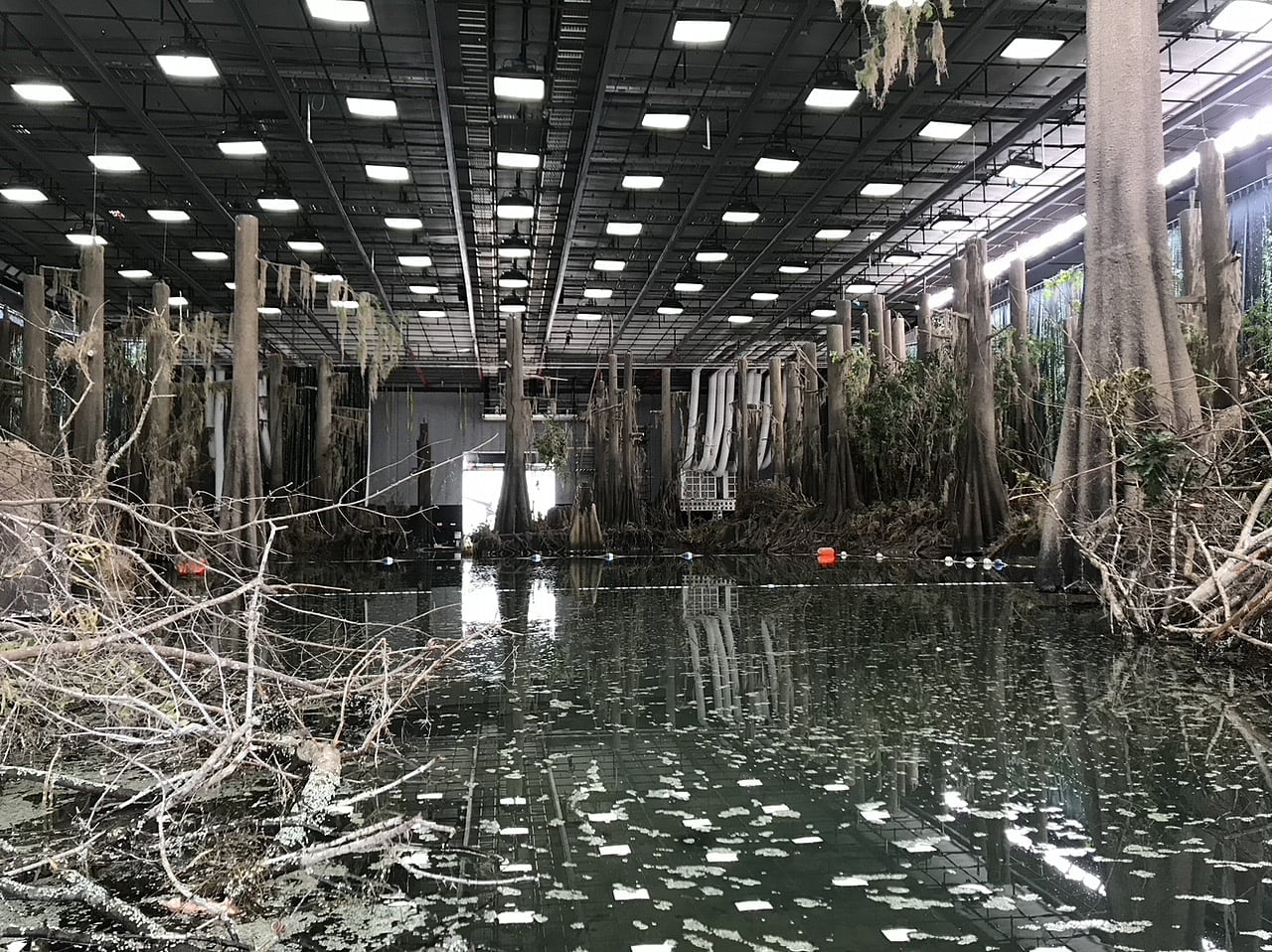
The lake. Here the logic flips. You store data first, raw, in whatever form it arrives, and decide its structure only when you read it: schema-on-read. Physically, a data lake is usually cheap cloud object storage, such as Amazon S3, Azure Data Lake Storage or Google Cloud Storage, full of files. Some of those files are in efficient analytical formats like Apache Parquet, which stores data by column so you can scan millions of rows quickly. Others are whatever you threw in: CSVs, JSON, logs, PDFs, images. To query it, you bring an engine to the water: Apache Spark for heavy processing, Trino or Presto for SQL, DuckDB for lighter work on your own machine.
Or so I’m told by people who understand this stuff.
The AEC translation is where it gets interesting. Take a file with data structured following the IFC scheme. It’s a container designed for exchange: a rich, hierarchical description of one model at one moment, meant to be opened and read as a whole. Now imagine instead a Parquet table with one row per element and one column per property, for every model your firm has produced in ten years. With the IFC, the question “how many fire doors have we specified in hospitals since 2018, and how often did they change after tender?” means opening hundreds of files one by one. With the table, it’s one query. That’s the promise of the lake. The catch, which we’ll meet in the swamps, is that someone has to make sure “fire door” means the same thing in every one of those rows.

The lake house. By the late 2010s, most large companies were running both a lake and a warehouse, copying data from one to the other and fighting to keep them consistent. The lakehouse is the attempt to merge them, formally described by Databricks co-founders in a 2021 paper. The idea is to keep the cheap, open files of the lake and add, on top of them, the guarantees of a warehouse: transactions that either complete or don’t, schemas that are enforced, a history you can go back to. This is done by open table formats: Delta Lake (open-sourced by Databricks), Apache Iceberg (born at Netflix) and Apache Hudi (born at Uber). They’re essentially a layer of metadata that turns a folder of Parquet files into something that behaves like a database table. The platforms built around them are Databricks, Snowflake (which now reads and writes Iceberg tables) and Microsoft Fabric, whose OneLake stores everything as Delta tables.
The watershed: the data mesh. Not a technology but an organisational idea, proposed by Zhamak Dehghani in 2019. Instead of one central team running one central lake, each domain owns its data and publishes it as a product for others, with shared rules and a common platform underneath. It’s worth knowing for one reason: it was the industry admitting that the hard part of all this is not where you put the water, but who’s responsible for it.
So that’s the full map: spring, reservoir, bottle, lake, lake house, watershed. Notice what changes as you move along it: the technology gets cheaper and more flexible, and the responsibility for making sense of the data moves later and later, from the moment you store it to the moment you read it. Keep that in mind, because it’s the key to everything that follows.
Now, let’s go hunting.
4. Confirmed Sightings of Data Lakes
To be fair to the creature, it does exist. There are documented sightings in AEC, and the two best ones are recent, both from late 2025, both come from the United States, both involve very large organisations, and both were reported by people with something to advocate, so we’ll handle them with the usual cryptozoologist’s caution.
Sighting one: HOK and the IDC. Greg Schleusner, director of design technology at HOK, has been arguing for years that our industry should stop treating BIM as a file-based activity and start treating it as data infrastructure. His view, as reported by AEC Magazine, is that project data is the industry’s most valuable asset, but it’s scattered across formats and locked behind proprietary files and metered APIs. Files, in other words, are poor containers for what we now want to do with them.
Schleusner sits on the executive committee of the Innovation Design Consortium, a public-benefit corporation whose members come mostly from the AIA’s Large Firm Roundtable: the biggest practices in the US. What they’re building is a lake house for AEC: extraction utilities, schema definitions, integrations and proof-of-concept pipelines, with Revit, Archicad and Tekla models published into a shared, vendor-neutral space. The principle is “single export, multi-use”: extract the data once, into open Parquet tables managed with Iceberg, and let every tool read it from there. Exactly the stack we met in the previous section.
The interesting part is where it gets stuck, because of course it does. Schleusner’s ideal is to stream BIM objects into the database as they’re authored, rather than exporting files after the fact. When he asked Autodesk whether Revit could do that, the answer was an unambiguous NOPE: Revit’s core is largely single-threaded and wasn’t built to emit changes as they happen. And the whole architecture is still in development, to be adopted by members when it’s ready.
Sighting two: Suffolk Construction and Speckle. The second sighting comes from a contractor, and from a blog post by Speckle, so it’s partly a sales pitch. Suffolk’s team includes a Director of Design AI and a BIM Data Engineer, two job titles almost nobody in construction had ten years ago: their pipeline collects model data from authoring tools and Autodesk Construction Cloud, cleans and normalises it, and stores it centrally, where it can be tagged and analysed at scale. It also serves people outside the design team (estimators, planners, superintendents) who would otherwise be working from PDFs.
The use case presented is wonderfully concrete and the stuff of horror stories. Two architects model the walls of the same room in two different ways, with different parameters, categories and materials. Before an estimator can price that room, someone has to decide that those are both “a wall of this type”, and an AI step suggests a single cost code for each element. Asked how it works in practice, the data engineer admits it’s “realistically, a lot of copy-paste”, because the source data is messy and inconsistent. The team is described as small. No numbers are given: no savings, no time reductions, no project counts. For the life of me, I can’t understand why you wouldn’t tackle this by enforcing a fucking standard, but here we are.

What the sightings have in common:
- these are very large organisations with the money and the scale to make the investment worth it;
- they’re run by dedicated people, often in roles that didn’t exist before: nobody is doing this as a side task between one CDE audit and the next;
- the hard part isn’t storage, storage is cheap: the hard part is normalisation, making “wall” mean the same thing across models, firms and years;
- both are still more promise than proof: one is an architecture in development, the other a set of goals without published results.
None of this means they’re wrong. Both are serious attempts by serious people, and I hope they succeed, but they tell us what a real data lake in AEC looks like: a strategic programme run by a team, in an organisation large enough to afford one.
And for every lake that’s been photographed, how many have quietly turned into something else?

5. Data Swamps
Every lake has a dark side, and Gartner gave it a name in that same 2014 report: without descriptive metadata, and without someone maintaining it, a data lake risks becoming a data swamp. A lake stores everything, in fact, but it doesn’t tell you what anything means, where it came from, who touched it last or whether it can be trusted. Gartner also pointed out the assumption hidden in the vendors’ pitch: that everyone using the lake would be a skilled data analyst, able to make sense of raw data on their own. Most people aren’t. Most organisations aren’t. Arguably, no one is without having that data’s context.
How often does it happen? Here we need to tread carefully, because the numbers that get quoted everywhere are slippery: back in 2016, which is ten years ago, Gartner estimated that 60% of big data projects failed; a year later analyst Nick Heudecker called that “too conservative” and put the figure closer to 85%. These are estimates about big data projects in general, not data lakes specifically, and the methodology was never published. So I won’t tell you that 85% of data lakes fail. I’ll tell you that for years the people paid to watch this market thought most of these projects weren’t delivering, and nobody argued otherwise.

And before you tell me “this was before AI”, the most useful recent look at the problem comes from a paper published this June, “What Went Wrong with Data Lakes? A 15-Year Reality Check from the Field”. Its author, Youssef Gahi, draws on 64 sources and close to 500 field reality checks from financial services and telecom projects, gives the swamp a working definition with measurable indicators, catalogues seven recurring anti-patterns, and offers an explanation that has nothing to do with technology: governance debt. It’s the compounding cost of governance decisions that organisations keep postponing. What goes in, what it means, who owns it, how long it’s kept, who can see it: every decision you don’t take when the data arrives becomes a debt you pay, with interest, when someone tries to use it.
Two more of his findings are worth keeping in our Wunderkammer. First, when governance gets hard, organisations tend to drift back towards structured, warehouse-style approaches, a phenomenon he calls governance gravity. Second, the newer architectures, lakehouse and data mesh, have advanced technically, but the organisational track record has barely improved. Better boats, same swamp.

If I have to confess something about our industry, we don’t need to build a data lake to have a swamp. Most of us already have one. It’s called the project archive: years of folders on a server, models saved as “FINAL_rev3_def_USE THIS”, exports nobody remembers making, naming conventions that changed with every project leader, and a vague belief that it’s all in there somewhere. Every one of those files was stored without anyone deciding what it meant, which is the definition of a lake. And every attempt to get something useful out of it ten years later is paying back the debt.
Which brings us to the question that surprised me most while writing this: if a swamp is what happens when you postpone decisions about information, what do we call the system whose whole purpose is to not postpone them?

6. The CDE is not a lake
Let’s go back to the question at the end of the swamp: what do we call a system whose whole purpose is to not postpone decisions about information? In our industry, we call it a Common Data Environment as defined by the standards.
As we know, ISO 19650-1 defines the CDE as the “agreed source of information” for a project or asset, used to collect, manage and disseminate each information container “through a managed process”, key words being agreed and managed. Not all the information, and not in its natural state. The unit of the CDE is the information container, defined as a named, persistent set of information which, importantly, can be a model, a document, a schedule or a database (3.3.12). So this isn’t about files versus data. It’s about something else.
The Italian version, interestingly, started from a slightly different place. UNI 11337-5, published a year before ISO 19650 in 2017, describes the ACDat (our acronym for the CDE) as an IT infrastructure for collecting and managing data in an organised way, together with its own procedure of use. Data, not containers. Among its requirements are support for a wide range of data formats and high query flows with easy extraction of data through open protocols, which sounds almost like a lake. Almost. Because the same clause also asks for access according to pre-established rules, a traceable history of revisions, and, among the expected benefits, less redundancy and fewer risks from duplicated data. Which is the exact opposite of pouring everything in and sorting it out later.
And there’s a detail in UNI 11337-1 that the drafters of the new part 7 might have considered superseded (since part 1 is currently under revision too): the series defines the CDE as the environment for the organised collection and sharing of data “for a single work or a single complex of works” (3.2.1). One project, in other words. For collecting data across many works, across a whole production chain, the same series uses a different term entirely: the digital collaboration platform (3.2.4). So in our own vocabulary, the thing that most resembles a data lake (data from every project, pooled to be analysed) isn’t a CDE at all. It has a different name, a different scope and, presumably, different people looking after it.
Now let’s see how a CDE actually works. The heart of it is the workflow in clause 12 of ISO 19650-1. Every current revision of every container sits in one of three states: work in progress, shared or published. An archive keeps a journal of everything that has been shared and published, as an audit trail. And the passage from one state to the next is a decision:
- Check, review and approve: before a container leaves the work in progress state, its own task team compares it against the delivery plan and the agreed standards (12.3).
- Review and authorise: before it becomes published, it’s compared against the information requirements for coordination, completeness and accuracy (12.5). Authorisation is what separates information you can rely on from information that can still change.
- Metadata: every container carries a revision code and a status code showing what it can be used for, and using it for anything else is, in the standard’s own words, at the user’s risk (12.1).
ISO 19650-2 turns this into requirements the appointing party must meet when it sets up the project CDE (5.1.7):
- a unique ID for every container, built on an agreed and documented convention;
- status, revision and classification attributes;
- recorded state transitions, with the user’s name and the date;
- access controlled at container level.
And of course it recommends having the CDE in place before going to tender.
Now put this next to Dixon’s lake. In the lake, data streams in raw and users come to examine it like gazelles at the pond, dive in or take samples, deciding for themselves what it means. In the CDE, nothing reaches anyone else until its author has checked it, and nothing becomes reliable until someone has authorised it. The lake postpones the decision about what information means and whether it can be trusted, and leaves it to whoever reads it. The CDE takes that decision upfront, and writes down who took it. One is schema-on-read. The other is something like trust-on-write.
In my view, they’re not two steps on the same path. They’re two opposite answers to the same question.
This doesn’t mean they can’t coexist, and here the standards are more open-minded than you’d think: ISO 19650-3, on the operational phase, says explicitly that it “does not specify or preclude the use of particular storage technologies”, provided those technologies support the CDE workflow (5.1.11). It goes further: it asks that the asset information model be able to separate information used for analysis and reporting from information being updated by delivery teams. And, among the processes to maintain it, it includes archiving or disposing of obsolete, unreliable or unwanted information (5.1.12). Throwing things away, on purpose, is the exact opposite of a swamp.
The Italian standard even drew it, back in 2017. In UNI 11337-5’s diagram of the ACDat information flow, what the appointed parties produce goes through coordination, then approval and verification, then sharing and archiving, and only at the very end is there an arrow labelled “extraction for reprocessing”. Extraction comes after approval.

So the standards already tell us where a lake could fit: downstream of the CDE, fed by information that has gone through its states, with the CDE’s metadata telling you what each piece is and how far it can be trusted. That’s Gartner’s 2014 advice, semantic consistency upstream, written into our information management standards. It’s also the answer to my earlier question about Suffolk’s walls: the CDE is the place where you enforce standards. A lake fed by a governed CDE has a chance. A lake built instead of one is a swamp waiting to happen.
Which makes the draft UNI 11337-7 even stranger. Its own family of standards already described the ACDat manager as someone who manages and maintains the environment, its data and the databases connected to it, within the boundaries of a single work, and drew analysis and extraction downstream of approval. The new draft keeps the name, stretches the environment to the whole organisation, adds “Data Science skills” and asks the same person to create lakes for predictive purposes. As if the word “data” in the acronym were an invitation rather than a responsibility.
7. What the CDE Manager actually needs
There’s an ironic bit, as Alanis Morrisette would sing. Go back to the swamp, and take a look at Gahi’s governance debt as the cost of decisions nobody took when the information arrived: what it is, what it means, who owns it, how long it’s kept, who can see it. Now go back to the CDE. Every one of those decisions is exactly what a CDE is built to take, container by container, state by state. The thing that stops a lake from becoming a swamp is the CDE Manager’s actual job.
And it’s the part the draft says least about. And it’s the part I need we need to bring back.
To be fair, it isn’t absent: the draft asks the CDE Manager to know and apply classification systems and shared vocabularies for the semantic structuring of information (K114, S114), to know open data models and exchange protocols, openCDE included (K113, K115, K116), and to sort information coming from multiple sources while preserving its uniqueness, security and traceability (K16). That’s good, and it’s the right direction. But look at what isn’t there, or is there only as a vague “know the level of workflow management in the CDE” (K11):
- States and gates. Knowing how to design and run the transitions between work in progress, shared, published and archive, and who is entitled to authorise what. This is the heart of the job, and the draft doesn’t name it.
- Naming and identity. Unique IDs built on an agreed convention, codified fields, the kind of discipline ISO 19650-2 requires from day one. Without it, no lake will ever know that two files are the same thing, or that two things are not.
- Status and revision metadata. What each piece of information can be used for, and how far it can be trusted. This is precisely the metadata whose absence Gartner said would turn lakes into swamps.
- Ownership. Who is responsible for each piece of information, and who is allowed to change it. ISO 19650-1 is clear that this stays with whoever produced it.
- Retention and disposal. How long information is kept, and when it’s archived or thrown away, on purpose. ISO 19650-1 asks for the retention timescale to be defined in the information requirements, and ISO 19650-3 lists disposal of obsolete and unreliable information among the processes to maintain the asset information model.
- Long-term preservation. Keeping information readable and accessible over decades, which the Ministry’s guidelines consider a qualifying feature of the CDE.
- The hand-over to analysis. Deciding what leaves the CDE towards a warehouse, a lake or a collaboration platform, in which state, with which metadata, so that whoever receives it knows what it is. That’s the one genuinely new competence the data age asks of a CDE Manager, and it’s the one that would make a lake possible.
None of these requires Data Science skills. All of them are what makes data science possible later.
So where does that leave the data lake? I’d draw the line like this: knowing what a data lake, a warehouse and a lakehouse are, absolutely, a CDE Manager should be able to sit at a table with a data engineer, understand what they’re asking for and know what the CDE can and can’t give them. That’s K15, and I’d keep it. Managing one, building one, for predictive purposes: no. That’s a different job, done by a different team, in the organisations that can afford it. And it rests entirely on whether the CDE Manager has done their own job first.
My instinct is that if we ask a CDE Manager to build a lake, we’ll get a swamp with very good intentions. Ask them to run a CDE that a lake could safely drink from, and you’ll have done something far more useful for the industry, and far more realistic for the person.







No Comments