
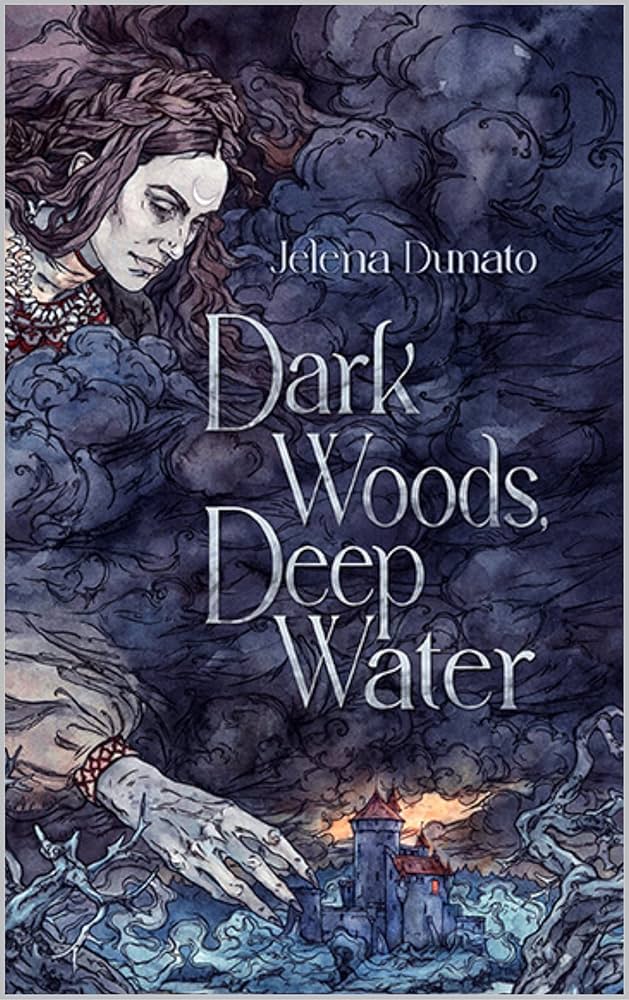
I’m doing some catching up on old reads, and here’s another one. I don’t know the author, this time, but I bought the book because of the publisher, which often associates it with the stunning “Winter Harvest” by Ioanna Papadopoulou, and the association is on point: “Dark Woods, Deep Water” is a mythological horror imbued with a lore of choice, which this time is Slavic folklore. It won’t be a delight for connoisseurs as Papadopoulou’s work but it will have its perks.
The story kind of revolves around Morana, here the goddess of death and particularly linked to winter, death by water, and that murky feeling that dying has nothing pleasant or glorious about it. Other deities will make their appearance: Perun, the Zeus-like father god of the sky, and Lela, here goddess of the hunt.
The story unfolds following the points of view of three different characters: the secretary to a heroic prince bound to duty, a con girl with a knack for surviving, and the romantic daughter of a low nobleman. The three plots start very slowly, I won’t deny it: if you want advice, you’ll have to push through until the con girl saves the child. At a certain point, the weaving of plots will start to intrigue you: are they connected? And how? Might this character be that character?
Two things I didn’t like, though.
The main one is that the atmosphere in the castle is gorgeous, but I feel the book would have needed a hundred pages more. The buildup doesn’t have enough time to breathe, and resolution comes way too quickly. The character of the lady goes from being a young, hopeful girl in love to being a lady trapped in a nightmare but we only actually see the first part of the transformation and, while I understand why the book’s structure demanded it, I would have liked to stay with her a little longer, and maybe see her snap out of it. Also the husband could have used a little more space, and I regretted not getting to see whether his rebirth changed him.
A secondary point is that all characters, with the possible exception of the secretary, are completely unlikable. There isn’t one I could bring myself to give a single fuck about; their destiny didn’t matter to me in the end, and I shrugged away some important character development without much thought.
Also, I feel a connection between a couple of characters might have been developed and then axed during editing: at a certain point, I was convinced we would see again the child Ida saves from the fever, all grown up, and I was disappointed it didn’t tie up that neatly.
Still, an enjoyable read with splendid atmospheres and a good example of why we need diverse and more varied voices in fantasy and science fiction.





No Comments