
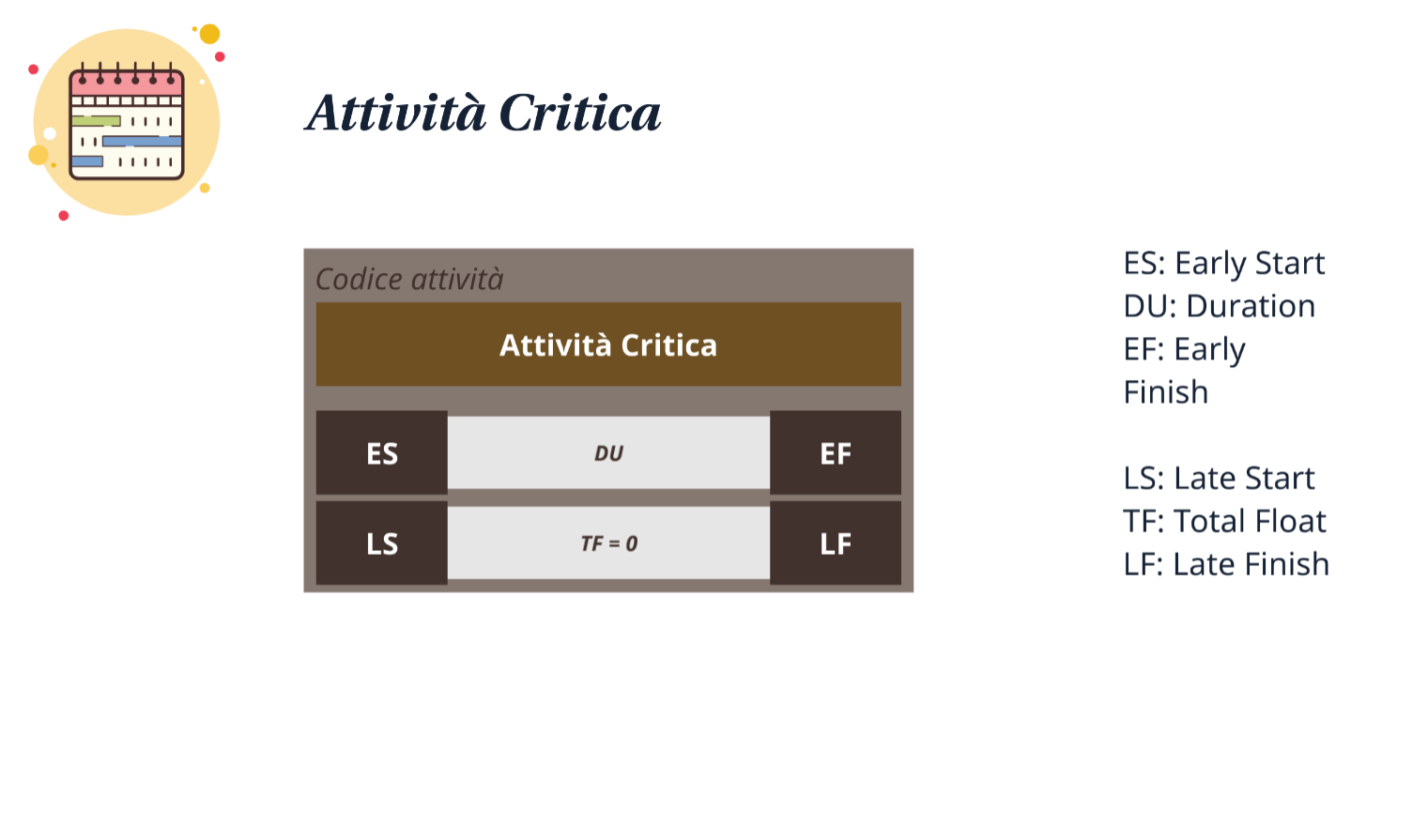
Nella definizione delle tempistiche connesse a un’attività, l’individuazione del percorso critico richiede in prima battuta l’individuazione di tre valori:
- ES: Early Start – la prima data di inizio ragionevole e possibile per quell’attività;
- DU: Duration – la durata;
- EF: Early Finish – la conseguente data di termine delle lavorazioni sulla base della data di inizio e della durata.
Questo però non è sufficiente: si tratta di una stima ottimistica. Il secondo passaggio richiede di procedere a ritroso con l’individuazione di altri tre valori, in ordine di individuazione:
- LF: Late Finish – l’ultima data utile per terminare la lavorazione senza che il suo ritardo abbia un impatto sul resto dei lavori;
- LS: Late Start – l’ultima data utile per iniziare la lavorazione, indipendentemente dalla sua durata, senza che altre lavorazioni connesse subiscano slittamenti che abbiano impatti significativi sulla durata dei lavori;
- TF: Total Float – lo scostamento generale tra early start e late start, tra early finish e late finish.

Un’attività si definisce non critica, quindi, quando esiste un certo grado di tolleranza sui ritardi che essa può subire per quanto riguarda la data di inizio o di fine.

Un’attività critica, viceversa, è un’attività che non consente margine di errore. L’insieme e la concatenazione di attività con queste caratteristiche costituisce il percorso critico, il campo minato lungo il quale nulla può andare storto.
Per riferimento su una trattazione estesa di questi argomenti, il libro di Antonio Ortenzi già citato settimana scorsa o il libro di Alberto Pavan edito da Tecniche Nuove.
A questo punto è importante ricordare che la maggior parte dei software di BIM authoring (incluso Revit) non implementano la dimensione temporale. La data può essere:
1. un testo;
2. un numero (strano);
3. un print dal clock di Windows.
I software che gestiscono le date (ovvero che sono in grado di effettuare operazioni di somma/sottrazione/confronto tra due date) operano tendenzialmente in due modi:
1. caricando un calendario e agendo con un indicatore “float” (si riconoscono perché ad esempio consentono di gestire la lunghezza della settimana e gestiscono correttamente le festività);
2. trasformando la data in un numero.
Software che apparentemente sono in grado di gestire una data, spesso si comportano diversamente. E’ il caso di Microsoft Excel, ad esempio (vedere qui).
«Excel stores date and time values as serial numbers in the back end.
This means that while you may see a date such as “10 January 2020” or “01/10/2020” in a cell, in the back-end, Excel is storing that as a number.
In Microsoft Excel for Windows, “01 Jan 1900” is stored as 1, “02 Jan 1900” is stored as 2, and so on».




No Comments