
Artemisia Gentileschi (July 8, 1593 – c. 1656) is one of the most famous Italian Baroque painters, whose work often outmatches contemporary celebrated geniuses like Caravaggio. A victim of violence herself, and a target of public shame following the trial of her assailant, her works are often mythological of biblical scenes in which women are rebelling against abuse. It’s the case of Judith Slaying Holofernes (1614-1620, currently in the Uffizi Gallery in Florence), where the scene of the beheading is depicted in a far less clean and detached way, compared to works by her contemporaries.
She worked in Florence as a court painter for the Medici and was the first woman to enter the Academy of Drawing, initiating a significant relationship with both powerful patrons of the time, as the Grand Duchess of Tuscany Christina of Lorraine, and influential figure of the Florentine scene, like Galileo Galilei.
From about 1616 to 1620, she entertained an affair with a wealthy nobleman of the city, an affair her husband was so aware that he himself corresponded with the same man on the back of Artemisia’s love letters. The rest of Florence, however, was not as open as them and they were eventually forced to relocate to Rome when rumours of the affair started to spread.
Artemisia had already been in Rome prior to the assault and the consequent trial, but this time she came back as an accomplished and successful artist. In spite of being excluded from papal commissions (possibly because Pope Urban VIII believed a woman would not have the strength to carry out the large-scale paintings he wanted), she worked for many private patrons. Works like Susanna and the Elders (1622) and the Venus and Cupid currently at the Virginia Museum of Fine Arts (1625-30) are from this period.
Between 1626 and 1627 she moved to Venice, where she was dedicated verses of praise for her talent and she produced works like Esther before Ahasyerus, now at the Metropolitan Museum of Art. Her Venetian stay is shaded in mystery and lasted three or four years, before she moved again and this time she went to Naples, possibly at the invitation of the Duke of Alcalá who already owned some of her paintings. A painting of dying Cleopatra (below) comes from this period.
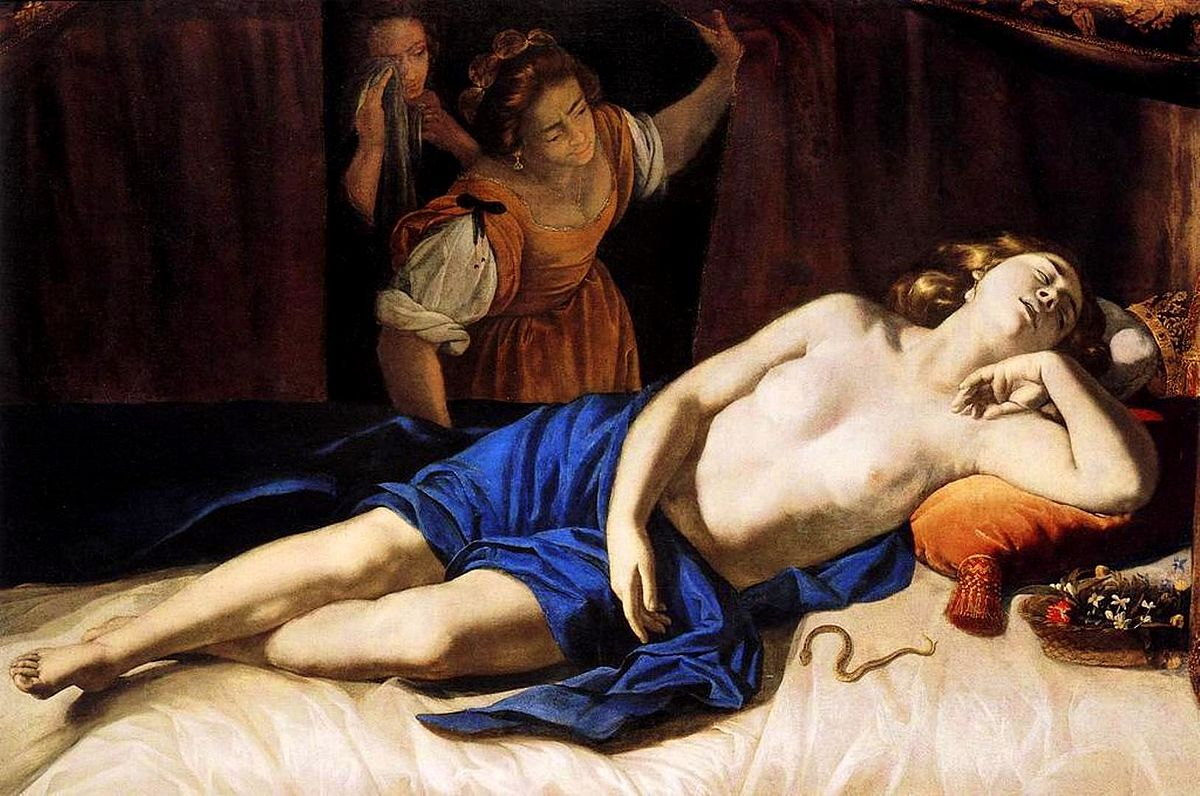
In 1638, she joined her father in London: Orazio was a court painter for Charles I and was working on a ceiling in the Greenwich house built for Queen Henrietta Maria. The King was an admirer of her and owned probably the most significant of her works: the Self-Portrait as the Allegory of Painting. Artemisia stayed in London till 1642, three years after her father’s death, and fulfilled several commissions, before returning to Naples to flee the Civil War that was just starting between English Royalists and Parliamentarians.
There’s little news of her death: the most accepted suggestion is that she died in Naples during the 1656 plague outbreak.
The painting depicting the rape of Lucretia is dated between the London stay and her return to Naples.

Artemisia Gentileschi
The Rape of Lucretia (1645-50)






No Comments