
Who’s afraid of the Big Bad Bricks?
You wouldn’t believe it, but there’s a question I get asked, in various forms, every single time I introduce LEGO Serious Play to a professional audience. Sometimes it comes as a practical concern: “Do we really need the LEGO, or can we use something else?” Sometimes it arrives as a logistical objection: “We don’t have budget for your travel expenses: can’t we do it with Post-its?” Occasionally, it’s more honest than that: “My team would feel ridiculous playing with toys in a meeting.”

The question changes shape depending on who’s asking, but the underlying anxiety is always the same: something about the bricks specifically makes people uncomfortable. Not the methodology. Not the theory. Not the idea of building physical models or telling stories about them. The damn bricks. The colourful, slightly childish, unmistakably playful LEGO bricks.
I find this interesting, because nobody asks whether you really need the whiteboard, or whether the flip chart could be replaced by a nice verbal discussion. Nobody suggests that the PowerPoint slides are making people feel ridiculous. Even post-its are accepted, and they are colourful. The bricks, however, require justification.
I want to be precise about what kind of question “can’t we do it without LEGO?” actually is. It sounds like a question about resources, or practicality, or professional decorum. It isn’t. It’s a question about whether the play mode is strictly necessary, whether the colourful, tangible, three-dimensional, slightly undignified quality of the whole thing is doing real work, or whether it’s just decorative. Whether you could achieve the same strategic outcomes by keeping everyone safely in their chairs, in their suits, in the mode of interaction they’re used to.
The short answer is no. The longer answer is what this week’s article is about.
In the two previous pieces in this series, I built the case for what LEGO Serious Play is and why it works: the origin in a strategic crisis at LEGO in the 1990s, the intellectual lineage through Piaget, Papert, Holland, and von Krogh and Roos, the theory of strategic imagination and its three interacting types, the capacity of physical building to surface mental models that language alone keeps invisible. What I didn’t fully answer — and I said so explicitly at the end of the second piece — is the “why LEGO?” question. Why these bricks, this medium, this particular mode of engagement. Why not clay, or pipe cleaners, or wooden blocks, or indeed Post-its.
The answer requires a detour through play theory that I’ve been putting off, partly because it takes some unpacking and partly because “let me explain the philosophy of play to you” is a sentence that makes even the most patient reader slightly nervous. But it turns out the philosophy of play is exactly where the answer lives. The discomfort executives feel about the bricks isn’t incidental to how the methodology works: it’s diagnostic of it. The bricks need to be bricks. They could be something else, of course, but not many things carry the same practicality and versatility for the play mode to stay play mode. And by the end of this, we’ll know precisely why, and why the manager who wants to do it with Post-its is, without knowing it, are asking to remove the one thing that makes the whole thing function.
Part I — Returning to the Question
1.1. What Roos and Victor actually changed
To answer the question properly, we need to go back again to the theoretical core of the methodology, and specifically to a 2004 paper by Johan Roos, Bart Victor, and Matt Statler published in Long Range Planning, titled “Playing Seriously with Strategy.” This is one of the papers that constitute the intellectual foundation of LEGO Serious Play as a methodology rather than just a practice, and the key concept it introduces is simple: the idea that every strategy-making process operates under two kinds of constraint:
- The medium: the materials and channels through which strategy gets made and communicated. In a conventional strategy process, the medium is a fairly narrow repertoire: conversations, documents, presentations, spreadsheets. Text. Numbers. Graphs. Everything is two-dimensional, and most of it is verbal.
- The mode: the dimensions of human experience that the strategy process actually engages. Again, in a conventional setting, this is quite narrow: cognitive activity predominates. People think, analyse, assess. They sit still. They talk. The social and emotional dimensions of experience are present, of course — anyone who has been in a tense strategy meeting knows perfectly well that emotions are in the room — but they’re suppressed rather than engaged, managed rather than used.
Roos, Victor and Statler’s central insight was that both of these constraints shape what content can emerge from a strategy process. The medium determines what kinds of ideas can be expressed and shared. The mode determines which parts of human intelligence are brought to bear. Change the constraints, and you change what’s possible.
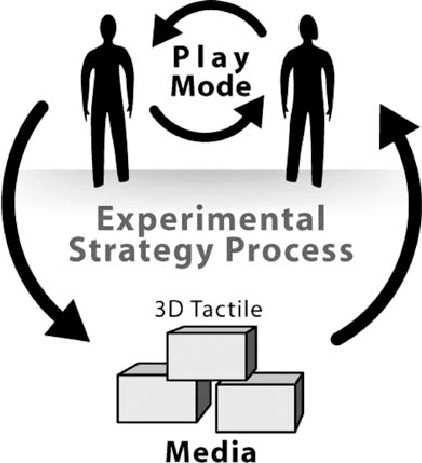
And they knew what they were talking about. By adding LEGO bricks to the medium — three-dimensional, tactile, physical — they shifted the mode from deliberate and uni-dimensional (cognitive) to emergent and multi-dimensional (cognitive, social, and emotional simultaneously), and they observed that the content generated changed. Participants produced insights that the same people, in the same room, working on the same problem through conventional means, hadn’t produced. The strategies that emerged were more original. The commitment to them was more genuine.
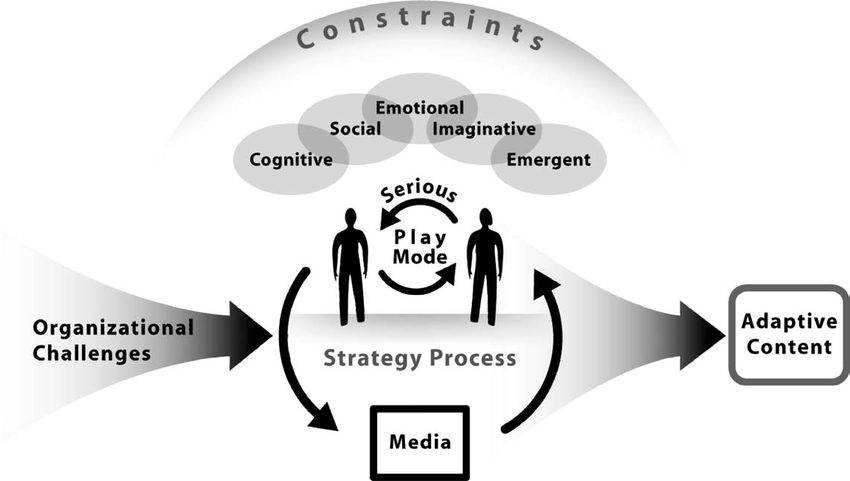
What we’ll unpack here is why those two specific changes produced those results: changing the medium to LEGO is one thing, but why does LEGO specifically activate the play mode? And what does the play mode actually do that the conventional work mode doesn’t? To answer that, we need to talk about play. Which means we first need to agree on what play is. And that, as it turns out, is considerably more complicated than it sounds.
1.2. You Can’t Answer “Why LEGO” Without First Answering “What Is Play”
The previous two articles in this series covered the cognitive science of building: why physical construction engages the brain differently from verbal reasoning, why externalising a mental model in three dimensions makes it visible and challengeable in ways that language doesn’t, why the hand-brain relationship is a feature rather than a distraction. That’s the medium side of the argument.
What those articles didn’t cover is the mode side. What specifically happens when people enter play mode? What changes, cognitively and socially, when the frame of an activity shifts from work to play? Why does that shift matter, and is it really a shift, or is “play” just a label we put on workshops to make them feel less threatening?
To answer those questions, we need to spend some time with people who have thought about play seriously. Which, appropriately enough, turns out to be a surprisingly contested and ideologically loaded undertaking.
Part II — The Trouble With Play
2.1. Everyone knows what Play is, and Everyone is Wrong
Here is the problem with play theory: everyone who has ever tried to define play has ended up defining something slightly different, and the differences reflect genuinely incompatible ideas about what play is for, who it belongs to, and what it says about the people doing it.
I could start with Plato through Socrates, but we’ll get back to that later. For now, let’s settle with Brian Sutton-Smith, a New Zealand-born scholar who spent most of his career at the University of Pennsylvania and is probably amongst the most rigorous theorists play has ever had. He spent decades trying to synthesise the field and eventually concluded, in his 1997 book The Ambiguity of Play, that the chaos was irreducible. Different disciplines — biology, psychology, anthropology, education, philosophy — don’t just have different theories of play: they have different objects. When an evolutionary biologist talks about play, and when a philosopher of culture talks about play, they’re not describing the same phenomenon and then disagreeing about its properties: they’re describing different things and calling them by the same name. Which generates part of the academic mess of play theory in the first place.
Sutton-Smith’s solution was to stop looking for the unified theory and start mapping the ideological frameworks — he called them “rhetorics” — through which play has been understood and justified at different times and in different contexts. He identified seven:
- play as fate;
- play as power;
- play as community identity;
- play as frivolity;
- play as progress;
- play as the imaginary;
- play as the self.
Each rhetoric has its own history, its own institutional advocates, its own preferred forms of play, and its own reasons for valuing (or dismissing) play in the first place.
For our purposes, two of these rhetorics matter enormously. The first is the rhetoric of the imaginary: the understanding of play as a space for possibility, transformation, and the exploration of futures that don’t yet exist. This is the rhetoric that underpins LEGO Serious Play as a strategic methodology: the idea that play creates conditions in which people can think about what isn’t yet real as if it were, and in doing so generate genuinely new strategic options rather than just repackaging existing ones.
The second, and more immediately relevant to the conversation, is the rhetoric of frivolity: the deep cultural reflex that treats play as the opposite of serious work, as something inherently trivial, unproductive, and slightly embarrassing for adults. This is the rhetoric that makes executives uncomfortable with LEGO bricks in a meeting room, and it’s worth being precise about what it actually is: not an observation about play, but a power move that protects the existing mode of work from challenge. When someone says “my team would feel ridiculous,” they’re not describing an immutable fact about adult psychology: they’re invoking a cultural norm that designates certain activities as serious and others as not, and using that norm to foreclose a challenge to the way things are done. They’re also probably talking less about the team and more about themselves. The rhetoric of frivolity isn’t neutral. It has reactionary interests.
Sutton-Smith’s insight is that recognising a rhetoric for what it is — a culturally embedded narrative, not a description of reality — is the first step to being able to choose differently. We don’t have to accept the frivolity frame. But to refuse it convincingly, we need a better account of what play actually is.
2.2. Huizinga’s Magic Circle, and why the Paradox is the Point
The best starting point for that account is still Johan Huizinga‘s Homo Ludens, published in 1944 and still the foundational text of play theory despite — or perhaps because of — the fact that Huizinga was a historian of culture rather than a psychologist or game designer, and was therefore less interested in what play does to individuals than in what it has done to civilisations.
Huizinga’s central argument is radical: play is not a secondary phenomenon that exists alongside culture, but a primary one that underlies it. Law, war, poetry, ritual, philosophy, Huizinga argues, have their roots in play, and retain playful elements even in their most serious manifestations. Yeah, even war, and you’d know it if you ever worked with the army. Any army. Homo ludens — the playing human — is as fundamental a category as homo sapiens or homo faber.
For our purposes, the most useful thing Huizinga does is identify the formal characteristics that make play recognisable across all its different manifestations. Play, in his account, is:
- voluntary: it cannot be compelled without ceasing to be play;
- bounded in time and space, with a clear beginning and end and a physical or conceptual precinct within which its rules apply;
- governed by rules that are freely accepted but absolutely binding within the frame;
- accompanied by a particular quality of absorption and tension that distinguishes it from routine activity.
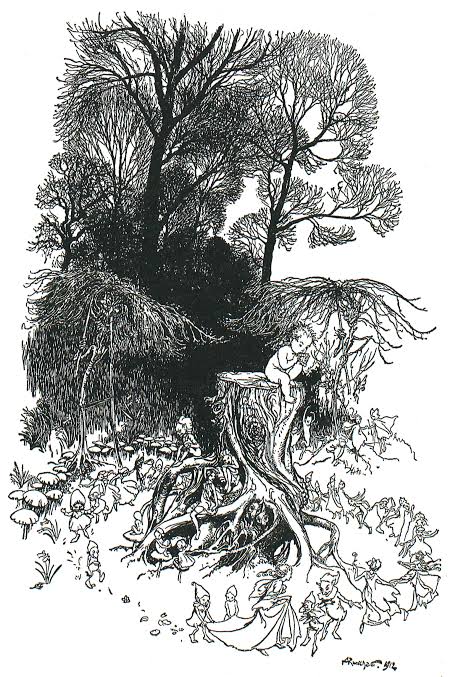
This spatial and temporal boundary — the circle within which play operates and outside which its rules don’t apply — Huizinga calls the magic circle, and it’s the concept that matters most for understanding what happens in a LEGO Serious Play session. The magic circle describes a genuine structural feature of play, the way in which the play frame creates a temporarily separate reality with its own logic, its own stakes, and its own social norms. Inside the circle, a brick can be a CEO, a supply chain bottleneck, or a competitive threat. Outside the circle, it’s a toy. The circle is what makes the difference.
The most important thing Huizinga says about this, however, is something he’s careful not to resolve: play is “not serious” — its outcomes don’t carry the social penalties of the real world — and yet it absorbs participants intensely and utterly. These two properties are in tension, and Huizinga insists that the tension is not a problem to be solved but the essential quality of play itself. The not-seriousness is what makes the intense absorption sustainable, and the intense absorption is what makes the not-seriousness productive rather than merely frivolous. Remove either pole, and you don’t get a more efficient version of play: you get something else entirely.
This is the first part of the answer to why the play mode can’t be substituted with something more comfortable: the magic circle needs to be genuinely separate from ordinary work life, which means it needs to feel different, to involve different materials, to require different behaviour. A workshop that feels exactly like a meeting, with the same chairs and the same slides and the same hierarchy and the same social costs for being wrong, is not inside a magic circle. It’s just a meeting. And a meeting, whatever its other virtues, is not going to do what the play mode does.
2.3. Serious Play: What the Adjective is actually doing
If Huizinga establishes that play is “not serious,” then the phrase “LEGO Serious Play” starts to look like a deliberate paradox and it is, though not in the way most people assume. The word serious in the methodology’s name isn’t there to reassure nervous executives that this isn’t really play, or to signal that the facilitator is going to maintain decorum. It’s doing something much more precise than that.
In a 2009 paper titled — with characteristic directness — “Ain’t Misbehavin’: Taking Play Seriously in Organizations,” Statler, Roos and Victor mount an explicit challenge to the dominant organisational logic that treats play as frivolous and therefore marginal. Their argument is that play in organisations has been systematically misunderstood because it has been evaluated against the wrong criteria, and that what’s needed is a theoretical framework that takes play seriously on its own terms rather than measuring it against the standards of conventional work. To that end, they propose a definition of play in organisational contexts built around three properties: play is imaginative, ethical, and autotelic.
Imaginative and ethical we’ve encountered before, at least in spirit: they map fairly directly onto the creative and challenging dimensions of strategic imagination developed last week. But autotelic is the one that does the most distinctive work here, so it’s worth dwelling on it, starting with a definition: an autotelic activity is one whose goal is contained within the activity itself. The point of doing it is the doing, not some external outcome it’s supposed to produce. Play is autotelic in the sense that people play because playing is satisfying, not because they’re trying to reach a destination beyond the play. Which sounds, in an organisational context, like exactly the kind of thing a serious person should find suspicious. A waste of time, some might say.
And yet this is precisely the property that makes the play mode strategically valuable. In a conventional strategy session, the output is under constant political pressure: every idea, every model, every intervention is evaluated not just for its strategic merit but for what it implies about the person who proposed it, whose position it supports or undermines, whether it makes the CEO look prescient or foolish. The stakes of the output aren’t just organisational — they’re personal and political — and that pressure systematically deforms the thinking that goes into producing it. People advocate for positions they can defend rather than ideas they believe, and the result is a strategy that reflects the organisation’s political landscape more faithfully than its actual strategic situation.
The autotelic quality of play short-circuits this. When the activity is its own point — when everyone in the room is oriented toward the building and the making rather than the outcome and its political implications — the pressure on the output drops dramatically, and people think differently as a result. The “serious” in LEGO Serious Play isn’t a reassurance that the stakes are low: it’s a signal that the methodology has found a way to keep the intellectual and organisational stakes high while suspending the social and political penalties that normally distort strategic thinking. That’s a much harder thing to do than it sounds, and it’s why the mode matters as much as the medium.
Part III — What the Play Mode does
3.1. Potential Space: what opens up when the Frame shifts
We have established, then, that the magic circle creates a temporary frame with its own rules and its own social logic, and that this frame is structurally distinct from the ordinary mode of work in ways that matter for what becomes cognitively and socially possible inside it. But saying that the frame changes things is not the same as explaining what it changes, or how. For that, we need to make a short detour into psychoanalytic theory, which I promise is less alarming than it sounds.

Donald Winnicott was a British paediatrician and psychoanalyst who spent most of his career at the Paddington Green Children’s Hospital in London, working with children and mothers, and thinking very carefully about what he observed. In 1971, he published Playing and Reality, in which he developed the concept he is now most associated with: potential space. The idea is this: between the inner reality of the individual — their private world of thoughts, feelings, fantasies, and models of how things work — and the outer reality of the shared world, there exists a third zone, neither purely subjective nor purely objective, which Winnicott describes as an intermediate area of experiencing. He calls it potential space because it’s the zone where things become possible that couldn’t be either purely imagined or purely real: the space where the invented and the discovered are not yet separated, where what you make and what you find are the same thing.
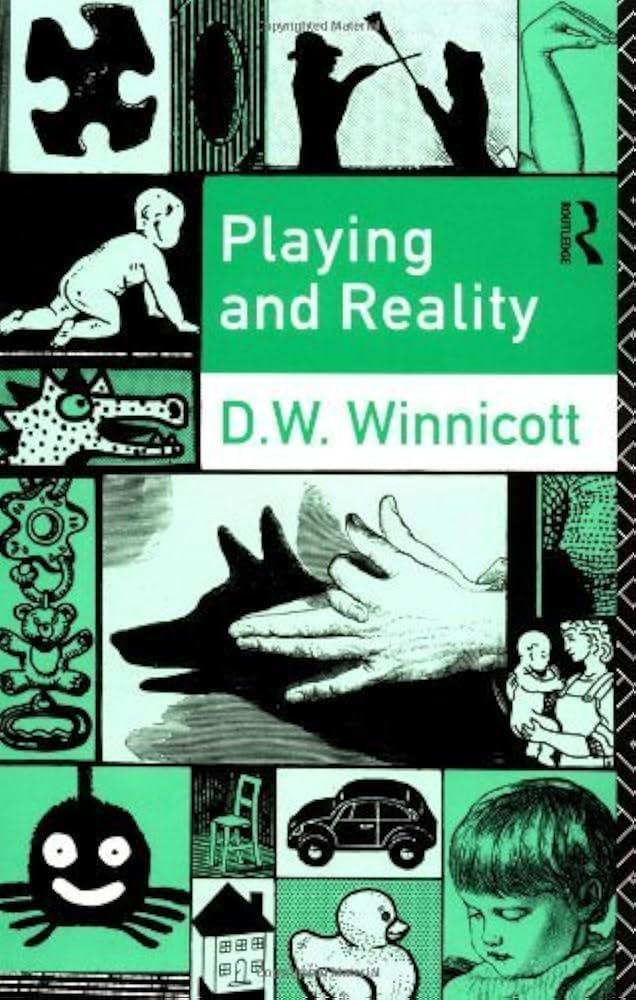
For Winnicott, this is where play happens and, crucially, it’s also where creativity happens, where cultural experience happens, where psychotherapy happens. His claim is strong and worth stating directly: “It is in playing and only in playing that the individual child or adult is able to be creative and to use the whole personality.” Not in analysis or work. Not in deliberate rational effort. In play. In the potential space that play creates and inhabits.
What makes potential space possible, however, is not just the existence of a frame or a set of rules. Winnicott is specific about this: potential space opens up only under conditions of sufficient safety and trust. In his developmental account, the infant can only begin to play — can only begin to use the intermediate zone between self and world — when there is a reliable, dependable environment that the infant has learned to trust. Without that foundation of confidence, the intermediate zone doesn’t open: the individual either retreats into pure inner reality (fantasy disconnected from the world) or collapses into pure outer reality (compliance without genuine engagement). The potential space requires a holding environment, Winnicott’s term for the set of conditions — relational and material — that make exploration safe enough to attempt.

The organisational implication of this is slightly uncomfortable but highly significant. It means that you cannot mandate creative thinking in a strategy session any more than you can mandate play in a child who doesn’t feel safe. The frame has to actually hold. The conditions have to be genuinely present, not performed. And this is where the question of what the magic circle is made of — what material, what medium, what set of structural features — stops being merely aesthetic and becomes genuinely consequential.
3.2. Why People say in Play Mode what they won’t say in Work Mode
This is where Amy Edmondson arrives, though with a slightly different argument than the one she’s usually cited for.
Edmondson is a professor at Harvard Business School whose 1999 paper, “Psychological Safety and Learning Behavior in Work Teams,” introduced the construct of psychological safety, defined as the shared belief, held by members of a team, that the team is safe for interpersonal risk-taking. Her original finding was counterintuitive: when she studied hospital nursing teams, the higher-performing teams reported more errors, not fewer. Not because they were making more mistakes, but because they felt safe enough to surface them. The lower-performing teams weren’t making fewer errors: they were just hiding them. Psychological safety, it turned out, was the variable that determined whether a team could learn from what was actually happening, or whether it was condemned to perform competence it didn’t have.

The way Edmondson’s work is usually applied in organisational development is as a cultural and leadership question: leaders must model vulnerability, invite participation, respond productively to bad news, and build — over time, through sustained behaviour — an environment in which people feel safe enough to speak honestly. This is all correct, and none of it is fast. Building psychological safety as a team climate is genuinely difficult work, and most organisations don’t manage it.
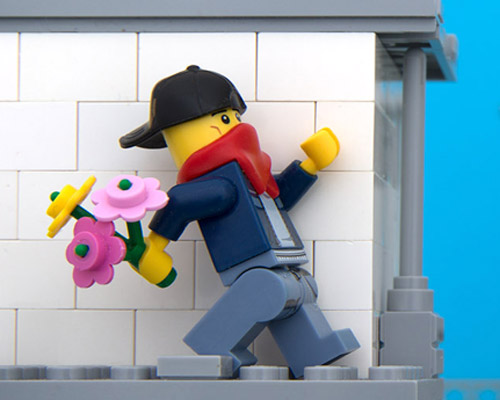
What LEGO Serious Play does, however, is something structurally different from building a psychologically safe climate, as it doesn’t rely on trust accumulated over time, or on a leader modelling the right behaviours. It engineers the material conditions under which interpersonal risk-taking becomes structurally less costly, through the physical properties of the medium itself. When your contribution to a strategy discussion takes the form of a LEGO model — a three-dimensional arrangement of bricks that can be disassembled in ten seconds and rebuilt differently — the material cost of being wrong is trivialised in a way that no amount of cultural work can fully replicate. You are not defending a position. You are not staking your professional credibility on an argument. You are building something that is, by definition, provisional, malleable, and easy to revise. The bricks absorb the risk.
This still doesn’t fully answer why it has to be LEGO specifically, rather than some other physical and revisable medium. That answer lives in the next section, and in an idea from a developmental psychologist that turns out to be the most precise account of what LEGO bricks actually do when you put them in an adult’s hands and ask them to build their organisation’s strategy.
Part IV — The Pivot: why Meaning needs an Object
4.1. Vygotsky’s Stick
We have now established what play mode is, structurally and socially, and what it does to the people inside it. What we haven’t yet established is why LEGO bricks specifically — rather than clay, or wooden blocks, or pipe cleaners, or indeed Post-its — are the right medium for activating and sustaining it. The answer to that question lives in developmental psychology, and specifically in an observation made by Lev Vygotsky about a child playing with a stick.

Vygotsky was a Soviet psychologist working in the 1920s and 1930s whose ideas about learning, language, and development were largely suppressed during his lifetime and didn’t reach Western audiences in any systematic way until decades after his death. When they did, they turned out to be remarkably generative not just for education, where his influence is now enormous, but for anyone trying to understand how human beings use objects to think with. The specific observation that matters for us appears in a 1933 lecture, later published as something along the lines of “The Role of Play in Development,” in which Vygotsky is trying to explain what happens cognitively when a child picks up a stick and uses it as a horse.
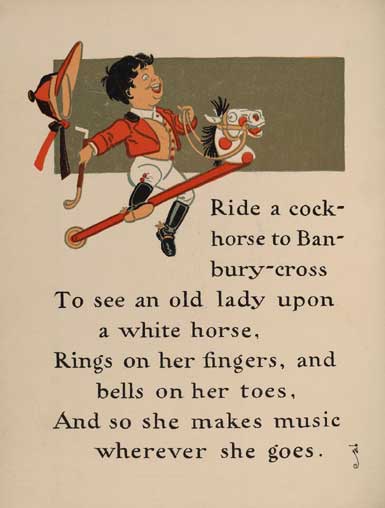
The obvious interpretation is that the stick represents the horse, that the child is using the stick as a symbol, the way a word represents a concept. But Vygotsky argues this is wrong, or at least importantly incomplete. The child, he says, is not yet capable of the kind of free symbolic substitution that adults take for granted: you cannot give a preschooler a postcard and tell them it’s a horse, because nothing in the postcard enables the action of riding. What makes the stick work as a horse is not that it looks like one, or that the child has decided to treat it as one in the abstract, but that it is the right kind of object for the action of riding — it has the right shape, the right size, the right physical affordance — and it is through the action of pretending to ride it that the meaning “horse” gets detached from any actual horse and made available as a free-standing concept.
Vygotsky calls the object that enables this meaning-detachment a pivot. The pivot is the material anchor that makes it possible to think about something that isn’t there, not by representing it symbolically but by enabling an action that embodies its meaning. The stick doesn’t mean “horse”: it does horse, and in the doing, the concept becomes mobile.
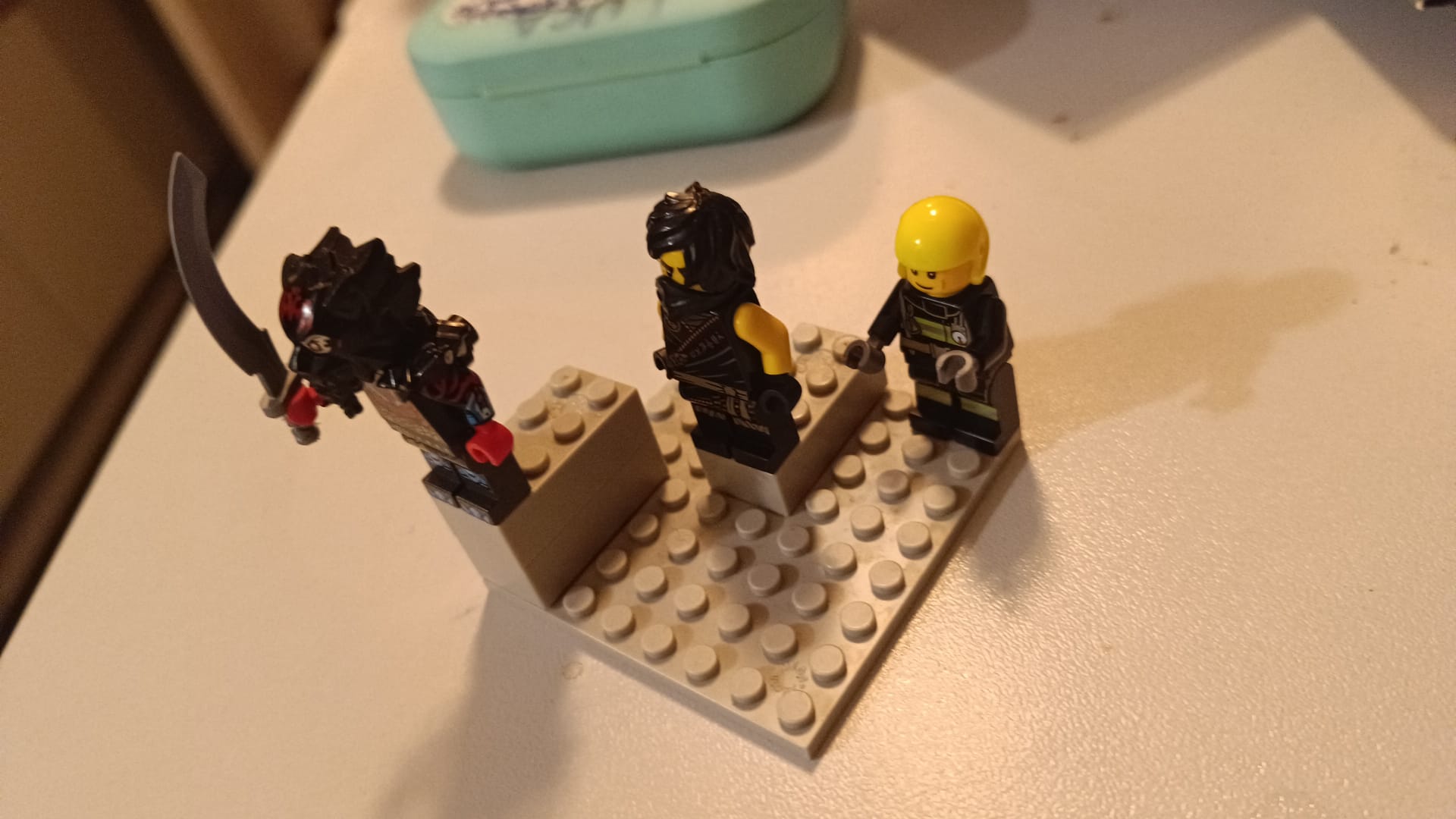
This distinction — between representing a meaning and enabling an action that embodies it — turns out to be exactly the distinction we need to explain what LEGO bricks do in a strategy session that Post-its don’t. A Post-it note is a symbol: you write a word on it, stick it on the wall, and it stands for whatever the word says. A LEGO brick is a pivot: you choose it because of its colour, its weight, its position relative to other bricks, its physical properties in space, and through the act of placing it and building around it, meaning emerges from the doing rather than being assigned in advance. The brick doesn’t represent the supply chain bottleneck: it is the supply chain bottleneck, in the sense that it sits there, red and heavy, blocking the flow of everything around it, and when you look at it you don’t need the word “bottleneck” to know what it means, because the model shows you.
4.2. The “As-If” Frame and the Imaginary Situation
Vygotsky’s pivot concept does something else that’s important beyond explaining the mechanics of meaning-making: it helps explain why the “as-if” frame is cognitively productive rather than merely metaphorical.
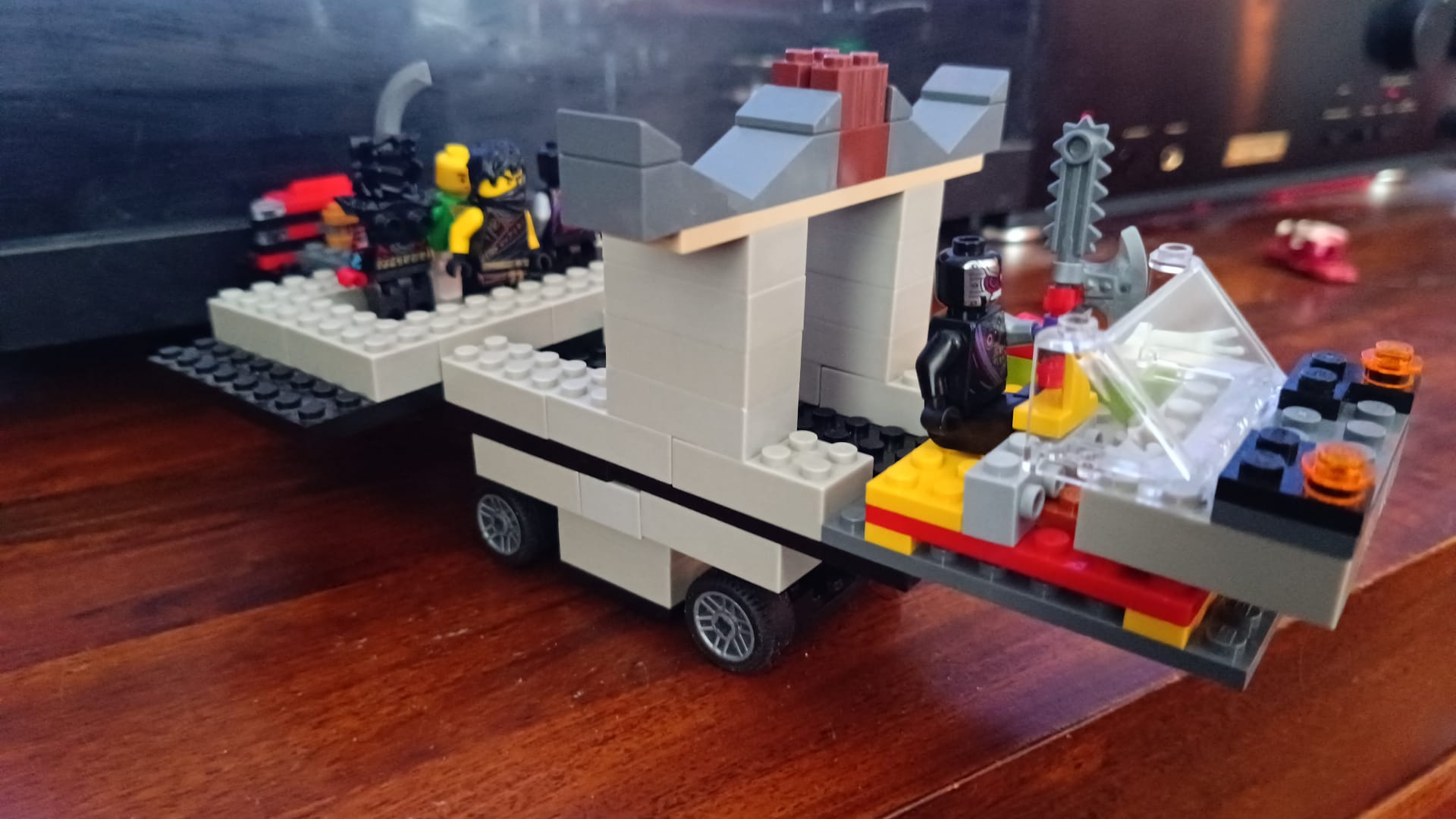
Every LEGO Serious Play session operates inside what we might call an “as-if” frame: these bricks are, as if, our organisation’s decision-making structure; this model represents, as if, the competitive landscape we’ll be navigating in three years. The “as if” is explicit, acknowledged, and shared through the workshop’s warm-up scaffolding that brings you to being comfortable with metaphors. Nobody in the room actually believes the bricks are the organisation. And yet — and this is the crucial thing — the participants interact with the models as if the models were the real concepts, modifying them, challenging them, connecting them to each other, reading meaning from their spatial relationships in ways that would be impossible if everyone were simply looking at a piece of paper.
Vygotsky’s account of why this works is precise. Play, he argues, always creates an imaginary situation — a gap between the visible field (what you actually see in front of you) and the field of meaning (what it represents and implies) — and this gap is not a limitation or a concession to childhood cognition: it is the mechanism through which abstract thought originates. The child playing horse-riding isn’t failing to engage with reality: they are constructing the cognitive capacity to think about “horse” as a concept independent of any particular horse, which is a prerequisite for all abstract reasoning. The imaginary situation is where abstraction begins.
For adults in a strategy session, the cognitive challenge is almost the inverse: not learning to abstract from concrete experience, but finding a way back to the concrete after years of working almost exclusively in abstraction. Executives are very good at talking about strategy in abstract terms — competitive positioning, resource allocation, organisational capability — and the very fluency of that abstract language conceals how much genuine thinking is not happening underneath it. People can discuss strategy for hours using perfectly coherent abstractions that don’t correspond to any shared understanding of what the organisation actually does or how it actually behaves.

The “as-if” frame of LEGO Serious Play interrupts this. When you are asked to build your organisation’s decision-making structure rather than describe it, the abstractions stop working as hiding places. You have to make choices — is this a linear flow or a feedback loop? Where does power actually sit? What gets blocked, and by what? — and those choices are immediately visible to everyone else in the room, not as words that can be interpreted in whatever way is most comfortable, but as physical arrangements that either match people’s experience or don’t.
There is one more thing Vygotsky says that deserves to be quoted almost directly, because it reframes the whole relationship between play and adult cognition in a way that nothing else quite manages: imagination in adolescents and adults, he writes, is “play without action.” It is the internalised residue of childhood play, detached from the physical doing that originally generated it. This is why adults can think about things that aren’t there, can plan and hypothesise and imagine futures, but it is also why adult imagination tends to be less generative than it could be, because it has lost the embodied, action-generated quality that made it powerful in the first place.
LEGO Serious Play reverses this. It takes the internalised, action-free imagination of the adult professional and gives it a body again: bricks, space, physical relationships, the resistance of objects that don’t quite do what you want them to do. It doesn’t make executives play like children: it restores to adult imagination the embodied quality that makes it most productive, by giving it something to push against. And in doing so, it answers, more precisely than anything else we’ve covered, the question of why you can’t do this with Post-its. A Post-it is a symbol. A LEGO brick is a pivot. The difference is not aesthetic: it is the difference between representing a thought and thinking with an object, and those are not the same cognitive act.
Part V — The Answer
5.1. So Why LEGO Specifically?
We are now, finally, in a position to answer the question properly.
LEGO bricks work as the medium for LEGO Serious Play not despite their associations with childhood and play, but precisely because of them. Those associations are not a liability to be overcome through careful facilitation and professional framing: they are the mechanism. They are what allows the magic circle to form quickly and without extensive scaffolding, because the bricks signal, immediately and unmistakably, that the rules here are different from the rules of a meeting. You don’t need to announce that you’ve entered a different frame. The bricks announce it for you.
This is the first and most immediate reason why substitutes don’t work as well. Clay, wooden blocks, pipe cleaners can serve as pivot materials in principle, and some facilitation approaches use them effectively, but none of them carries the same immediate, cross-cultural, cross-generational signal that LEGO bricks carry. LEGO is one of the most recognisable objects in the world, present in more households across more countries than almost any other manufactured product, and its associations are almost universally with a particular kind of absorbed, self-directed, rule-governed play. When you put LEGO bricks on a table in front of a group of adults, something shifts — often visibly, in people’s posture and facial expressions — before anyone has said a word. The magic circle begins to form at the moment of contact.
The second reason is modularity, and this connects directly to the pivot argument from the previous section. LEGO bricks are neither so specific in their form that they resist metaphorical use — they are not model cars or dinosaurs, they are generic building elements — nor so featureless that they offer no physical properties to generate meaning from. A smooth, flat tile means something different from a brick with studs, which means something different from a transparent element, which means something different from a hinge piece that can rotate. Colour, texture, size, connectivity, orientation are available characteristics to be used as meaning-generating properties, none of them so dominant that they force a particular interpretation. This is the exact point on the axis between symbolic abstraction and material constraint that Vygotsky’s pivot requires: enough specificity to generate meaning through physical choice, enough flexibility to represent almost any concept.
The third reason is impermanence, which we touched on in the psychological safety argument but which is worth stating clearly here as a design property of the medium rather than just a social benefit. LEGO bricks are, by their nature, provisional. Nothing you build with them is fixed. Every choice can be undone in seconds, every model revised, every relationship between elements reconfigured. And that carries a revolutionary value in strategy making at a corporate level.
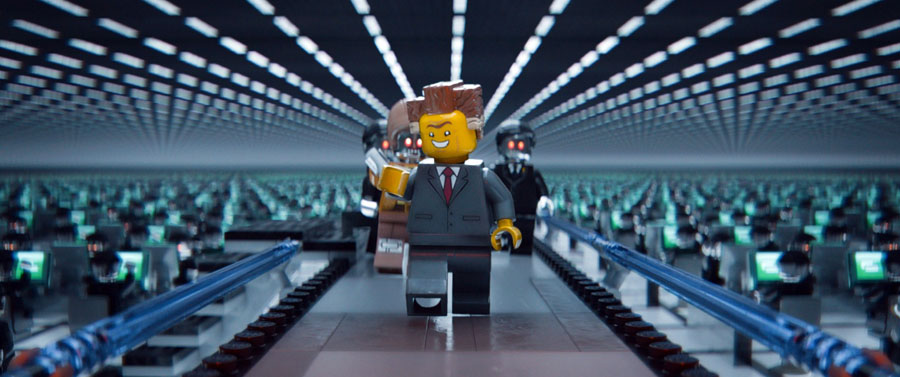
This is structurally different from drawing a diagram, writing a document, or creating a slide, all of which have a permanence that makes revision feel like an admission of error rather than a natural part of thinking. The LEGO model is never finished in a way that forecloses further thought. It is always, explicitly, a current version rather than a conclusion.
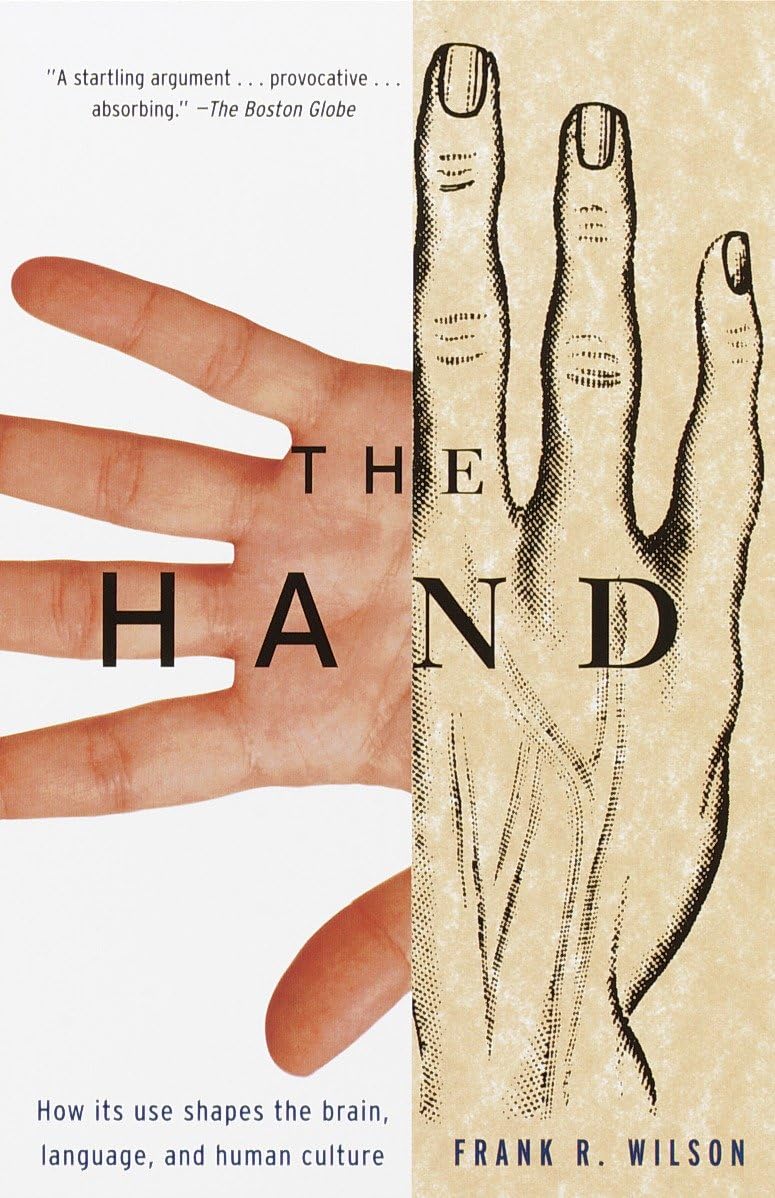
The fourth reason, briefly, is three-dimensionality. Physical models in space activate spatial reasoning, proprioceptive awareness, and the hand-brain relationship in ways that two-dimensional representations don’t — and as Frank Wilson argued in The Hand (1998), the hand is not merely an instrument of the brain but a co-contributor to thought, with its own embedded intelligence that gets engaged when you build and suppressed when you type or point at a screen. This is the piece of the argument that the previous articles in this series covered most thoroughly, so there’s no need to develop it further here, but it belongs in the list.
And the fifth reason — the one that ties all the others together — is that LEGO’s deliberate unsophistication is a feature, not a limitation. A more expressive medium creates a different set of pressures: investment in the artefact itself, anxiety about aesthetic judgment, competence comparisons between participants who build well and those who don’t. All of these pressures work against the play mode by reintroducing the social costs that the magic circle is designed to suspend. LEGO bricks are simple enough that building competence is not meaningfully variable across a group of adults, when facilitated right: everyone can pick up a brick and attach it to another brick, and the warm-up exercises are there to create the feeling that this isn’t a building competition. The medium democratises participation structurally, in the same way that the play mode democratises contribution socially. The bricks need to be bricks. Their simplicity is doing serious work.
5.2. Mode and Medium Together — Why You Can’t Separate Them
There is one final move to make, and it is in some ways the most important one: mode and medium are not independent variables that can be adjusted separately and recombined at will. They are, in the language of the 2004 paper, constraints that interact, and what makes LEGO Serious Play specifically generative is not the LEGO medium alone, nor the play mode alone, but the fact that this particular medium and this particular mode produce each other.
Just for the sake of the argument, consider what happens when you change one without the other.
If you keep the LEGO medium but remove the play mode — if you put bricks on the table but run the session with the social logic of a conventional meeting, with hierarchy operating normally, status anxiety intact, and outcomes under political pressure — you don’t get LEGO Serious Play: you get an art project, or a competition, or a deeply uncomfortable experience in which people feel exposed rather than engaged, because the medium is asking for something that the mode refuses to provide. The bricks without the frame are just bricks. And I’m afraid loads of people experienced this while being told it was LEGO Serious Play.
Conversely, if you keep the play mode but change the medium — if you try to create the same magic circle, the same autotelic orientation, the same psychological safety, using Post-its or whiteboards or verbal brainstorming — you discover that the medium is doing more of the work than you thought. The play mode needs to be embodied in something that carries the right affordances: pivot capacity, impermanence, three-dimensionality, the democratic simplicity we just described. Without a medium that structurally supports those properties, the play mode has nothing to grip onto, and the magic circle tends to collapse back into the familiar social logic of work, because the familiar social logic of work is what the familiar materials of work activate.
This mutual dependency is, in the end, the most precise answer to the “can’t we use something else?” question. The question assumes that the LEGO medium is a container that could be swapped out while the methodology inside it remained intact, the way you might serve the same dish in a different bowl. But the medium is not a container. It is a co-producer of the experience, shaping the mode as much as the mode shapes what the medium can yield. You could, in principle, find another medium that sits at the same point on all the relevant axes — pivot capacity, impermanence, democratic simplicity, cultural signal — and you might get something that functions comparably. But you would be designing LEGO Serious Play again from scratch, and I’m willing to bet you would end up with something that looks remarkably similar to what Roos, Victor, and a century of play theorists already arrived at. The bricks are not arbitrary. They are the answer to a very specific question about what happens when you need the imagination of adult professionals to become, temporarily, as embodied and generative as the play of a child with a stick.
Conclusion: the Debt, Paid
At the end of the previous article in this series, I said there was an answer to “why LEGO” that went beyond “it just happened that way,” and that it would have to wait for another week. This is that week, and here is that answer: the bricks work because of what they are, not despite it. The play mode works because of its specific cognitive and social properties, not in spite of their incongruity with professional norms. And the two work together because this particular medium and this particular mode are not independent choices that happened to be combined. They are, in the technical sense, co-determined. Each produces the conditions for the other.
The discomfort that executives feel about the bricks, which is where this piece started, turns out to be diagnostic rather than incidental: it signals that the magic circle is forming, that the frame is genuinely different from a meeting, that the ordinary social penalties are being suspended. The resistance is the point.

Here’s what I think: if your team walks into an LSP session and immediately feels completely at ease, something has probably gone wrong. Either the session is being run more like a fun activity than a working space, or the facilitator is working too hard to make everyone comfortable, which is subtly different from making everyone safe. Comfort and safety are not the same thing. Potential space, as Winnicott was careful to specify, requires trust but it also requires a degree of uncertainty, of not-knowing, of genuine openness to what might emerge. The bricks provide that, along with everything else.
Which raises, inevitably, the question of the facilitator. If the play mode is a cognitive and social technology, and if the LEGO medium is the material infrastructure that supports it, then there is a human being somewhere in the room whose job it is to hold the whole thing together, to maintain the magic circle without policing it, to create the holding environment without controlling what it holds, to keep the “as-if” frame alive without letting it become either too comfortable or too threatening. What that person actually does, and what skills it requires that a conventional workshop designer doesn’t need, is a question for a different article. But it’s the right next question. And if you’ve made it this far, you already know more than most about why it matters.




1 Comment
Pingback:Shelidon | The Sophist in the Room: Facilitation, Maieutics, and LEGO® Serious Play®
Posted at 09:00h, 26 June[…] in the second section of the previous article about LEGO® Serious Play®, I mentioned Plato and Socrates in passing, and then promptly moved on […]