
Last week, I wrote a little thing on doing strategy with LEGO® Serious Play®, and I mentioned in passing the theoretical foundations of the method. This week, I’d like to dive deeper into that. To understand why LEGO Serious Play works the way it does, in fact, you need to understand the intellectual tradition Johan Roos and Bart Victor were drawing from, and you’ll understand the methodology is clever because it’s grounded in decades of research about how human beings actually learn and how complex systems actually behave.
Also, the theoretical foundation helps us better understand why LEGO Serious Play works particularly well when applied to strategy, and the kind of skills it triggers in leaders and strategy-makers.
1. The Intellectual Lineage: applying Learning Theory to Organisational Strategy
1.1. Piaget’s Constructivism (1951): Learning as Active Construction
Let’s start with Jean Piaget, the Swiss psychologist who fundamentally changed how we understand learning. His core insight was radical for his time: children don’t learn by receiving information passively, but they only learn when they’re allowed to actively construct their understanding of the world through interaction with it.
Before Piaget, the dominant model of learning was transmission: a teacher has knowledge, transfers it to a student, the student receives it, and it’s like pouring water from a pitcher into a cup. Many still believe in this model, both when it comes to children and when it comes to transferring technical knowledge to adults. We know it only too well. And yet, Piaget showed that’s not how the brain works: a child who is told “two plus two equals four” won’t believe you and won’t actually understand addition until they’ve manipulated objects — arranged them, counted them, rearranged them, made mistakes, discovered the pattern — and internalised the rule through repeated active engagement.

The deeper insight is this: understanding isn’t something that gets transferred. Understanding is something that gets constructed through interaction. And the learner isn’t passive in this: the learner is an agent who builds meaning by actively engaging with the world.
For strategy-making, this reframes everything. Traditional strategy goes: “Here is the situation (data). Here is the analysis (insight). Here is the strategy (recommendation).” That’s transmission, and the executive receives the strategy to be applied.
Piaget tells us that people don’t develop genuine strategic understanding by receiving analysis, but they can develop it by actively constructing their understanding through engagement. This is why a consultant’s beautiful PowerPoint deck doesn’t create strategic understanding, even if everyone nods. You’re in transmission mode. You’re receiving. But when you sit down with materials and are asked to build your organisation’s strategy, you’re in construction mode. You’re the agent. You’re building something. And through that building, understanding emerges.
1.2. Papert and Harel’s Constructionism (1991): Tangible Construction Amplifies Learning
Idit Harel and Seymour Papert, who was actually a student of Piaget, took Piaget’s insight and refined it with a crucial addition: we learn even better when we construct something tangible, something physical, something we can show to other people.
Papert’s original research was with children learning geometry, and he found that when kids built something physical — a representation of a geometric concept using materials — they understood it more deeply and retained it longer than when they learned the same concept through discussion or diagrams or even computer simulations. The physicality mattered.
But the refinement goes deeper than that because it’s not just about construction: it’s about externalisation. When you build something physical, you’re taking what’s in your head — your implicit understanding, your fuzzy intuitions, your competing models — and making it visible, shareable, and open to challenge.
That externalisation is where collective learning happens: now you can see what you actually think, and other people can see it too. And they can say “Wait, that’s not what I understood,” or “That’s brilliant, I didn’t think of it that way.” Your internal model hits the external world, and through that collision, we reach a deeper level of understanding.
For strategy, this means that your mental model of how your organisation works stays invisible even to yourself until you externalise it. You hold it in your head, and it’s fuzzy. Your colleague holds a different model in their head, and that might be fuzzy in a whole different way. You talk past each other because you’re both assuming your own model is obvious. But when you build it — when you make it physical — the incompatibility becomes immediately visible.
This is one of the reasons why LEGO matters as a medium: it certainly isn’t the most sophisticated representation tool available, but it’s extremely good at externalising thinking in a way that’s transparent and open to challenge. A LEGO model shows your actual thinking, not a polished communication design. It shows where you struggled. It shows what you thought was important to include. It shows your real assumptions, not your interpreted assumptions.
That’s not the only reason, but it’s a powerful one.
1.3. Holland’s Complex Adaptive Systems Theory (1995): Organizations as Non-Decomposable Systems
Now let’s jump to John Holland and complexity science. As we saw last week, Holland’s research showed that complex systems — systems with many interdependent parts — don’t behave according to decomposition logic. They have emergent properties that arise from the interaction of the parts but can’t be predicted from analysing the parts individually.
A flock of birds doesn’t follow the commands of a lead bird: each bird follows simple local rules (maintain distance from neighbours, match their velocity, move toward the centre), and from that emerges the complex, coherent, seemingly choreographed behaviour of the flock. No central plan. No choreographer. Just local rules interacting, producing emergent behaviour at the system level.

Organisations are complex adaptive systems in exactly this way: you have hundreds or thousands of people following local rules — my job description, my incentives, my relationship with my manager, the team culture I inherited, the processes I learned, the patterns I’ve seen work before — and from that organisational behaviour emerges, something that no single person designed and that no one person fully understands. Even in companies with the strongest vision, you can’t predict it from any individual’s intentions. It emerges from the system.
The implication is: you can’t develop strategies for a complex organisation in a complex world by analysing functions or causes or phenomena separately. The organisation isn’t the sum of its functions. It’s a system with feedback loops, emergent properties, non-linear dynamics. You have to understand the system as an integrated whole.
Marketing analysis +
Sales analysis +
Product analysis +
Operations analysis
≠ Organizational strategy
Traditional strategy methods — decomposition, analysis, frameworks — are designed for complicated systems (many parts, but predictable relationships). They’re not designed for complex systems (many parts, unpredictable relationships, emergent properties).
1.4. Von Krogh & Roos: Autopoietic Corporate Epistemology (1994-1995): How Organizations Know Things
Finally, Johan Roos took all of this and, together with Georg von Krogh, asked the crucial question: how do organisations specifically create knowledge? How do they move from individual understanding to organisational understanding? And how does that knowledge become embedded in strategy, culture, and identity?
They drew on the biological concept of autopoiesis — systems that create and recreate themselves — and asked how organisations do this epistemologically (in terms of knowledge creation and validation). The core insight is this: organisations aren’t just containers for knowledge, but they have their own ways of knowing, their own processes for determining what counts as true or real. They have their own ways of validating ideas and converting individual insights into organisational direction.

This is why individual insights often die in organisations: not because an organisation is inherently evil, but because individual insights conflict with the organisation’s way of knowing. A salesperson might have a genuine insight about customer needs that contradicts what product believes about the market. The insight might be right, but it doesn’t get absorbed into strategy because it doesn’t fit the organisation’s existing knowledge structures, incentive systems, power relationships, or sense of identity. Just like the child who doesn’t believe you when you tell them 2 + 2 = 4, the organisation doesn’t believe the individual without the necessary structure.

But when you create a shared understanding of how the system works — when multiple perspectives come together and build a coherent (not consensus, but coherent) model of reality — that understanding can be absorbed, because it now comes from inside the organisation’s own process, not from an outsider telling them what they should do. It emerged through the organisation’s own sense-making machinery.
This is why LEGO Serious Play creates strategies that actually get implemented: instead of having consultants (or executives) imposing strategy, the organisation’s own people use the organisation’s own collaborative thinking processes, building a shared understanding that then becomes organisational direction.
2. Strategic Imagination: the Missing Variable
All of this theoretical background points to a central insight that Roos and Victor articulated: the problem with traditional strategy-making is that it’s not imaginative enough.
That sounds backwards, doesn’t it? Most people think of strategy as hyper-analytical, data-driven, rigorous, logical. Where does imagination fit in?

The intellectual lineage is crucial particularly because this would sound illogical without it. If strategy-making is about understanding complex adaptive systems (Holland), and complex systems can’t be fully understood through analysis of their parts, then strategy-making requires something beyond analysis. It requires constructing new possibilities that don’t currently exist (Piaget and Papert). It requires organisations translating individual insights into organisational knowledge (von Krogh & Roos). It requires imagining how a system might behave under different conditions. And it requires all these things at the same time.
Strategic Imagination is the integrated, embodied capacity to understand complex systems and imagine how they might be different. It’s what allows you to see the system clearly, envision new possibilities for it, question your assumptions about it, and move all three of these simultaneously toward actual organisational action.
This is a missing variable in traditional strategy. Most companies are really good at analysis, and that leverages what we call descriptive imagination. Some have creative brainstorming capacity, which is very nice indeed. Almost none have strong challenging imagination as an organisational capability, as it’s often seen as negativity or troublemaking rather than strategic thinking. And almost no organisation has them in active, integrated conversation.

Strategic Imagination is not the same as creativity: you can be very creative and still be strategically unimaginative if your creativity is disconnected from reality or from the actual constraints and dynamics of your organisation. Just the same, you can be very analytical and still be strategically unimaginative if your analysis doesn’t surface the nonlinear dynamics and feedback loops that actually drive behaviour. And if you’re just challenging… well, you’re probably an asshole.
3. The Three Types of Imagination
According to Roos and Victor, this means that Strategic Imagination isn’t a single capacity: it’s an emergent property of three distinct types of imagination working in concert and in balance. Let’s explore each one in detail, because understanding these three is essential to understanding why LEGO Serious Play works and why other methods struggle.
3.1. Descriptive Imagination
Descriptive Imagination is the one that’s often downplayed as “not imagination,” while in reality it plays a crucial role in every process, even the ones we consider “creative.” It’s ability to perceive and interpret patterns in the world as it currently exists, to see complexity and describe it coherently. In other words, it’s the ability to see what others are missing.
In strategy, you use your descriptive imagination while conducting competitive analysis and spotting trends that competitors haven’t noticed yet, for instance, or while mapping the value chain and identifying where profit is actually created. Looking at your organisation, and seeing cultural patterns nobody talks about, is an act of descriptive imagination. The whole Little Prince thing of the elephant and the snake and the hat is an exercise in descriptive imagination.

Descriptive imagination is the foundation of any strategic process: you need an accurate perception of reality, and most strategic failures start with misunderstanding the market, misreading customer needs, not seeing internal dynamics that will sabotage implementation. Those are all failures in applying descriptive imagination.
Companies with strong descriptive imagination, on the other hand, see what competitors miss: they spot opportunities and threats earlier, and understand their own organisations more clearly than competitors understand theirs. They develop strategies based on reality rather than wishful thinking.
Now, it doesn’t come without pitfalls. Particularly, descriptive imagination has a strong confirmation bias, particularly seeing patterns that confirm what you already believe and creating spurious correlations. So it can be sophisticated and still be fundamentally wrong because it’s either trapped in the current paradigm or in its own head. Even when the patterns you see are real, the frame you’re seeing them through might be outdated.
3.2. Creative Imagination
Creative imagination is the ability to envision possibilities that don’t currently exist, to recombine elements in novel ways. To ask “what if?” and follow it somewhere interesting.

When you use creative imagination in strategy, you’re envisioning a completely different business model (from selling products to selling services; from B2C to B2B; from retail to direct), imagining a product or a service that doesn’t yet exist, reimagining your target customer or market or thinking about entering an adjacent market or industry. This is the stuff that gets celebrated as “innovation” and “thinking outside the box.” And it matters. Organisations that can’t imagine genuinely different futures get disrupted by competitors who can.
In other words, creative imagination is what lets you escape current constraints. It’s what lets a bicycle company imagine becoming a personal transportation company, a cable company imagine becoming a streaming service. It’s how you avoid being disrupted by imagining your own disruption. It’s the only way to develop truly differentiated strategies.
Unfortunately, creative imagination without grounding in descriptive reality becomes just a fantasy: you imagine wonderful things that have no connection to customer needs, market constraints, organisational capability, or financial viability. You end up with blue-sky ideas that sound amazing in a brainstorm but can’t actually be executed. And creative imagination can turn toxic if it’s not balanced with the third kind of imagination.
3.3. Challenging Imagination
Challenging Imagination is the ability to negate, deconstruct, and question current assumptions. To ask “why do we actually believe that?” and follow it into uncomfortable places. To say no, or at least question whether our assumptions are actually true.
Used in strategy, it means that you question fundamental assumptions about the market, deconstruct the current business model, challenge sacred cows and untouchable wisdom. This is less celebrated than creative imagination, because it’s uncomfortable, but it might be the most important: the biggest strategic threats often come not from new ideas, but from the collapse of old certainties. Organisations with a strong challenging imagination, stay sharp. They don’t become complacent. They question their own strategies and don’t fall in love with their own business models. They’re harder to disrupt because they’ve done it already, multiple times, and the version you’re seeing is the one that eventually reassembled itself, stronger than ever.

They also tend to make more ethical choices, which is interesting, because they’re constantly questioning what they’re doing and why: you’re not ethical because you have a code nobody is allowed to question, but because you’re constantly questioning yourself and your own choices. This also resonates a lot on a personal level, at least with me.
Challenging imagination, like the other two, needs to be balanced: without the other two, it becomes nihilism, a situation in which you question everything and propose nothing. You become paralysed by doubt or, worse, you become cynical, pointing out everything that’s wrong without any genuine commitment to making it better.
Challenging imagination can also turn destructive. You can use it to tear down competitors or individuals rather than to genuinely understand what needs to change, and you can question for dominance, proving that someone else’s idea is wrong rather than exploring whether it might be partly right. This is particularly dangerous in competitive scenarios such as a C-suite meeting.
3.4. The Balance
If you take a look at the picture where the three imaginations play in concert, each imagination has a small bubble representing what happens when there’s no balance and one imagination takes the lead.

Descriptive imagination without the other two becomes the phenomenon we call “analysis paralysis“. You keep describing the system, refining your understanding, conducting another study, waiting for more data, but you never move to imagining what to do about it. And in fast-changing environments, perfect information never arrives: you have to act on incomplete understanding.
And creative imagination, aside from generating fantasies if it’s not grounded in reality, can turn toxic if it’s not balanced with challenging imagination: you can imagine a future that’s creative but deeply unethical. As we will see, this brings us back to Bart Victor.
4. From Thinking Strategy to Doing Strategy
The 1999 paper on Strategic Imagination was the theoretical foundation for the most advanced, current applications of LEGO Serious Play, but Roos didn’t stop there. Over the next decade, he deepened and extended the work, particularly around the question of how strategy becomes embodied action.
In Thinking from Within: A Hands-On Strategy Practice (2006), written with collaborators including Peter Bürgi and Mark Marotto, Roos articulated a crucial reframe: “When we do strategy rather than think strategy, we engage our senses so that we describe, create and challenge what we know in ways that pure intellectual reasoning cannot.”
The distinction relies on something called object-mediated communication, the idea that when we use physical objects to represent our ideas, thoughts, and emotions, we engage different parts of our brain, access different kinds of knowledge, and communicate in ways that go beyond words. A LEGO model doesn’t just represent your thinking; it is your thinking made visible. That externalisation changes everything about how other people can engage with your ideas.

The broader argument in Thinking from Within is that the Enlightenment values of rationality and analytical precision have created an imbalance in how organisations approach strategy. We’ve become hyper-rational, hyper-analytical, at the expense of imagination, embodiment, and wisdom. Without arguing against analysis, we can argue that analysis without imagination is sterile, and that the way to rebalance is not to eliminate analysis but to engage the whole person — hands, body, emotions, intuition — alongside the analytical mind.
5. Bart Victor: Moral Leadership and Strategic Questioning
While Roos focused on the cognitive and epistemological dimensions of strategy, taking a look at his co-creator Bart Victor and his work brings us to a different angle: the moral and ethical dimensions of strategic imagination.
Victor later became the Cal Turner Professor of Moral Leadership at Vanderbilt University, and his subsequent research has focused on the practical and moral dimensions of strategy-making. In my opinion, this wasn’t a shift away from his LEGO Serious Play work, and there’s a lot of wisdom to be taken from his work as well. Particularly, we need to take a look at his work with Roos and later colleagues on concepts like practical wisdom and moral imagination.
Victor articulated that challenging imagination isn’t just about questioning assumptions analytically. It’s about questioning what we’re doing and why, from a moral and ethical perspective, which brings us back to the ethical value of that kind of imagination. “One of the things we’re working on,” he stated in 2000, “is how to understand how we exercise our moral imagination, our ethical judgement, under conditions that are highly unpredictable and complex in dynamic environments.” Can you see, again, how dealing with complexity is always the focus here? Everyone can decide whether to do the right thing when business is easy.
This means that, when you build your organisation’s strategy through the construction of a system in LEGO Serious Play, you’re making choices about what matters, who you serve, what values drive you. Those choices have ethical dimensions. The challenging imagination that questions whether your strategy is right — not just whether it will work — connects to moral leadership.
True strategic imagination, we might say, doesn’t only require cognitive sophistication but moral sophistication as well, the capacity to ask not just “can we do this?” and “will this work?” but also “should we do this?” and “what kind of organisation will we become if we do?”

This is especially important in complex, interdependent organisations where decisions ripple across stakeholders and consequences aren’t always visible. You need the kind of imagination that can see those ripples and question whether the strategy is ethical, not just effective.
6. Strategic Imagination as Emergent Property
As we were seeing, Strategic Imagination isn’t the sum of the three imaginations (Descriptive, Creative and Challenging), but an emergent property that only exists through their interaction.
You need descriptive imagination to be grounded in reality. But without creative imagination, you just optimize what already exists. You need creative imagination to envision new futures. But without descriptive imagination, those futures are fantasy. You need challenging imagination to question assumptions and stay sharp. But without creative imagination, you just tear things down. That’s the easy way to understand it.
More subtly, the balance between these three changes depending on the strategic challenge. In a stable market where your main risk is being disrupted by a competitor, you need strong descriptive imagination to spot threats early and strong challenging imagination to question whether your model is still viable. In an emerging market where the future is genuinely uncertain, you need creative imagination to imagine possibilities and descriptive imagination to test them against early signals from the market. In a crisis, you might need primarily challenging imagination to deconstruct what’s broken.
The problem is that we tend to tackle only the kind of imagination that’s predominantly useful in the challenge we’re facing. Also, the kind of predominant imagination has to do with company culture, and that’s why most organisations are wildly imbalanced. They might have strong analytical capability (descriptive imagination) because that’s what business schools teach and consulting firms sell, or they might just have creative capability because they perceive their work as being creative (architectural firms, I’m looking at you). Almost none have a strong challenging imagination as an organisational capacity, ’cause that would be weird. And almost no organisation has the three in active, integrated conversation. The analyst sits in one department. The creative thinker sits in another. The questioner sits in… well, usually they’re isolated individuals who people learn to avoid.

LEGO Serious Play, as a methodology, engages all three simultaneously and forces them into conversation. It’s in the method’s foundation. It’s the main focus of the two original ideators. It’s embedded in its architecture.
When you sit down with bricks and you’re asked to build your strategy, your descriptive imagination is engaged because you have to see the system as it actually works. Your creative imagination is then engaged because you’re building something tangible that represents possibilities, changes, adaptations. Your challenging imagination is engaged because when you see someone else’s model, you immediately see assumptions you don’t agree with, and you have to articulate why. And because it’s all happening in one room, with physical models in front of everyone, the three types of imagination are forced to interact.
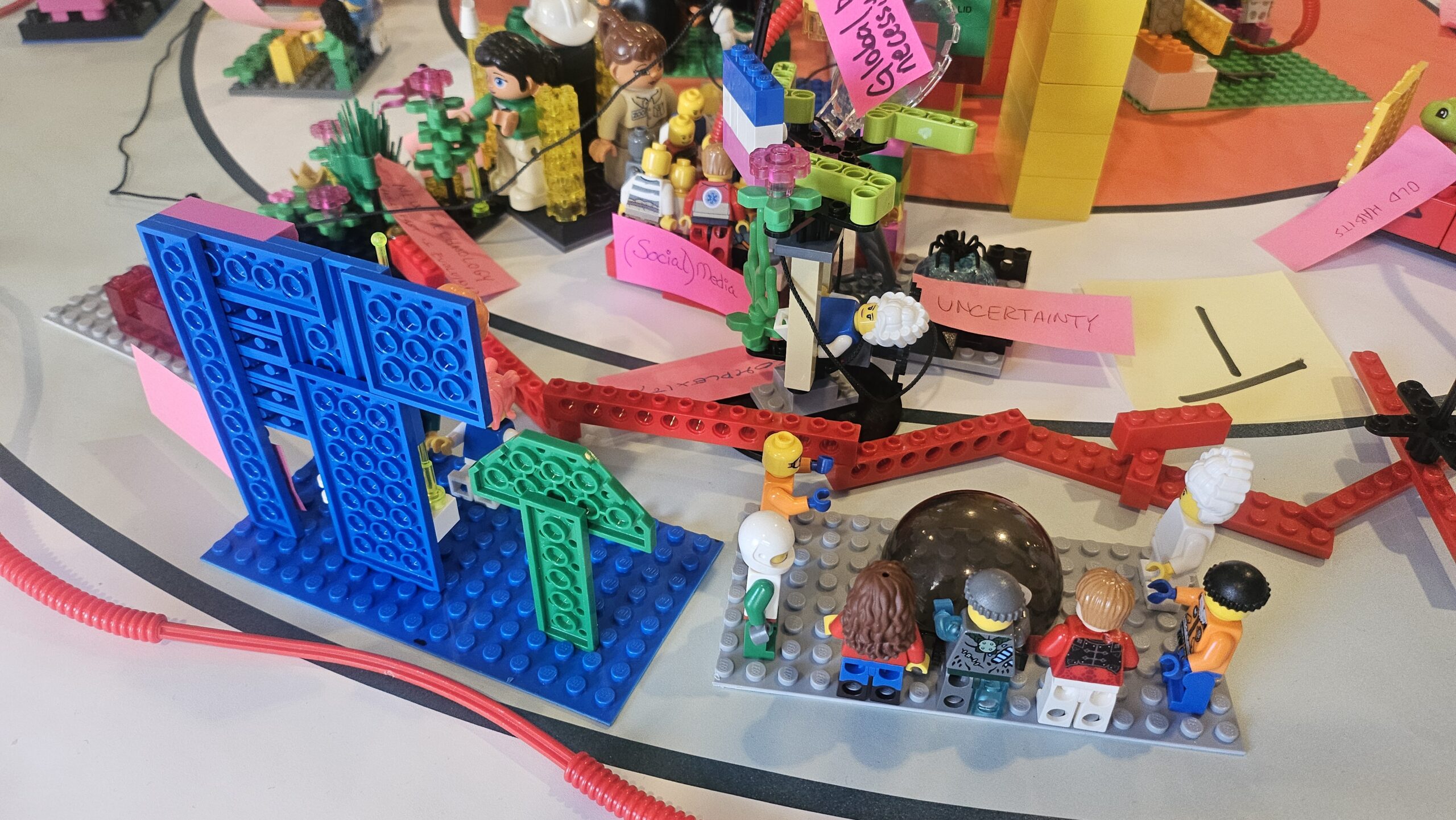
That friction, that negotiation, that collision between the three types of imagination is where strategic imagination actually emerges. And that’s why LEGO Serious Play creates more original, more grounded, more resilient, and more ethically-considered strategies than methods that engage only one or two of these types.
I still haven’t answered the question “why LEGO”, and there is an answer that goes beyond “it just happened that way,” but I guess that will happen another week.





1 Comment
Pingback:Shelidon | Why LEGO? Medium and Mode in the theory of LEGO® Serious Play®
Posted at 09:00h, 19 June[…] alone keeps invisible. What I didn’t fully answer — and I said so explicitly at the end of the second piece — is the “why LEGO?” question. Why these bricks, this medium, this particular mode of […]