
This is another book that was foundational in my intellectual development and it’s actually at the crossroads between architecture, level design and user experience.
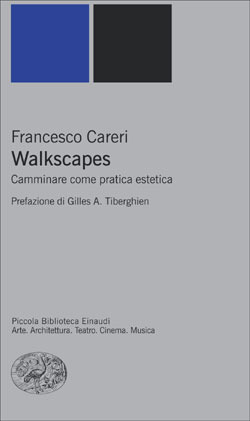
Francesco Careri, its author, trained as an architect in Rome and finished in Naples with a doctoral thesis titled “Il percorso,” the path. In 1995, he co-founded Stalker, an informal collective of architects, artists, and researchers who conduct what they call transurbanza: long collective walks through what Careri names the città attuale, the current city. In 1999, walking with Rome’s Kurdish community, Stalker occupied a disused building at the old Campo Boario slaughterhouse and renamed it Ararat, turning it into an experimental public space built on hospitality. A decade later, the group walked the entire length of Rome’s ring road on foot, mapping the improvised, informal city that had grown up along a route designed purely for cars. Walkscapes, published in 2002, is the theoretical spine underneath all of this, and expresses the idea that walking is not merely how you get somewhere in a landscape, but one of the oldest ways of actually creating a landscape. I’m sure this will sound familiar to everyone who’s been following this August reading list.
The book romantically traces this thread from the raising of menhirs through Egyptian and Greek processional routes into the Dadaist and Surrealist excursions of the 1920s, the Situationist dérive of the 1950s and 60s, and the Land Art walks of Richard Long and Robert Smithson, in a genealogy that treats walking-as-art as a practice periodically rediscovered and as tool that’s particularly good for, specifically, attending to spaces that you can’t effectivelly capture from above. A terrain vague doesn’t show up clearly on a masterplan; its value, if it has any, is illegible from an aerial photograph and only becomes available to someone willing to actually walk it, slowly, registering what a plan view flattens out. Stalker’s method treats this walking as “the simultaneous reading and writing of space.”
This is also an active practice: leaving your mark on an ignored place with your own body changes the place itself. Careri’s whole practice suggests that walking through a landscape, when done with enough attention and enough patience, might already be the intervention, or at least the only reliable way of finding out what an intervention in that particular place should actually be.
This is going to be the last book for this August. What did you read?


No Comments