"All this he saw, for one moment breathless and intense, vivid on the morning sky; and still, as he looked, he lived; and still, as he lived, he wondered."

The Tomb of Sarah

Frederick George Loring was an English naval officer born in 1869, an early expert in the pioneering technology of wireless telegraphy and, incidentally, a writer. Born in the Isle of Wight as the eldest son of Admiral Sir William Loring and Frances Louisa Adams, he followed in his father’s and grandfather’s footsteps and served as a sub-lieutenant on the royal yacht Victoria and Albert in 1891, but he started working as a writer much later, with his first documented exploits being as a naval correspondent for the Western Morning News and as a technical writer for accounts such as “A survey of marine radio progress, with special reference to RMS Queen Mary”, published in 1937 in the Institution of Electrical Engineers’ Journal and which he co-authored.

He wrote poetry and short stories, but “The Tomb of Sarah” is undoubtedly his most famous and acclaimed work. It appeared in the Pall Mall magazine in December 1910, thirteen years after the publication of Bram Stoker’s Dracula, and bears many markings of the classical vampire story. For reference, in the final appendix I have included the chapters of Lucy Westenra’s demise from Bram Stoker’s Dracula, as the mood has much to share with that passage.

The title of the story is interesting to analyse too: the “Tomb of Sarah” is an alternative name to the Cave of the Patriarchs, known to Jews by its Biblical name Cave of Machpelah and to Muslims as the Sanctuary of Abraham. Located in the heart of the Old City of Hebron in the West Bank, the cave is traditionally believed to be the burial site of Sarah, Abraham’s wife, as well as other biblical patriarchs and matriarchs. It’s a place of pilgrimage, and the sentence has been used metaphorically to represent the passing of time and mortality.

In the context of the tale, Sarah is an evil Countess, murdered in 1630, and she’s been resting under a church until her tomb is discovered during a renovation and has to be relocated. As you can imagine, things go very South, very fast.

Enjoy! Patrons in tier 1 get the full novel, while people in tier 2 and 3 get the downloadable file with the appendix.

And yes, this means another agent politely declined to represent my novel.

comics and illustration

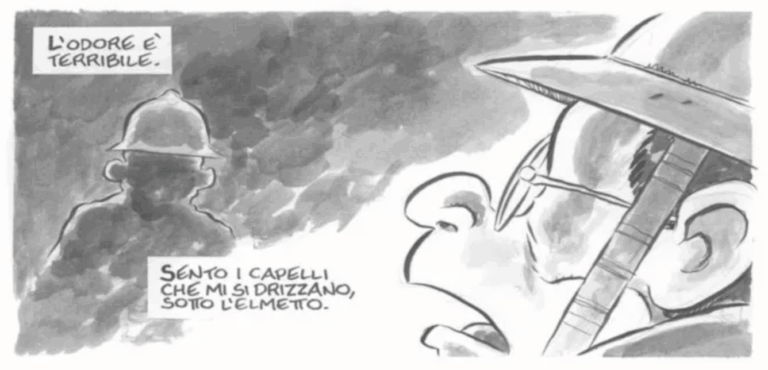
Leo Ortolani, Tapum

A un certo punto ci sarà una battuta, in questo fumetto, e riderete. Sappiate che è l’unica. Com’è giusto che sia. Se devo paragonare quest’opera a qualcosa, il confronto più azzeccato è probabilmente lo spettacolo che Marco Paolini trasse dal Sergente nella neve di Rigoni

Read More »
Summertime

Omeros in the Caribbeans

Derek Walcott was a Saint Lucian poet, playwright, and painter, and one of the major voices of Caribbean literature. He won the Nobel Prize in Literature in 1992, and his work often explores Caribbean history, identity, colonial inheritance, and the meeting of European and African

Read More »
books and literature

Ioanna Papadopoulou’s The Castaway and the Witch

I had a genuine “oh shit” moment when I read the author’s preface saying this was darker than “Winter Harvest” because – and I absolutely ADORED “Winter Harvest” – that was pitch-black dark. I thought “we’re all going to die”. This maybe has something to

Read More »
Share on LinkedIn
Throw on Reddit
Roll on Tumblr
Mail it
No Comments

Post A Comment

This site uses Akismet to reduce spam. Learn how your comment data is processed.

RELATED POSTS

Leo Ortolani, Tapum

A un certo punto ci sarà una battuta, in questo fumetto, e riderete. Sappiate che è l’unica. Com’è giusto che sia. Se devo paragonare quest’opera a qualcosa, il confronto più azzeccato è probabilmente lo spettacolo che Marco Paolini trasse dal Sergente nella neve di Rigoni

Read More

Omeros in the Caribbeans

Derek Walcott was a Saint Lucian poet, playwright, and painter, and one of the major voices of Caribbean literature. He won the Nobel Prize in Literature in 1992, and his work often explores Caribbean history, identity, colonial inheritance, and the meeting of European and African

Read More

Ioanna Papadopoulou’s The Castaway and the Witch

I had a genuine “oh shit” moment when I read the author’s preface saying this was darker than “Winter Harvest” because – and I absolutely ADORED “Winter Harvest” – that was pitch-black dark. I thought “we’re all going to die”. This maybe has something to

Read More