
Every text this last few days has, in one way or another, been circling around the same question: what’s a path and what makes a path? Not a road already drawn and simply walked afterward, but a path in the sense that seems to keep surfacing wherever this week’s writers put their attention: it has been a mirror corridor that loops rather than leads, a coastline that dissolves into digression, an ancestral track kept alive only by being sung, a sea-crossing that never quite leaves the island it circles, a hospital corridor crossed without moving an inch, nine lines insisting there was no way there to begin with. None of these were really poems or novels about scenery. They were all, underneath, asking the same question about production: does the path precede the walking, or does the walking make the path?
The oldest answer to that question this week comes from Bashō, a 17th‑century Japanese poet and one of the most celebrated masters of the short-form poem that became haiku (originally the hokku). Born Matsuo Munefusa in 1644 to a low-ranking samurai family, he studied Chinese poetry and Zen, adopted the pen-name Bashō (from a banana plant gifted by a pupil), and spent much of his later life travelling and writing; his work deepened haiku’s aesthetic of simplicity, nature-attuned observation, and spiritual depth.
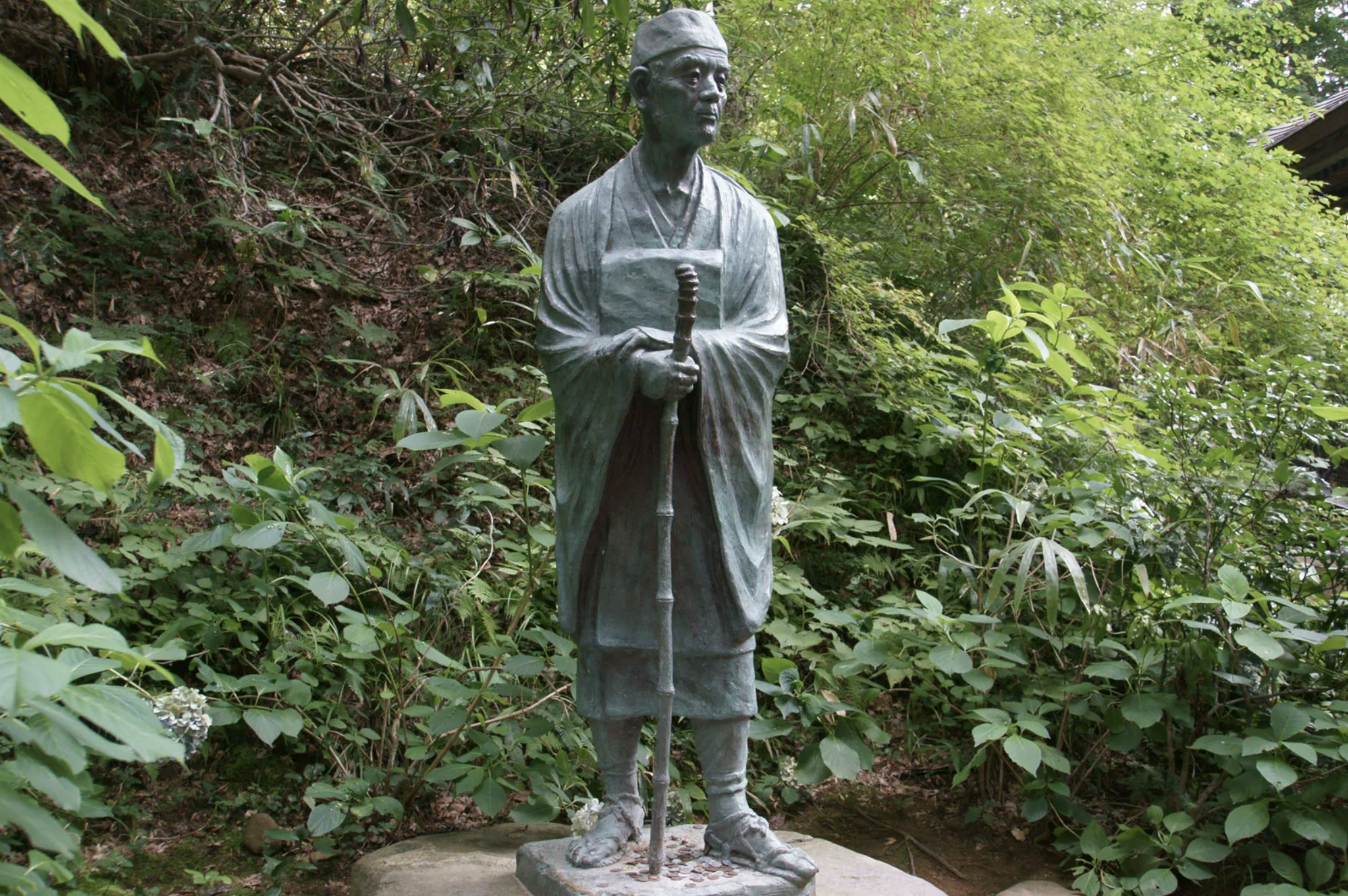
The most enthralling fact about Bashō’s Narrow Road to the Deep North is that it isn’t really a diary in the modern sense: he wrote it after the journey, over roughly five years of revision, taking documented liberties with what actually happened along the way — a night with courtesans that his travelling companion Sora’s own diary never mentions, encounters reshaped, sequences rearranged — so that the “narrow road” we read is not a record of a path being walked but a path being composed, retrospectively, out of a walk that had already ended. The textual path and the physical path turn out to be two separate acts of production, and the second one, the writing, took considerably longer than the first.
Yosa Buson inherited that finished text, and didn’t take it as something to admire from a chair. Born a few decades after Bashō’s death, he walked it, following Bashō’s route stage by stage, retraced the entire pilgrimage on foot and then made it again a third time, in paint, producing an illustrated scroll of the journey, image by image, at each of the stops the original book had marked. This is a strange act if you think a canonised path, once written down, becomes fixed: it was a route so famous, by Buson’s time, that it had its own commemorative stones and place-name associations, the eighteenth-century equivalent of a heritage trail. Buson had every reason to treat it as settled. Instead, he re-produced it twice over: once with his feet, once with a brush, as if the path’s existence in Bashō’s text hadn’t actually finished the job of making it real, and needed to be renewed by somebody willing to put their own body and eye through the same ground. A path that’s already been walked and already been written down, in other words, still isn’t done. It has to be remade by whoever comes next, or it stops being a path and starts being only a description of one.
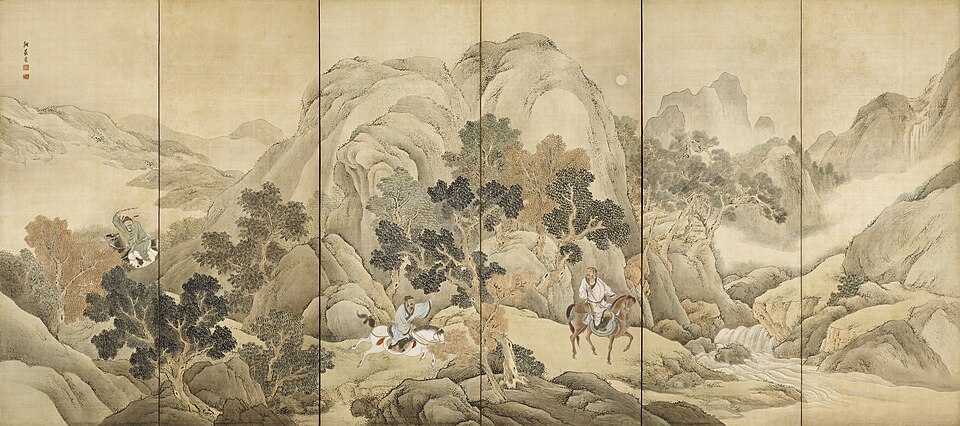
This week’s other reading has been an argument, from six directions that share almost nothing else in common, for exactly that claim: that a path is not laid out in advance, waiting to be found, but produced, each time, by whoever is moving through it. And, by extention, a building only make as much sense as the people living through it.
Alejandra Pizarnik gets there by refusal: her mirror-paths in Los caminos del espejo promise arrival and deliver only the walker, again, having gone nowhere except further into herself. “My endless falling into my endless falling / where nobody waited for me.” There’s no destination to be reached, none that pre-exist the walk. There’s only the walking, folding back on the one doing it.
W.G. Sebald produces space by an almost opposite method, not through repetition of a known route but through digression, letting each mile of actual Suffolk coastline open sideways into centuries of unrelated history until the geography stops being the point and the accumulation becomes it. The path in The Rings of Saturn is barely a path in the conventional sense at all; it’s a pretext that lets one digression lead credibly into the next.
Alexis Wright‘s Carpentaria pushes the claim further than anyone else is willing to go, because her ancestral tracks aren’t optional to remake: Mozzie Fishman’s convoy exists because the songline’s survival depends on continued, obligatory performance — singing the stories, driving the route again — not on anyone’s aesthetic choice to revisit a landmark. Where Buson chose to re-walk a beloved dead poet’s road out of devotion, Fishman’s convoy sings and drives the ancestor’s road because stopping would mean the road stops being real at all. This is the same principle, with the safety net removed: a path this dependent on being walked isn’t just a metaphor for impermanence, but a living legal and spiritual order that can be genuinely lost, not just neglected.
Derek Walcott, in Omeros, complicates the picture from another angle again: his are journeys that never actually leave. The sea only appears to move around the island; the traveller’s hand always knows it must return to the port it started from. And running underneath that circling is Philoctete’s wound, a threshold that has refused for generations to finish being crossed, proof that not every unresolved path is a failure waiting to be corrected. Some are left open on purpose, because closing them the easy way would have meant closing them wrong.
Kathleen Jamie breaks the week’s pattern entirely: her thresholds in Findings need no real distance at all — a hospital corridor, a kitchen window — only the “care and maintenance of the web of our noticing.” The crossing happens through attention, which suggests the formal apparatus we build to stage a threshold is doing far less work than we’d like to believe, if nobody moving through it is actually paying heed.
And Antonio Machado states that there is no way, the way is made by walking, and the trace it leaves — footprints on land, worse, wakes on the sea — won’t survive being looked at twice. Buson’s re-walking of Bashō’s road is the practical, patient demonstration of what Machado says in nine lines: the path doesn’t hold its shape once you’ve turned away from it. Somebody has to keep making it, on foot, or it reverts to being ordinary ground with a famous poem attached to it.
This is a harder standard than architecture usually holds itself to, because we are, on the whole, in the business of making paths and buildings that are supposed to work correctly without anyone’s continued devotion: a circulation route that functions whether or not the people using it feel anything about it at all, on the reasonable grounds that public infrastructure shouldn’t depend on romance to keep operating. But it’s worth noticing how much of what actually makes a route feel alive, rather than merely serviceable, comes from exactly the kind of remaking these writers describe: the market street that only stays a market street because generations kept choosing to trade there; the pilgrimage route that survives because people keep walking it for reasons the original planners never specified; the shortcut that a masterplan tried to close and the users simply reopened, on foot, until the plan gave up and the desire line got paved. Buson didn’t have to walk Bashō’s road again. Nothing about the book required it. He did it because a path, once you’ve understood what these writers are each independently saying, was never the kind of thing that finishes being made.




No Comments