
Annie Dillard is an American writer best known for her lyrical and philosophical essays about nature, attention, and spiritual life. Her most famous book, Pilgrim at Tinker Creek (1974), won the Pulitzer Prize for Nonfiction.
It’s a work of made up of connected essays and observations from Dillard’s time near Tinker Creek in Virginia’s Blue Ridge Mountains, and it mixes close reading of the natural world with reflections on beauty, suffering, faith, and the strangeness of existence.
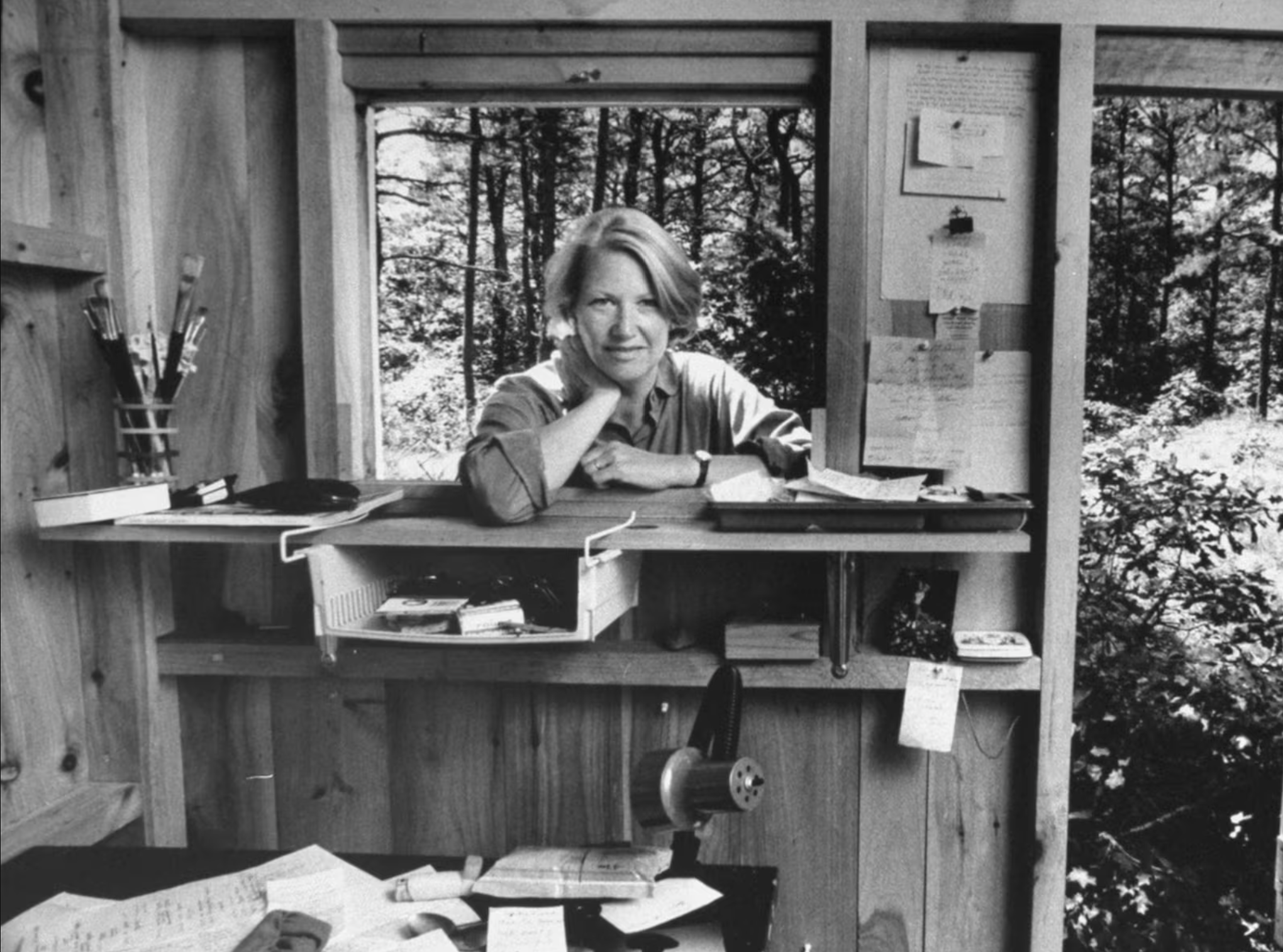
The chapter “Seeing” opens with a small anecdote: as a child, Dillard used to hide a penny somewhere along a stretch of sidewalk, then leave chalk arrows on the pavement pointing toward it, as a gift for a stranger who might never come. The joy was in the possibility that someone, walking past with their attention actually switched on, might notice the arrows, follow them, and find something they weren’t looking for. Most people, she says, wouldn’t have bothered to look down at all. Those who did, deserved a reward.
“Seeing is of course very much a matter of verbalization.
Unless I call my attention to what passes before my eyes, I simply won’t see it.”
Seeing, on these terms, isn’t a passive optical event. It’s an act you have to perform, and most of the time we don’t.
The piece of evidence Dillard reaches for is fairly extreme: case histories of patients born blind who gained sight as adults through cataract surgery, and who, on opening their eyes for the first time, didn’t see the world the way sighted people do. Colour arrived immediately, as flat patches. Space did not. One patient, newly sighted, kept bumping into the colour-patches he saw, startled that they had substance, the way a tactile object does; walking around a room, he had to work out, laboriously, that a shape passed on the left disappears from view for a reason, and that, however he turned, there was always a visual space in front of him. This meant he had to reason his way into realising that there was necessarily also a space behind him that he could not see. Depth, distance, the whole three-dimensional architecture of a room had to be built up through deduction and touch. Vision supplied the light, but didn’t supply space: space had to be learned.
This is an interesting perspective for anyone whose profession depends on the assumption that spatial experience is simply delivered to a person the moment they walk into a room. It isn’t, quite. It comes from a training we take for granted. A trained eye, I’d argue, reads a sequence of thresholds, a compressed entry opening into a tall volume, a change in material signalling a change in use, more or less instantly, because that eye has spent years being taught what those cues mean. An untrained visitor is not missing the cues because they’re insensitive, as architects often think: they simply haven’t yet done the work Dillard’s patients had to do to turn colour into space.
High-end architecture assumes a literate reader the same way a page of text does, and most of the training that produces that literacy happens invisibly, over years, the way a newly sighted adult has to relearn depth by bumping into it.
So, the question Dillard prompts to ask ourselves is: are we designing spaces for everyone, or are we building buildings that only the other architects can understand and navigate?





No Comments