
In Letters to Milena, Franz Kafka tries to name a specific distortion he believes is introduced by mediated communication, such as letters, then (already, in 1922) telecoms. Kafka writes this after a long, anguished correspondence in which he repeatedly doubts what writing letters is doing to him and to the relationship, and the passage in question is explicitly dated “Prague, end of March 1922.” Recent Kafka media-theory scholarship often refers to this March 1922 passage as the “letter of the ghosts” (Gespensterbrief) and reads it explicitly as Kafka thinking through communication technologies and subjectivity.
What triggers the reflection is a deep unhappiness: he writes that his “misfortune… derives… from letters or from the possibility of writing letters,” and insists that letters — especially his own letters — are a self-deceiving device. “Writing letters is actually an intercourse with ghosts,” he says.
The ghosts he refers to are not just the absent recipient; they include a ghost of the writer generated inside the act of writing: “…not… just… the ghost of the addressee but also… one’s own ghost, which secretly evolves inside the letter.”
So the haunting is double:
- the recipient becomes a phantom: you relate to an imagined Milena assembled from traces, not to the living person;
- the self becomes a phantom: the I in the letter is an authored construct that begins to act back on you.
This is why he asks, almost incredulously: “How did people ever get the idea they could communicate… by letter!”
Kafka’s most vivid image is about affect and intimacy being consumed by the medium itself: “Written kisses never arrive…; the ghosts drink them up along the way.” In other words, what you send does not simply “arrive later.” It was captured by an in-between realm that thrives on that exposure the communication medium triggers. Letter-writing, in Kafka’s idea, is a kind of self-stripping. So the ghosts are also a theory of mediation as vampirism: the more you try to compensate for distance by writing more, the more you feed the intermediaries. Which is fascinating enough.
I wasn’t familiar with any of this, until I read it in Byung-Chul Han‘s Digital Swarm (I wrote about it before), and what Han does is take Kafka’s anxieties and give them further psychological depth and connect them to what digital means of communication are doing to us. Kafka argued that people tried to regain “natural intercourse” by inventing faster travel (trains, cars, aeroplanes), but the other side innovates faster, and the ghosts didn’t stay postal.
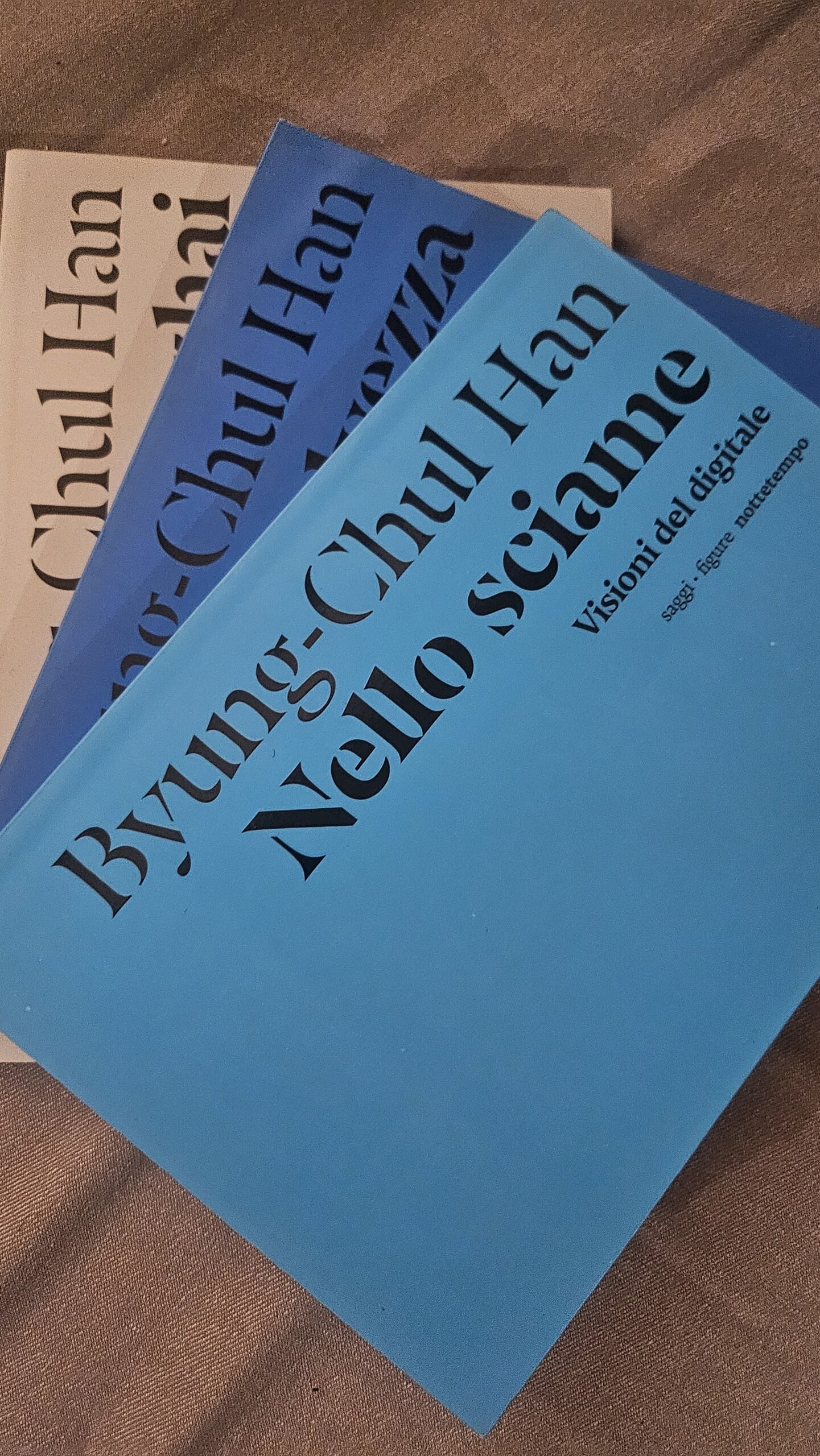
This got me thinking: how much of our digital communication, claiming to be transparent, is just feeding the ghosts? It’s the paradox of transparency: when everything is available, nothing matters. So I think it’s worth thinking about it for a while: comprehensive transparency and real-time access eliminate opacity in principle while generating unexpected shadows in practice. Or, as Han puts it, you take away the spotlight, and this means that diffuse lighting doesn’t really illuminate anything.
That’s it. Just a brief reflection, this week.




No Comments