
The Gwrach y Rhibyn, also known as “The Hag of the Mist,” is a figure from Welsh folklore often compared to the Irish Banshee. She is a harbinger of death, as her shrieks and wails warn of impending doom for those who hear them. She is described as a grotesque, ghostly figure with long, matted hair, often dark or white, that falls in unkempt strands around her face. Her eyes are burning, her mouth is wide and gaping with sharp teeth, and she is often clothed in tattered, flowing garments that appear to be part of the mist she emerges from. The Gwrach y Rhibyn might also possess bat-like wings, which she spreads when flying through the night skies. Some depictions also show her with elongated, claw-like fingers.

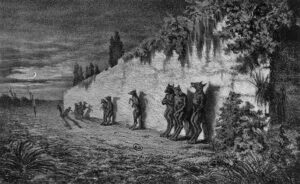
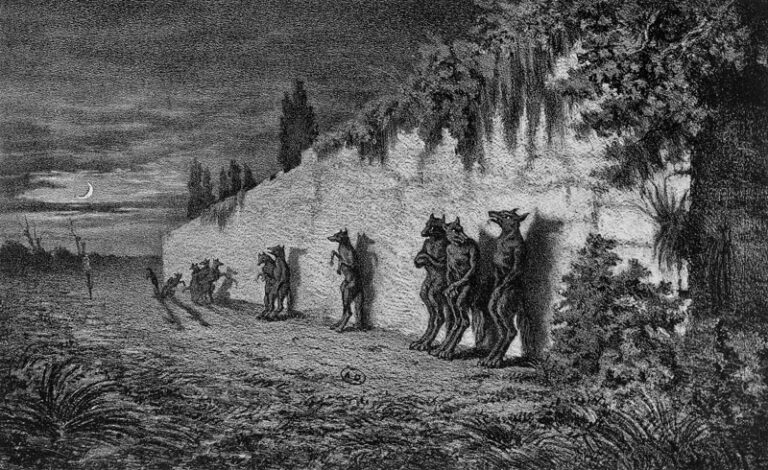
Not sure whether Goya had her in mind (probably not), but this doesn’t look good.
The Gwrach y Rhibyn is most active at night, particularly in the misty, liminal hours before dawn. According to legend, she appears to individuals or families before a death, often hovering outside a window or door, crying in the darkness. The wail of Gwrach y Rhibyn is said to be a harrowing sound, a mix of a woman’s scream and the howling wind.
She is believed to frequent isolated rural areas, especially near rivers, crossroads, and graveyards. She is sometimes associated with ancient burial sites, where she is thought to watch over the restless dead. In some legends, she is said to be the ghost of a wronged woman, cursed to roam the earth eternally, seeking out those who are nearing death.
The Gwrach y Rhibyn’s behavior is also linked to family heritage. According to certain tales, she appears specifically to members of old Welsh families, following their bloodlines through generations. She might even be seen as a twisted protector, ensuring that no death in her chosen family goes unmarked by her presence.

View from Greenwood Cemetery, by Rudolph Cronau
One of the most well-known stories involving the Gwrach y Rhibyn tells of her appearance to a family in a remote Welsh village. A young boy in the family fell seriously ill, and despite the best efforts of the local healer, he continued to worsen. One night, the family heard a loud, mournful cry outside their window. The father rushed outside, thinking it was an animal in distress, only to be met with the horrifying sight of a Gwrach y Rhibyn, flapping in the mist with tattered wings. Her wild eyes met his for a brief moment before she vanished into the night. The boy passed away the following morning, and the family believed that the Hag of the Mist had come to claim his soul.
Another tale speaks of the Gwrach y Rhibyn appearing at a crossroad, where a group of travellers heard her wailing in the distance. Curious but cautious, they approached the sound only to see her ghastly figure standing in the middle of the road, her wings spread wide, blocking their path. Paralyzed by fear, they watched as she slowly faded into the mist. The travellers later discovered that one of their companions, who had ventured ahead, had met with a fatal accident just beyond that very crossroad.

You do not mess with crossroads. (Jan Brueghel The Elder, Landscape with Village near Crossroads and Distant View)
Although Gwrach y Rhibyn is a lesser-known figure in wider European folklore, as many Welsh folklore compared to the over-used Irish creatures, she has inspired a number of Welsh artists and illustrators over the years. Her haunting figure can be found in illustrations from Welsh folklore collections, often depicted as a spectral hag wrapped in mist, her wings spread wide against a bleak, moody landscape.
One notable modern depiction is found in the artwork of Welsh artist Margaret D Junes Jones, who created an evocative piece of Gwrach y Rhibyn hovering over a misty valley. Here you can read more about her, and find some of the books she illustrated.
No Comments