
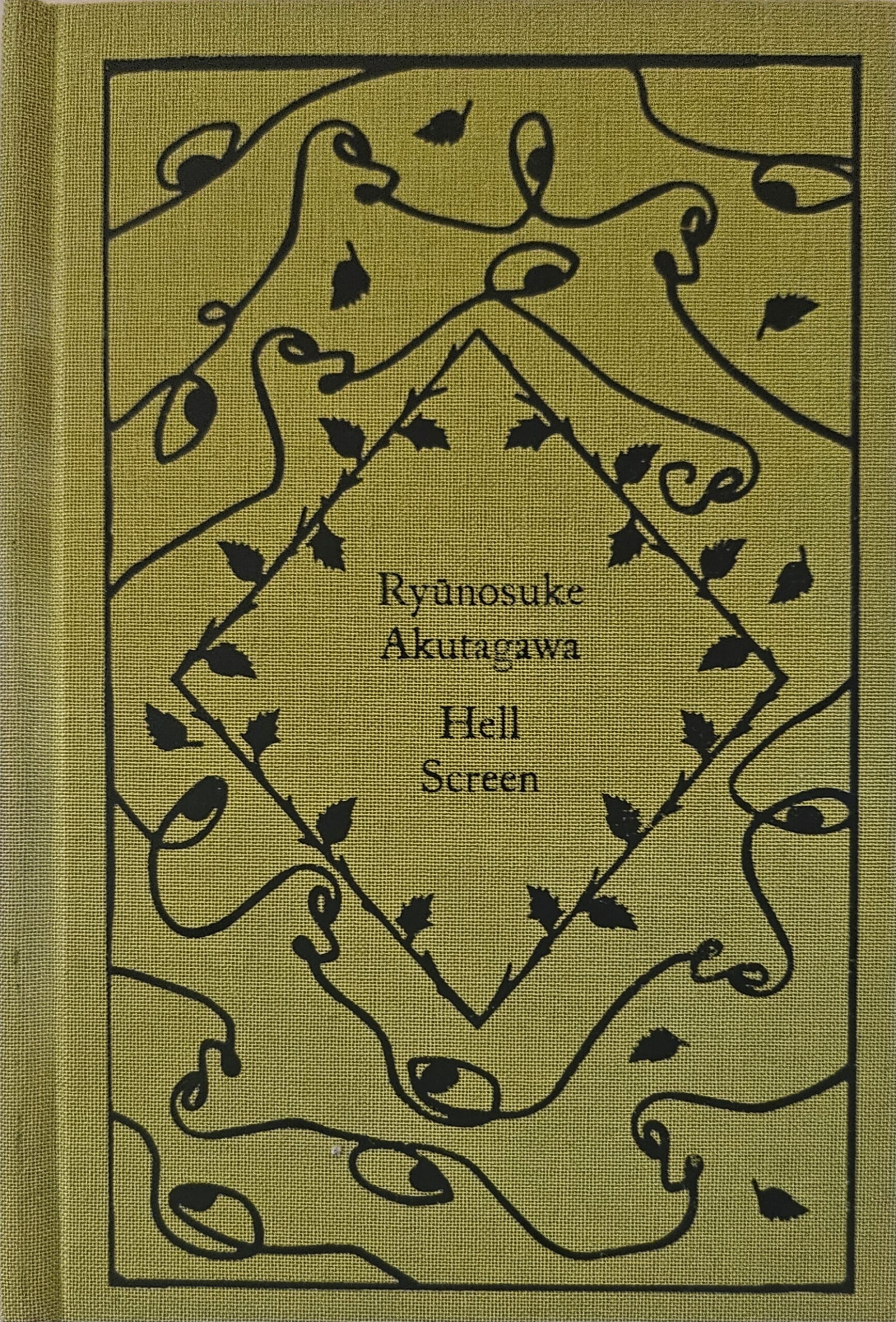
There’s a time limit, apparently, that saves you from having a book with a tacky cover and a sticker that says “From this, the major motion picture.” 76 years seems to be enough. So yeah, Hell Screen by Ryūnosuke Akutagawa is a collection of short stories that does include “Rashōmon” and “In the Grove“: the first one gave the title to the 1950 movie by Akira Kurosawa, and the second one is the story from which the movie’s plot draws its inspiration. And yet, the collection draws its title from one of the longest stories, about a painter who’s commissioned to paint scenes from Hell on a folding screen.
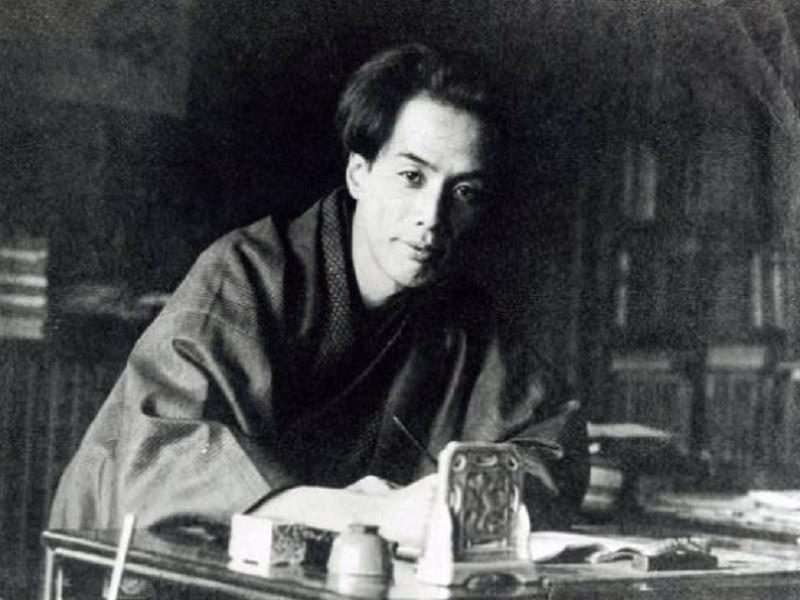
Ryūnosuke Akutagawa
Ryūnosuke Akutagawa, who also wrote under the name Chōkōdō Shujin, was a Japanese writer active in the Taishō period (1912 – 1926) and he’s sometimes known as the father of the Japanese short story, for reasons that are self-evident in this small collection. His short life wasn’t entirely unhappy: after a troubled childhood, riddled by his mother’s mental illness, he met and married Fumi Tsukamoto, and had three children with her. A full-time writer by 1912, he worked both as a novelist and a journalist, with some experience as a poet, but his physical and mental health started deteriorating after a vexing expedition as a reporter in China. He took his own life with barbital in 1927, aged 35.
His work, explicitly autobiographical at times, is deeply influenced by his experiences: the estranged parents, the shadows of an unstable mental health, society’s stigma and unsettling physical experiences are all themes you can find in his works.
Works in the collection
The collection includes eleven short stories of various lengths:
- Rashōmon, 1915, the story of a ronin who has to decide whether to become a thief or slip into poverty and eventually decides when he stumbles upon an old woman plucking hair from a corpse: the story has nothing to do with Kurosawa’s movie (they just liked the name);
- In a Bamboo Grove, 1922, from which the movie draws its inspiration: the death of a samurai is recounted by different people who were variously involved, and they all give different versions;
- The Nose, 1916, the story of a priest who has a nose so long it dangles in front of his lips;
- The Spider Thread, 1918, featuring Hell itself and a sinner, Kandata, who once had the mercy to save a spider and might have the chance to save himself;
- Hell Screen, 1918, the titular story of the collection and an unreliable narrator if there ever was one;
- Dr. Ogata Ryosai: Memorandum, 1917, featuring a weird depiction of Christianity;
- The Story of a Head that Fell Off, 1917, another story of weird occurrences with body parts;
- Horse Legs, 1925, the weirdest tale in the category, possibly featuring the most inefficient Afterlife office ever, which of course is Chinese;
- Death Register, 1926, an autobiographical excerpt;
- The Life of a Stupid Man, 1927, one of his final works;
- Spinning Gears, 1927.
Now, talking about each and every one of these would be beside the point, but let me expand on the “there’s a reason he’s the master of Japanese short stories,” at least. And I’m not a fan of short stories, I think they’re entertaining at best but I always regret the way they’re often over as soon as they get interesting (which, I understand, is kind of the point most of the time). Still, some of these are absolutely incredible, starting from In a Bamboo Grove, though my being partial to Kurosawa’s movie might be complicit in how much I liked this. The story is very brief, half a page for each testimony, the prose is dry and not dramatic at all, and yet the drama emerges under grim lights as soon as you start noticing the discrepancies in the testimonies. Eventually, you’re left with the wild notion that even the dead might be lying, not out of malice but out of the fact that the truth is bloody subjective. A masterpiece in its own right.
My second-favourite story is indeed the titular one, Hell Screen, partly because its tension is derived by the fact that the narrator, though being in apparent good faith, probably doesn’t understand the story he’s telling. Another reason this story deeply resonated with me, is the many references to particular art pieces of Japanese tradition, and the way the story has all the traits of a traditional legend while being deeply imbued of psychology and contemporary themes like obsession, emotional transfer and psychosis. And there’s a monkey.
The last work I want to draw your attention to is also the final story of the collection, Spinning Gears, a Lovecraftian-level horror story, a haunting tale of looming death that’s even more powerful if you think the author will kill himself not much time after writing it. Read this one if you have to pick just one.
Oh, and if you want to know more about the author, I suggest you read this.


No Comments