
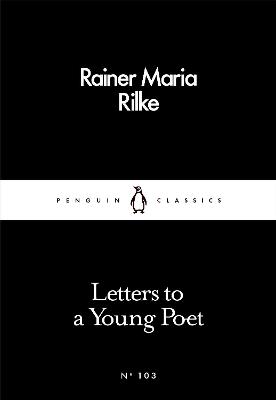
Same poet, different book. Rilke, the Bohemian poet and playwright, already made an appearance in the original list, so I’m well aware that bringing him back on day two of a sequel about not repeating myself is a strange way to start. But the Duino Elegies and Letters to a Young Poet are not really the same
writer wearing two different outfits, they’re closer to two different jobs he happened to do with the
same hands. The Elegies are the playwright in poetry, it’s Rilke showing off his talent and dedicating it to a Princess nonetheless. The Letters are Rilke advising, which is a much more dangerous activity, because advice gets tested against your life in a way that poetry, mercifully, does not.
The letters were written to a nineteen-year-old cadet named Franz Xaver Kappus, who had sent Rilke his
own poems and asked, essentially, whether he should keep going. Rilke’s answer is ten letters long and
contains almost no actual answer, which is the first thing worth sitting with if you build things for a
living. He tells Kappus, more or less, that he cannot tell whether his verses are good because that’s not
the question that matters. The question that matters is whether he feels he has to write. And then, in the line everyone quotes and almost nobody follows, he says:
“Have patience with everything that remains unsolved in your heart.
Try to love the questions themselves.”
This is, professionally speaking, appalling advice for an architect, as nothing in your training rewards
loving a question. You are handed unsolved things constantly — an ambiguous brief, a site with three
contradictory constraints, a client who wants a building that is simultaneously monumental and
invisible — and the entire discipline is a machine for converting those unsolved things into a design
that resolves them, on a schedule, for a fee. Unfinished has a cost code. Somewhere between the sketch and the permit application, every open question has to close, whether or not it was actually ready to.
I don’t think Rilke is non-appliable to the discipline, though: I think he’s describing a different phase of the same process, one we’ve gotten very good at skipping. Because before a question becomes a design, it has to be a question you actually understand, and understanding a genuinely difficult constraint — the kind that doesn’t resolve cleanly no matter which way you turn it — takes exactly the kind of unglamorous patience Rilke is recommending. What we call “design development” is very often just premature resolution: forcing an answer into existence because the schedule requires an answer to exist, not because the site, or the brief, or the actual human problem underneath both, has told you what it wants yet. And that’s why architects often revert to copying and adapting previous solutions: not because they lack the mindset, but because they lack the time to live in the question. Living the question, in Rilke’s sense, is what happens in the version of the process where nobody is watching the clock, in the
sketch that gets redrawn eleven times because the question hadn’t finished telling you what it was.
There’s a second half to that same piece of advice that gets quoted far less, and it’s the more useful
half:
“Live the questions now.
Perhaps you will then gradually,
without noticing it,
live along some distant day into the answer.”
The answer, in other words, isn’t produced: it’s arrived at, sideways, by someone who kept living inside the problem long enough that the problem eventually reorganised itself into something answerable. That is not how we’re taught to work, but it is, suspiciously, how the work we’re proudest of usually happened: the project where the concept actually held together, ten years later, was rarely the one where the first good idea in the first charrette got protected all the way to construction. It was the one that stayed unresolved just long enough to stop being generic.
None of this is an argument for missing deadlines, and Rilke, to be fair, was writing to a poet, not a person with a construction loan. But it is worth noticing which parts of a project can afford to live in the question a little longer, and which parts are being resolved early purely because early resolution is more comfortable than sitting with the not-knowing. Kappus, incidentally, never became the poet he was hoping to become. He became a novelist and a magazine editor instead, which either proves Rilke’s advice worked, in the sense that Kappus eventually found the shape his own unresolved question was actually pointing toward, or proves nothing at all, and he just wrote to a famous poet once and got ten generous letters back. Either way, the letters outlived the ambition that prompted them, which is probably the most Rilke thing that could have happened.


No Comments