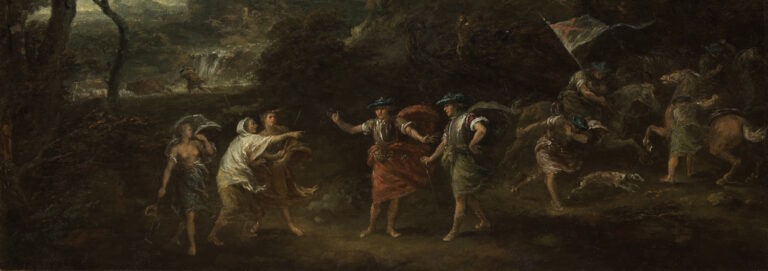
"All this he saw, for one moment breathless and intense, vivid on the morning sky; and still, as he looked, he lived; and still, as he lived, he wondered."

Pride Month 2025 – Words of the Day

Letters in Exile: Rumi’s Longing for Shams al-Din Tabrizi

“Since Shams appeared,
my heart has been a hundred thousand burning lamps.
The world is a candle, and I am the wick:
I am consumed in the flame of love.”
— Divan-e Shams-e Tabrizi, 13th century, Persia

Among the most exalted voices in Islamic mysticism, Jalāl ad-Dīn Muhammad Rūmī, better known simply as Rumi, has been canonised as a sage of universal love. Yet within the swirling mysticism of his poetry lies a core of unmistakable longing: one intimately bound to the figure of Shams al-Din Tabrizi, the elusive dervish whose arrival in Rumi’s life set both his spirit and his verse ablaze.

When they met in 1244 in Konya, Rumi was already a respected jurist and teacher. Shams, a wandering mystic with no allegiance to orthodoxy, shattered his world. Their bond was immediate, intense, and transformative. Rumi abandoned his public teaching. The two withdrew into private communion: days of silence, laughter, gazes, poetry, and spiritual transmission. Their closeness scandalised Rumi’s followers, who saw their beloved master vanishing into obsession.

And then Shams disappeared, either murdered by jealous disciples or choosing exile once more. Rumi was devastated. What followed was one of the most remarkable outpourings of grief and ecstatic love in world literature: the Divan-e Shams-e Tabrizi, a collection of over 3,000 poems in which Shams is muse, beloved, mirror.

Rumi’s language is rapturous, full of fire, yearning, surrender. He speaks of kisses, of annihilation, of being consumed. The gender of the beloved, when specified, is male. And though the poetry is often couched in metaphysical terms — the beloved as a vessel for divine love — it pulses with earthly longing, erotic metaphor, and emotional intimacy that defy strict spiritual abstraction.


Version 1.0.0
architecture, engineering and construction

A New Vision for the Learning Crisis

The end of 2024 brought us no grand educational reckoning, no moment of consensus that we need to reimagine how adults learn. Instead, through 2025, we’ve settled into a peculiarly quiet collective exhaustion with the pandemic’s educational experiments, paired with a creeping anxiety that something

Read More »
books and literature

Lolly Willowes

Sylvia Townsend Warner is one of the most interesting literary figures of the 21st century, and Lolly Willowes is one of her finest works, even more stunning if you think it was her debut novel. Self-supporting, intellectually independent, and consistently sceptical of social and religious

Read More »
books and literature

Fugitive Telemetry

This is book #6 in the Murderbot series (yes, I accidentally skipped #5, I’m circling back to that), and I’m afraid I didn’t like this as much as the others. The whole investigation felt a bit rushed and, though the final twist is interesting in

Read More »
Share on LinkedIn
Throw on Reddit
Roll on Tumblr
Mail it
No Comments

Post A Comment

This site uses Akismet to reduce spam. Learn how your comment data is processed.

RELATED POSTS

A New Vision for the Learning Crisis

The end of 2024 brought us no grand educational reckoning, no moment of consensus that we need to reimagine how adults learn. Instead, through 2025, we’ve settled into a peculiarly quiet collective exhaustion with the pandemic’s educational experiments, paired with a creeping anxiety that something

Read More

Lolly Willowes

Sylvia Townsend Warner is one of the most interesting literary figures of the 21st century, and Lolly Willowes is one of her finest works, even more stunning if you think it was her debut novel. Self-supporting, intellectually independent, and consistently sceptical of social and religious

Read More

Fugitive Telemetry

This is book #6 in the Murderbot series (yes, I accidentally skipped #5, I’m circling back to that), and I’m afraid I didn’t like this as much as the others. The whole investigation felt a bit rushed and, though the final twist is interesting in

Read More