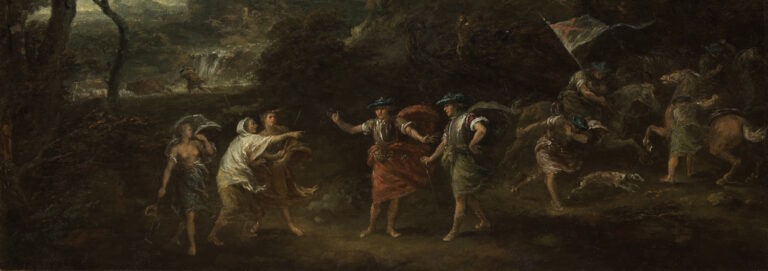
"All this he saw, for one moment breathless and intense, vivid on the morning sky; and still, as he looked, he lived; and still, as he lived, he wondered."

Pride Month 2025: Words of the Day

Unbound, Unnameable: Desire and Dissolution in Marguerite Porete’s Mirror

“Love has no why,
and the soul who loves has no need to ask.
She is unbound. She neither wills nor does not will,
for she is held, wholly,
in the embrace of Love’s will.”
— Marguerite Porete, The Mirror of Simple Souls (Le Mirouer des simples âmes anéanties), c. 1290–1306

Marguerite Porete was a French beguine and mystic whose treatise The Mirror of Simple Souls was deemed so radical by the ecclesiastical authorities that she was executed for heresy in 1310. Her crime? Writing of a soul — cast as feminine — that is so wholly annihilated in divine love that she transcends all ecclesiastical structures, all moral effort, all binaries of obedience and disobedience.

In The Mirror, the Soul speaks of surrendering to Love in terms that are profoundly erotic, emotional, and ecstatic. She ceases to act, chooses no longer to will anything: she becomes, instead, a vessel of divine flow, suspended in the arms of a lover who is not God-the-Father, but Love itself.

This language of annihilation and passivity has often been interpreted theologically, but for many queer readers of the Ace community, it also evokes the erasure of normative identity and the longing for unbounded intimacy without phisicality, beyond rules, beyond roles. The soul here is gendered and desiring, but also liberated from social constraints: free of “why,” living in a logic outside law and structure. The beguine movement itself was often a refuge for women who lived independently, formed spiritual partnerships, and resisted patriarchal control.

Porete’s words survived after her condemnation, smuggled, copied anonymously, and eventually rediscovered centuries later. Today, her text is recognized not only as a masterpiece of mystical literature, but also as a queer devotional document, where love is surrender, loss is freedom, and identity is porous, radiant, and unnameable.

books and literature

Lolly Willowes

Sylvia Townsend Warner is one of the most interesting literary figures of the 21st century, and Lolly Willowes is one of her finest works, even more stunning if you think it was her debut novel. Self-supporting, intellectually independent, and consistently sceptical of social and religious

Read More »
books and literature

Fugitive Telemetry

This is book #6 in the Murderbot series (yes, I accidentally skipped #5, I’m circling back to that), and I’m afraid I didn’t like this as much as the others. The whole investigation felt a bit rushed and, though the final twist is interesting in

Read More »
architecture, engineering and construction

The Discipline of Inspiration: Valéry and the Algorithmic Mind

Paul Valéry rejected inspiration as miracle, seeing creativity as the discipline of thought in motion. This week, we parallel his notion of mental “operations” with computational procedures in design: iteration, optimisation, constraint, and recombination, and challenge the dichotomy between intuition and automation. Drawing on contemporary

Read More »
Share on LinkedIn
Throw on Reddit
Roll on Tumblr
Mail it
No Comments

Post A Comment

This site uses Akismet to reduce spam. Learn how your comment data is processed.

RELATED POSTS

Lolly Willowes

Sylvia Townsend Warner is one of the most interesting literary figures of the 21st century, and Lolly Willowes is one of her finest works, even more stunning if you think it was her debut novel. Self-supporting, intellectually independent, and consistently sceptical of social and religious

Read More

Fugitive Telemetry

This is book #6 in the Murderbot series (yes, I accidentally skipped #5, I’m circling back to that), and I’m afraid I didn’t like this as much as the others. The whole investigation felt a bit rushed and, though the final twist is interesting in

Read More

The Discipline of Inspiration: Valéry and the Algorithmic Mind

Paul Valéry rejected inspiration as miracle, seeing creativity as the discipline of thought in motion. This week, we parallel his notion of mental “operations” with computational procedures in design: iteration, optimisation, constraint, and recombination, and challenge the dichotomy between intuition and automation. Drawing on contemporary

Read More