"All this he saw, for one moment breathless and intense, vivid on the morning sky; and still, as he looked, he lived; and still, as he lived, he wondered."

Pride Month 2025: Story of the Day

Singing for the Goddess: the Queer Voices of Inanna’s Gala Priests

Long before modern notions of gender came into form, the streets of ancient Sumer — in what is now southern Iraq — roamed with people whose identities didn’t feel the need to toe the lines of male or female. Among the most enigmatic and compelling were the Gala priests of Inanna, goddess of love, war, and transformation.

The Gala were individuals born as male, who adopted feminine speech patterns, wore women’s clothing, and performed ritual lamentations and songs in the goddess’s temples. In particular, they composed and recited sacred poetry in the eme-sal dialect — a register of Sumerian associated with female voices and deities — and were believed to channel Inanna’s power through song, grief, and ecstasy. Their role was of official cult functionaries, often held in high esteem.

Texts from the third millennium BCE describe them as “having neither father nor mother” — divine rather than natural. Some were described using words that modern scholars have interpreted as signalling gender-affirming surgery, homosexuality, or gender nonconformity, though these categories must be approached with cultural caution. What’s clear is that the Gala occupied a space well outside normative masculinity, and that this affirmation was not only accepted, but sacralized. Inanna herself was a non-conforming deity: fierce yet seductive, nurturing yet destructive, known for descending into the underworld and emerging transformed. Her followers mirrored this dynamic — living embodiments of fluidity, transformation, and the refusal to conform to fixed gender roles.

The story of the Gala priests reminds us that gender variance is not a modern deviation, but an ancient tradition — honoured, institutionalised, and spiritually powerful. In the temples of Ur and Uruk, queerness was not condemned; it was divine.
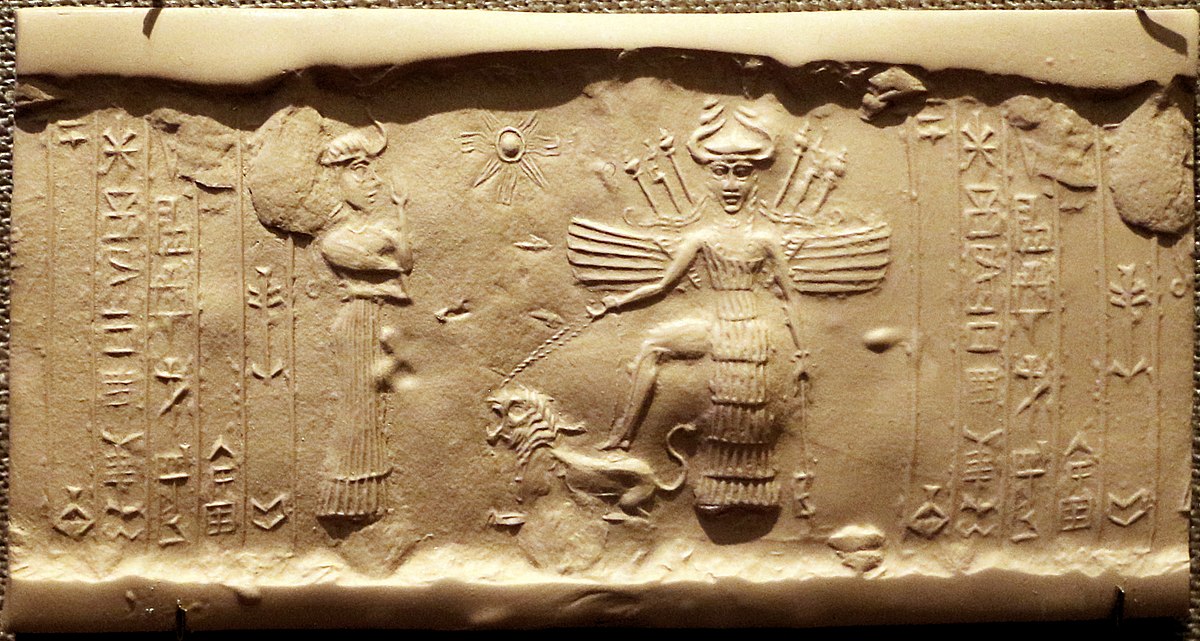

Impression of an Akkadian cylinder seal with Inanna resting her foot on a lion while Ninšubur stands before her in obedience, c. 2334- 2154 BC.

Spooktober

Spooktober 27 – The Black Monk (2)

Chapter 3 After supper, when the visitors had gone, he went to his room and lay down on the sofa: he wanted to think about the monk. But a minute later Tanya came in. “Here, Andryusha; read father’s articles,” she said, giving him a bundle

Read More »
Spooktober

Spooktober 26 – The Black Monk (1)

Anton Chekhov (1860–1904) was a Russian physician, short-story writer and playwright, and I’m not particularly fond of him, though he’s widely regarded as one of the greatest masters of modern short fiction and who am I to argue? His work is celebrated for its psychological

Read More »
art and fashion

Beauty and Ugliness: an exhibition

A few pictures from the recently closed exhibition on Beauty and Ugliness as an aesthetic paradigma in which what’s ideal and what’s grotesque melt together as sides of the same coin. The exhibition featured works by Brueghel (lent from the other exhibition at Palazzo Reale),

Read More »
Share on LinkedIn
Throw on Reddit
Roll on Tumblr
Mail it
No Comments

Post A Comment

This site uses Akismet to reduce spam. Learn how your comment data is processed.

RELATED POSTS

Spooktober 27 – The Black Monk (2)

Chapter 3 After supper, when the visitors had gone, he went to his room and lay down on the sofa: he wanted to think about the monk. But a minute later Tanya came in. “Here, Andryusha; read father’s articles,” she said, giving him a bundle

Read More

Spooktober 26 – The Black Monk (1)

Anton Chekhov (1860–1904) was a Russian physician, short-story writer and playwright, and I’m not particularly fond of him, though he’s widely regarded as one of the greatest masters of modern short fiction and who am I to argue? His work is celebrated for its psychological

Read More

Beauty and Ugliness: an exhibition

A few pictures from the recently closed exhibition on Beauty and Ugliness as an aesthetic paradigma in which what’s ideal and what’s grotesque melt together as sides of the same coin. The exhibition featured works by Brueghel (lent from the other exhibition at Palazzo Reale),

Read More
