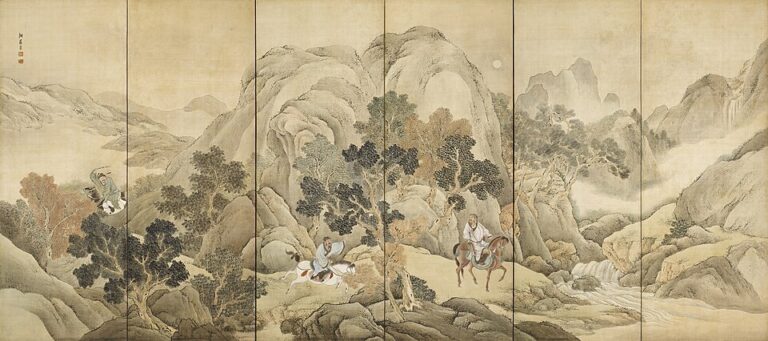
"All this he saw, for one moment breathless and intense, vivid on the morning sky; and still, as he looked, he lived; and still, as he lived, he wondered."

#OTD in 1709: Alexander Selkirk is rescued

Who’s Alexander Selkirk, you ask? Well, he’s Robinson Crusoe in real life. Sort of.

Born in Scotland in 1676, Selkirk had joined a buccaneering expedition to the South Pacific during the War of the Spanish Succession, in 1703, and he found himself embarked on a ship called Cinque Ports, captained by Thomas Stradling. When the ship made port at the uninhabited Juan Fernández Islands, west of South America, Selkirk expressed his concerns about the condition of the vessel, concerns that the Captain promptly dismissed. The Scotsman was so serious that he requested to be left on the island instead of going back on the ship.
As it turns out, he was correct: the ship sank near Malpelo Island, 400 km off the coast of nowadays Colombia.

Selkirk was left on the island with a musket, a hatchet, a knife, a cooking pot, a Bible, bedding and some clothes. He more than survived on the island: he settled there, planting trees and building a house, putting together a system for hunting and making new clothes and shoes.

On 2 February 1709, five years later, the Duke vessel anchored on the island and its physician Thomas “Quicksilver” Dover, the inventor of a famous fever medicine, rescued Selkirk.
Upon returning to England, his story of endurance and survival was broadly publicized as a symbol of the modern man’s resourcefulness and eventually served as inspiration for Daniel Defoe’s Robinson Crusoe.

Selkirk’s fate wasn’t as rosy, though. He lived the rest of his life mourning his secluded and solitary life on the island, embarked again on a pirate-hunting expedition and eventually died of yellow fever in 1721 around the coast of West Africa.

architecture, engineering and construction

The Sustained Path

Every text this last few days has, in one way or another, been circling around the same question: what’s a path and what makes a path? Not a road already drawn and simply walked afterward, but a path in the sense that seems to keep

Read More »
Summertime

The Road is Made by Walking

Antonio Machado was a major Spanish poet and playwright, associated with the Generation of ’98, a group of writers who reflected on Spain’s identity and crisis at the turn of the 20th century. He was born in Seville in 1875 and died in 1939 in

Read More »
Summertime

Kathleen Jamie on Attention and Corridors

Kathleen Jamie is a Scottish poet and essayist, born in 1962, known for her prose and poetry about landscape, place, and everyday life. Findings is her essay collection of personal reflections, first published in 2005, and it moves through nature and cities, archaeology, hospitals, family

Read More »
Share on LinkedIn
Throw on Reddit
Roll on Tumblr
Mail it
No Comments

Post A Comment

This site uses Akismet to reduce spam. Learn how your comment data is processed.

RELATED POSTS

The Sustained Path

Every text this last few days has, in one way or another, been circling around the same question: what’s a path and what makes a path? Not a road already drawn and simply walked afterward, but a path in the sense that seems to keep

Read More

The Road is Made by Walking

Antonio Machado was a major Spanish poet and playwright, associated with the Generation of ’98, a group of writers who reflected on Spain’s identity and crisis at the turn of the 20th century. He was born in Seville in 1875 and died in 1939 in

Read More

Kathleen Jamie on Attention and Corridors

Kathleen Jamie is a Scottish poet and essayist, born in 1962, known for her prose and poetry about landscape, place, and everyday life. Findings is her essay collection of personal reflections, first published in 2005, and it moves through nature and cities, archaeology, hospitals, family

Read More