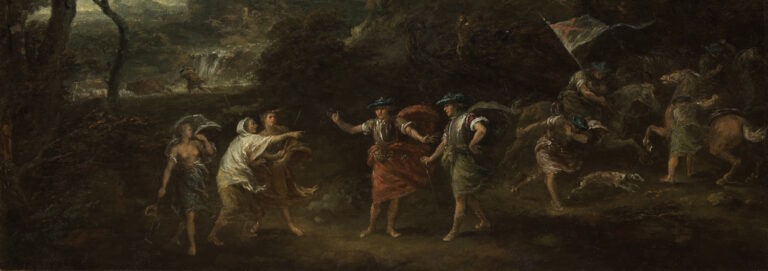
"All this he saw, for one moment breathless and intense, vivid on the morning sky; and still, as he looked, he lived; and still, as he lived, he wondered."

Occhio di Falco: Punto Cieco

Ok, mettiamo subito le carte in tavola: mi aspettavo di più. Molto di più.
Punto Cieco è una mini di quattro che si pone sul solco di Hawkeye & Mockingbird (Occhio di Falco e Mimo, pubblicato in Italia come Marvel Mix #91) e del suo crossover Widowmaker (i.e., Marvel Mix #95), e forse mi trovo a giudicare quest’albo in modo un po’ freddo perché non ho letto il primo e non sono riuscita a finire il secondo, ma quello che Jim McCann ci propone non è l’Occhio di Falco che ricordavo io. L’altissimo, tragico Occhio di Falco di House of M lascia qui il posto ad un personaggio che non sembra poi molto diverso da un mix insipido tra Daredevil e l’Uomo Ragno, uno spaccone con la battuta pronta ed uno spiccato spirito di negazione che si trova a… Quasi mi vergogno a dirlo. Cosa c’è di più banale? Occhio di Falco sta diventando cieco. E gli amici che tentano di fargli accettare la cosa. E lui che rifiuta. E i flash-back. E che palle. A corredo del tutto, degli insipidi disegni chiaroscurati a morte, opera di Paco Diaz, cui si alternano nei flash-back nomi come Nick Dragotta e Brad Simpson, Valentine DeLandro, Lee Weeks e Stefano Gaudiano.
L’unica cosa di buono che c’è in questo fumetto è la tesserina plasticata.

20120708-120753.jpg

  • Senza Vista (Sight Unseen) da Hawkeye: Blind Spot #1 dell’aprile 2011;
  • Bersaglio Mancato (Off Target) da Hawkeye: Blind Spot #2 del maggio 2011;
  • L’assassino di mio fratello (My brother’s killer) da Hawkeye: Blind Spot #3 del giugno 2011;
  • L’inizio (The Beginning) da Hawkeye: Blind Spot #4 del luglio 2011;
books and literature

Lolly Willowes

Sylvia Townsend Warner is one of the most interesting literary figures of the 21st century, and Lolly Willowes is one of her finest works, even more stunning if you think it was her debut novel. Self-supporting, intellectually independent, and consistently sceptical of social and religious

Read More »
books and literature

Fugitive Telemetry

This is book #6 in the Murderbot series (yes, I accidentally skipped #5, I’m circling back to that), and I’m afraid I didn’t like this as much as the others. The whole investigation felt a bit rushed and, though the final twist is interesting in

Read More »
architecture, engineering and construction

The Discipline of Inspiration: Valéry and the Algorithmic Mind

Paul Valéry rejected inspiration as miracle, seeing creativity as the discipline of thought in motion. This week, we parallel his notion of mental “operations” with computational procedures in design: iteration, optimisation, constraint, and recombination, and challenge the dichotomy between intuition and automation. Drawing on contemporary

Read More »
Share on LinkedIn
Throw on Reddit
Roll on Tumblr
Mail it
No Comments

Post A Comment

This site uses Akismet to reduce spam. Learn how your comment data is processed.

RELATED POSTS

Lolly Willowes

Sylvia Townsend Warner is one of the most interesting literary figures of the 21st century, and Lolly Willowes is one of her finest works, even more stunning if you think it was her debut novel. Self-supporting, intellectually independent, and consistently sceptical of social and religious

Read More

Fugitive Telemetry

This is book #6 in the Murderbot series (yes, I accidentally skipped #5, I’m circling back to that), and I’m afraid I didn’t like this as much as the others. The whole investigation felt a bit rushed and, though the final twist is interesting in

Read More

The Discipline of Inspiration: Valéry and the Algorithmic Mind

Paul Valéry rejected inspiration as miracle, seeing creativity as the discipline of thought in motion. This week, we parallel his notion of mental “operations” with computational procedures in design: iteration, optimisation, constraint, and recombination, and challenge the dichotomy between intuition and automation. Drawing on contemporary

Read More