
I have a particular fondness for Middle-East, Africa and the Mediterranean Region and, as such, I was sure not to be disappointed by my brief visit to Morocco. We spent a handful of days between Marrakesh and Essaouira, on the Atlantic sea, with a stop in the Agafay desert. It was one of those experiences where you taste and breathe everything that connects us, we Mediterranean people, through food and music and art and customs and different religions that share common beliefs (and you know how I feel about religion), and yet also one of those experiences where you can feel how deeply unequal our world merrily manages to be. It’s not a holiday if I don’t come home angry, you know that.
So, here’s a couple of notes I jolted down while I was there. I hope you enjoy them. Or you can flick through the pictures, if you prefer.

Marrakech: Dar El Bacha Museum
Officially the Musée des Confluences, the museum is a gorgeous former palace in Marrakech’s medina that’s hosting collections on Morocco as a meeting point of cultures, from Arab‑Andalusian to African, from Islamic to Jewish, Christian and Sufi: built around 1910 as the private residence of Thami El Glaoui, soon to be the appointed Pasha of Marrakech by Sultan Moulay Youssef, its name means House of the Pasha, in case you forgot who lived here. Architecturally, it’s a riad, with a stunning central courtyard featuring fountains and orange trees.


The museum presents Moroccan craftsmanship (zellige tilework, carved cedar ceilings, metalwork, textiles) alongside objects from Africa, Asia, and the Americas, and a wing is dedicated to the collection of Patti Cadby Birch (1906–2007), an American philanthropist and supporter of Islamic art who served as a trustee of the Metropolitan Museum of Art (the Met) in New York.
What impressed me the most, however, was the coexistence of traditional and historical art with a stunning exhibition of contemporary paintings by Casablancan artist Mohamed Azouzi. Born in Casablanca in 1946, he studied at the Beaux‑Arts in Casablanca and then in Paris, becoming one of the most experienced figures of modern Moroccan painting, and his retrospective at Dar El Bacha hosts abstract and symbolic works, organised around recurring signs and motifs rather than direct representation. If you remember my visit at Bagatti Valsecchi here in Milan, to see Depero, the emotion was similar.


Marrakech: the Ben Youssef Madrasa
If you want to be amazed (although maybe not amused), visit the Medersa Ben Youssef, Marrakech’s most celebrated Islamic college and one of the finest surviving examples of Saadian-era Moroccan architecture. Built around a serene central courtyard, it was once the largest madrasa in the whole area of Maghreb and a major centre of Quranic, legal, and theological study. They bag it’s the oldest university in the world, though the debate is heated depending on how you define “old” and… well, “university”. It was founded in the 14th century under the Marinid sultan Abu al-Hasan, beside the already existing Ben Youssef Mosque, hence the name. The present building, however, was rebuilt on a much larger scale by the Saadian sultan Abdallah al-Ghalib and completed in 1564–65 CE. On top of the courtyard and the Mosque, you’ll be able to see the students’ rooms, small cells with windows facing a small, central courtyard, following the architectural idea of the riad.


Marrakech: the Suk
I don’t have many pictures, ’cause I’m not afraid but I’m also not stupid. If you pick a guided tour, they might take you to a “traditional pharmacy” to knock yourself out with Argan oil and other bullshit (no, ginger most definitely doesn’t cure cancer…), and there’s a pictoresque alley of dyers but beware that’s a cul-de-sac: don’t wander inside alone unless you really want to buy a scarf. Overall, it isn’t the worst old city I’ve visited but stick to the primary streets if you aren’t with a local guide: there are small alleys where you can see artisans at work, and it’s interesting, but it’s also very very dark and very very poor.


The Agafay Desert
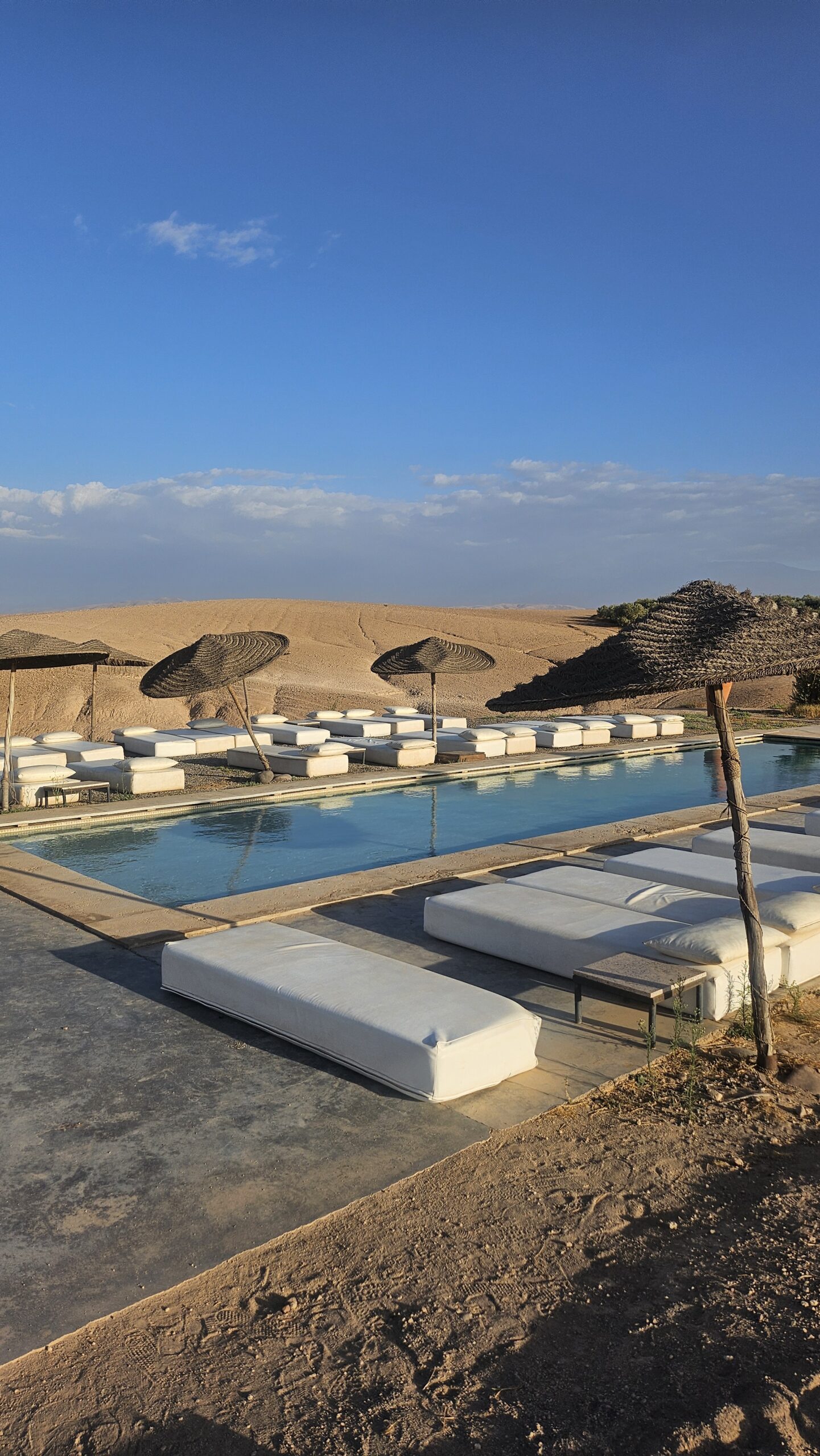
Two things I learned, while visiting this place: Riccione is a condition of your soul, and people don’t know what a desert is. The street going from Marrakech to Essaouira, on the Atlantic Ocean, crosses a portion of the Sahara Desert (yeah, that’s still the Sahara) laying at the feet of the Atlas Mountain and, compared to the desert you might have in mind, it’s a rocky, moon-like scenery. Since it’s a convenient stop en route, the region is literally riddled of encampments offering tourists a “traditional” experience. Meaning tents have air conditioning and in-house toilets with running water, and groups of local people will dress up in “traditional” attires to play “traditional” songs for your enjoyment. I’m not a fan of this kind of things.
My fellow travellers went on a ride with quads. I stayed by the pool drinking a beer and reading Selma Lagerlöf. At least I got to enjoy the silence, if only for a little while.



Essaouira: the Sqala al‑Marsa
Essaouira has a significantly different vibe than Marrakech (too bad I couldn’t visit it much because I was stuck in a fucking “cooking class”, chopping vegetables for four hours straight), and the best thing I saw possibly was the Sqala al‑Marsa, an 18th‑century artillery platform that guards the entrance to the city’s harbour. It gave off strong Madeira vibes.
Built in 1769 under Sultan Mohammed ben Abdallah of the Alaouite dynasty, it’s part of a project to create a new, fortified Atlantic port then known as Mogador. The overall design was French, entrusted to the military engineer Théodore Cornut, who drew on Vauban‑style European military architecture. It has been officially listed as a historic monument in 1924.

YouRoad? I certainly won’t.
An additional note on the journey’s organisation. For some reason, we decided to join a trip organised by WeRoad, an organisation that groups together people based by their age, and throws them together with a “group coordinator” that’s not a tour guide and whose responsibilities aren’t particularly clear, aside from collecting money and spending it on the group’s behalf. The group stresses your need to be “flexible and adaptable”, which of course is a way to say they aren’t particularly organised and you shouldn’t complain.
Not complaining isn’t my strongest suit.
So here are some reasons not to pick WeRoad for your next journey.
- Together Alone. The general vibe stresses the idea that every activity should be done together, so you might not feel comfortable to detatch from the group and pick an alternative activity for yourself. At the same time, you won’t have the level of safety an organised group can provide: the coordinator isn’t responsible for your security and might vanish, leaving you alone in the Suq (it happened) or might give you appointment for dinner in a dark alley not bothering to walk women there himself (that happened too).
- Bachelor Party Mood. The direction of the trip isn’t that of a cultural voyage, even if millennia of history are watching you from those walls. I was in a group of people spanning from 25 to 50 years old. People wanted to go to the disco. We had full-on music from the portable speaker at midnight in the middle of the desert. The activities suggested were: a hammam where we were 5 people stuffed in a treatment room meant for 2; quad rides; a camel ride at sunrise (not my thing, but fair enough), a cooking class where we “learned” to cook tagin (it’s chopped vegetables in a pan). We literally saw one thing (the university): all the rest, I saw by myself with my friend.
- A shitload of money. The front cost of the travel is low, of course, but almost everything’s extra, from food to drinks to transfers. It’s written in the travel’s description, it isn’t a surprise, but the cost might significantly vary depending on what you want or don’t want to do, so be prepared. Since activities are paid with common funds, be also prepared to withdraw a ton of money and see a portion returned to them by the end of the journey, so you can pay the commission to change it back. That isn’t how I usually roll.
- You won’t know where you sleep. The detailed programme will arrive just a few days before departure, when it’s too late to cancel, and that’s sketchy enough in itself. On top of that, not all lodgings will be clean or in a good venue. One of them, maybe. We couldn’t have both. And listen, I understand what it means to sleep in a historical city, I know you have to compromise on something, but I’m not sure I like the price I paid for lodgings that are clearly affiliated (we saw other WeRoad groups coming and going).
- Social Cult Vibes. Last, but not least, communications will have this pretence of “you joined something great”, “you’re part of us”, “we’re in this together”, and my spider-sense really itches.
I’m sure it’s enjoyable for loads of people who mostly want to get together with other people their age and have fun. I don’t see why you have to travel all the way to Morocco to do that but hey, it’s fine. It’s just clearly not meant for me.

No Comments