
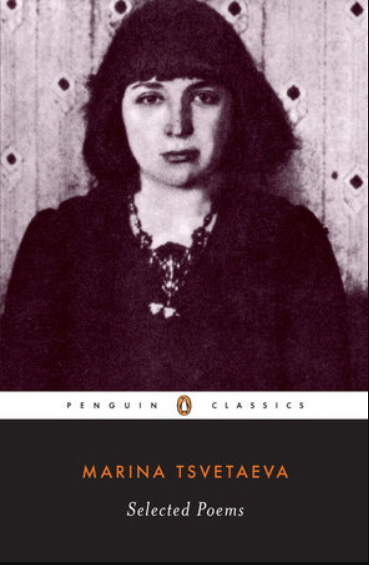
Rilke wasn’t chosen at random for this slot, last week, and neither is today’s Marina Ivanovna Tsvetaeva, though I’ll admit I didn’t plan the connection until I went looking for her and found it waiting there already. In the spring of 1926, Tsvetaeva, Rilke, and Boris Pasternak, another poet, were mid-way through one of the strangest literary triangles of the twentieth century: a three-way correspondence conducted almost entirely in letters, since the three of them were never in the same room, or indeed the same country, at the same time. Around April 20th, Pasternak wrote to Tsvetaeva describing a dream: he had been with her, he said, in a happy, luminous, endless dream, in a bright, immaculate hotel room. Tsvetaeva took the dream and built a poem out of it, called Popytka komnaty (Попытка комнаты), variably translated as A Room Essay or An Attempt of a Room.
What she builds is, characteristically, a demolition: the poem opens with her trying to reconstruct the room Pasternak described, and immediately admitting she can’t quite do it:
The walls of inertia are numbered
before me. But – a quirk? A coincidence? –
I remember three walls.
I can’t vouch for the fourth.
This is a room being assembled in real time out of unreliable memory and someone else’s dream, and Tsvetaeva is scrupulously honest about exactly where the construction fails. Three walls, confirmed. The fourth, missing, or possibly never there, or there but not remembered, and rather than paper over the gap the way description normally does, she leaves it as a hole in the text, a wall she refuses to invent just because a room conventionally needs four of them.
I don’t think there’s a more precise image, anywhere in this month’s reading list, of what happens to a space once it stops being a drawing and starts being a memory. Our as-built drawings are supposed to be exactly that: as built, verified, four walls confirmed by someone who went and measured them. But the room anyone actually carries around afterwards, the one that gets described at a dinner party or half-remembered, is never the as-built version. It’s missing a wall, or has acquired a window it didn’t have, or the ceiling has quietly become higher than it was, because memory doesn’t archive space, it re-composes it, and re-composition always drops something and invents something else to fill the gap. Tsvetaeva’s achievement is refusing to fill the gap. Most people, describing a remembered room, will confidently supply a fourth wall out of sheer narrative tidiness. She just tells you it isn’t there and moves on, which is a far more accurate report of what memory of a specific space actually feels like from the inside.
The room is hastily put together,
whitish on gray—
sketched in rough draft.
Not a plasterer, not a roofer –
Dream.
The poem gets stranger from there: over its course, the room Tsvetaeva is building keeps threatening to dissolve entirely, walls sliding, the whole structure destabilising the more she tries to pin it down, until it’s not clear whether the room ever had a fixed shape at all or whether it only existed, all along, as an act of wanting it to exist. Pure Inception style. A marvel.
There’s a small, unbearably sad footnote to this poem that I think belongs here: fifteen years after writing this, in 1941, Tsvetaeva hanged herself in a small provincial house in Yelabuga, having spent the previous two decades moving between rented rooms in Prague, Berlin, and Paris that she never fully owned and rarely stayed in for long. A woman who spent that much of her life being evicted from, or fleeing, rooms that were never really hers had, I think, an entirely legitimate claim to being uncertain about the fourth wall. Permanence was not something her actual rooms ever offered her; it makes sense that the rooms in her poems don’t offer it either.


No Comments