
Ogni lunedì un libro per iniziare la settimana.
La settimana scorsa ho consigliato un libro di storia: questa settimana tocca a un libro di geometria. E, di nuovo, uno dei libri più esilaranti che io abbia letto negli ultimi anni.
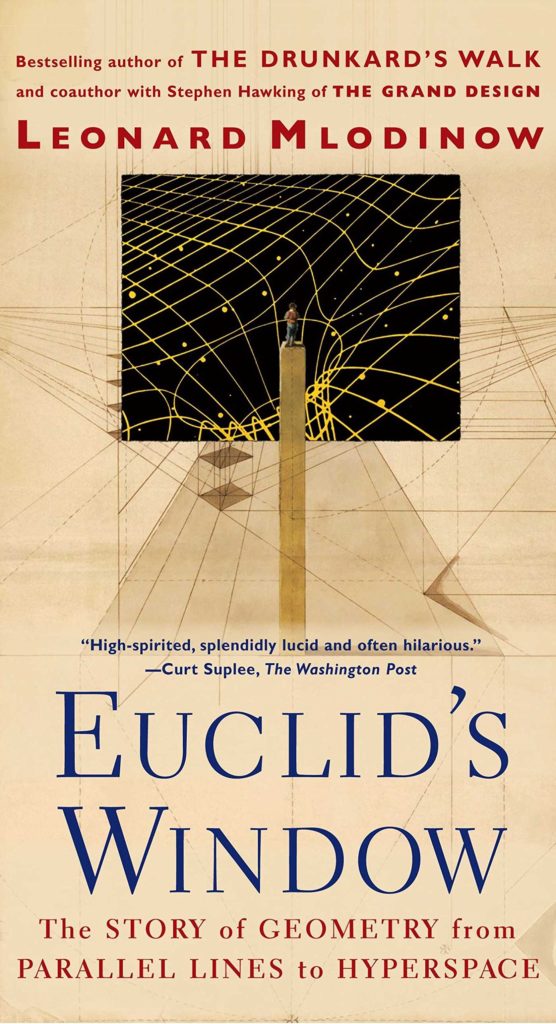
Leonard Mlodinow,
Euclid’s Window: The Story of Geometry from Parallel Lines to Hyperspace
Buona parte di ciò che utilizziamo, ormai istintivamente in progettazione, è un costrutto astratto, una forma di rappresentazione della realtà e uno strumento di interpretazione che talvolta evolve, si modifica con il tempo, e al mutare del quale si aprono nuove forme di pensiero. Per tutti coloro che vogliono recuperare il vero senso della geometria, la bellezza nella forma espressiva dei suoi teoremi, e approfondire la storia che ci ha portato a pensare gli spazi come li pensiamo oggi, La Finestra di Euclide sarà una gioia da leggere.
Through Euclid’s Window Leonard Mlodinow brilliantly and delightfully leads us on a journey through five revolutions in geometry, from the Greek concept of parallel lines to the latest notions of hyperspace. Here is an altogether new, refreshing, alternative history of math revealing how simple questions anyone might ask about space — in the living room or in some other galaxy — have been the hidden engine of the highest achievements in science and technology.
Il libro si snoda attraverso cinque parti cronologicamente e logicamente in sequenza, che ci presentano la geometria attraverso la sua formulazione da parte di cinque pensatori chiave: Euclide, Descartes, Gauss, Einstein e Witten.
- The Story of Euclid:
- The First Revolution;
- The Geometry of Taxation;
- Among the Seven Sages;
- The Secret Society;:
- Euclid’s Manifesto;
- A Beautiful Woman, a Library, and the End of Civilization.
- The Story of Descartes:
- The Revolution in Place;
- The Origin of Latitude and Longitude;
- The Legacy of the Rotten Romans;
- The Discreet Charm of the Graph;
- A Soldier’s Story;
- Iced by the Snow Queen.
- The Story of Gauss:
- The Curved Space Revolution;
- The Trouble of Ptolemy;
- A Napoleonic Hero;
- The Fall of the Fifth Poastulate;
- lost in Hyperbolic Space;
- Some Insects Called the Human Race;
- A Tale of Two Aliens;
- After 2.000 Years, A Face-lift.
- The Story of Einstein:
- Revolution at the Speed of Light;
- Relativity’s Other Albert;
- The Stuff of Space;
- Probationaty Technical Expert, Third Class;
- A Relatively Euclidean Approach;
- Einstein’s Apple;
- From Inspiration to Perspiration;
- Blue Hair Triumphs.
- The Story of Witten:
- The Weird Revolution;
- Ten Things I Gate About Your Theory;
- The Necessary Uncertainty of Being;
- Clash of the Titans;
- A Message in a Kaluza-Klein Bottle;
- The Birth of Strings;
- Particles, Schmarticles!
- The Trouble with Strings;
- The Theory Formerly Known as Strings.


No Comments