"All this he saw, for one moment breathless and intense, vivid on the morning sky; and still, as he looked, he lived; and still, as he lived, he wondered."

Leo Tolstoy’s The Cossacks

After War and Peace, every character ranks a score between 1 and Pierre. On a scale from 1 to Pierre, The Cossacks‘ main character ranks a solid 9, with his strife for happiness and his zero idea of how to achieve it.

Leo Tolstoy’s The Cossacks (1863) is a short novel subtitled “A Caucasus Tale of 1852,” and it follows the emotional journey of a young Russian nobleman, Dmitry Olenin, during his time among the Greben Cossacks in the Caucasus. Again, it’s partly autobiographical and draws on Tolstoy’s own experiences as an officer in the region.

Tolstoy uses the Cossacks to explore the contrast between the urban Russian aristocracy and what he portrays as the more genuine life of the Cossacks. Among the main themes, there’s the nobleman’s search for authenticity and moral purpose through contact with a simpler, active, rural–warrior culture (something Pierre would certainly approve), and a subsequent, inevitable tension between this romantic idealisation and the gritty realities of violence and war.

As others are saying on Goodreads, the first part is a little slow, and it takes a while for the situation to take off. Still, it eventually entraps you, and Tolstoy’s always a master in painting subtle shades of how humans can complicate their own lives. Until war arrives and tips the scales for absolutely nothing.

In the header, Cossacks are Writing a Letter to the Turkish Sultan by the Ukrainian painter Ilya Repin
Summertime

The Road is Made by Walking

Antonio Machado was a major Spanish poet and playwright, associated with the Generation of ’98, a group of writers who reflected on Spain’s identity and crisis at the turn of the 20th century. He was born in Seville in 1875 and died in 1939 in

Read More »

Kathleen Jamie on Attention and Corridors

Kathleen Jamie is a Scottish poet and essayist, born in 1962, known for her prose and poetry about landscape, place, and everyday life. Findings is her essay collection of personal reflections, first published in 2005, and it moves through nature and cities, archaeology, hospitals, family

Read More »
comics and illustration

Leo Ortolani, Tapum

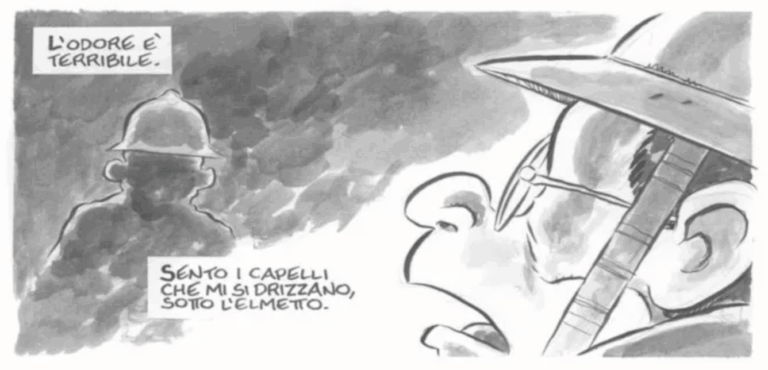
A un certo punto ci sarà una battuta, in questo fumetto, e riderete. Sappiate che è l’unica. Com’è giusto che sia. Se devo paragonare quest’opera a qualcosa, il confronto più azzeccato è probabilmente lo spettacolo che Marco Paolini trasse dal Sergente nella neve di Rigoni

Read More »
Share on LinkedIn
Throw on Reddit
Roll on Tumblr
Mail it
No Comments

Post A Comment

This site uses Akismet to reduce spam. Learn how your comment data is processed.

RELATED POSTS

The Road is Made by Walking

Antonio Machado was a major Spanish poet and playwright, associated with the Generation of ’98, a group of writers who reflected on Spain’s identity and crisis at the turn of the 20th century. He was born in Seville in 1875 and died in 1939 in

Read More

Kathleen Jamie on Attention and Corridors

Kathleen Jamie is a Scottish poet and essayist, born in 1962, known for her prose and poetry about landscape, place, and everyday life. Findings is her essay collection of personal reflections, first published in 2005, and it moves through nature and cities, archaeology, hospitals, family

Read More

Leo Ortolani, Tapum

A un certo punto ci sarà una battuta, in questo fumetto, e riderete. Sappiate che è l’unica. Com’è giusto che sia. Se devo paragonare quest’opera a qualcosa, il confronto più azzeccato è probabilmente lo spettacolo che Marco Paolini trasse dal Sergente nella neve di Rigoni

Read More