
I’m in Denmark, these days, at the International LEGO® Serious Play® Conference set up by IntHrface with co-creator Johan Roos, and I’ll tell you all about it when I get back, but I wanted to follow up on what we saw last Wednesday about the Ladder of Inference, because I believe that we haven’t said everything there is to say about it.
1. No Lecture can save you
So here I am, in Billund, home of the LEGO bricks, sitting in rooms with people who’ve spent decades thinking about play, and it strikes me that the Ladder of Inference has a problem that no amount of explaining actually solves: knowing about the ladder doesn’t stop you from climbing it. I can draw the seven rungs on a whiteboard, walk a room through the reflexive loop, get everyone nodding, and the very next coordination meeting, the same people will build beliefs on top of assumptions, exactly as before. The lecture lands. The habit doesn’t move.
This isn’t a failure of the model, of course: it’s a category error in how we tried to fix it. The Ladder of Inference describes a cognitive habit, something that happens fast, below the level where reasoning usually intervenes, and cognitive habits — the actually stubborn kind — were never going to budge because someone was told, in words, that they exist. You don’t stop a reflex by naming it: you stop it by rehearsing, enough times, a different motion in its place, until the different motion is the one that fires first.

Which is roughly where LEGO® Serious Play® comes in, though not for the reason people usually reach for it. It’s not that building with bricks is a nicer way to teach the ladder than a slide with seven boxes on it, though it probably would be. Remember that LEGO® Serious Play® isn’t a method for teaching: it’s a method for tapping knowledge that’s already there. And the method puts a physical object between you and your conclusion, an object that refuses to be skipped.
2. Selected Data, Made Out of Plastic
Rung two of the ladder — selected data — is the one that does the most damage precisely because it’s invisible even to the person doing the selecting (and also because I care about data, giving my main line of work). Out of everything you could have noticed about a situation, you noticed a handful of things, and you noticed them for reasons that had as much to do with your mood, your perceived role, and what you were already primed to look for as with the situation itself. Nobody experiences this as selection: it feels like noticing the important stuff. It’s instinctual, and it keeps us alive.

A building challenge in LEGO® Serious Play® does something that a question in a meeting rarely does: it forces the selection to happen in public, with a time limit, using a fixed and finite vocabulary of pieces. “Build a model of the biggest obstacle between your team and its goal” doesn’t let you retreat into “well, it’s complicated:” you have three minutes and a pile of bricks, and whatever you reach for first, whatever piece your hand goes to before your reasoning catches up, is the selection. It’s rung two, made out of plastic, sitting on the table where you can look at it afterwards and ask yourself why that piece and not another one.

This is close to a diagnostic. In an ordinary conversation, if I asked you what data you’d selected to reach your conclusion, you’d have to reconstruct an answer after the fact, and the reconstruction would already be contaminated by the conclusion you’re trying to explain. Humans are notoriously bad at reporting our own reasons, and rather good at inventing plausible ones. But a model built under a genuine building challenge doesn’t ask you to report your selection. It is your selection that gets externalised before you have time to launder it into something more coherent. You can misread a model, but you can’t unbuild it into having been about something else.
What this buys a facilitator — or a coordinator, or anyone paying attention — is a rare thing: a look at rung two while it’s still warm, before it’s had time to harden into rung three’s tidy meaning and rung five’s confident conclusion. Which is exactly where the next problem starts.
A good building challenge acknowledges that we’re buidling our view of the current situation, and sharing that view allows us to tap into different slices of the available data, all provided by the rich diversity of viewpoints already present in the room.
3. Meaning has to leave your head
Rung three is where the room has to get involved, because a pile of bricks arranged in a shape isn’t yet a meaning, it’s just a shape, until people says what it’s a model of. That act of saying is rung three happening out loud, in front of witnesses, which is not a small difference from the way it usually happens.
In an ordinary meeting, the jump from “here’s what I noticed” to “here’s what it means” occurs privately, inside one’s head, and arrives in the room already finished as an output, without transparency on the inference process. Nobody in the room saw the moment the meaning got attached with glue or duct tape, so nobody can question it at the only point where questioning would actually be cheap: before it’s hardened into a sentence that sounds like a fact. LEGO® Serious Play® structurally refuses that shortcut. The etiquette we talked about a few months back — the builder assigns meaning to their model, and only the builder — isn’t just a rule about politeness. It’s a rule that forces rung three to happen in the open, one piece at a time, narrated, in a room full of people whose job is to ask what it shows rather than accept what it’s called.
And there’s a particular kind of surprise that happens at this stage, and anyone who’s facilitated more than a handful of sessions has seen it: someone starts describing their model, questions are asked and answered, and the builder stops mid-sentence, genuinely startled by what they’ve just said, because the meaning that came out of their mouth wasn’t the meaning they thought they’d built. The hand knew something the reasoning hadn’t caught up to yet. That gap — between what got selected at rung two and what actually gets said at rung three — is usually invisible precisely because it closes instantly, in private, in an ordinary conversation. Here it closes in front of an audience, slowly enough to watch.
None of this works — let me stress this again — if the facilitator or anyone else in the room supplies the meaning first. The moment someone says “so what you’re saying is—” before the builder has finished finding their own words, rung three gets skipped exactly the way it always does. The bricks don’t protect you from that: only etiquette and discipline do. And a skilled facilitator needs to avoid this from happening.

4. The Sharing Phase as Structural Inquiry
Argyris and Senge gave us a name for the antidote to rung-skipping, if you remember: it was inquiry, the discipline of asking someone where their certainty actually came from. Peter Senge offers it as a technique to be learned, practised, added to a conversational repertoire that didn’t have it. LEGO® Serious Play® got there from a different direction, as the structure of the method itself.
Consider what the etiquette of LEGO® Serious Play® actually forbids and permits. “What does this piece represent?” is allowed. “Why did you build it that way?” is not. I covered why in a piece about facilitation a few months back, and the reason very neatly maps onto the ladder. The forbidden question reaches for the person, for their private rung-two selection and rung-four assumptions, the parts of the climb that happened invisibly and that a defensive answer will happily climb onto. The permitted question stays on the model, on the thing that’s already been externalised, and asks the builder to keep climbing down through it rather than leap to defending the top. Asking what does a specific piece represent is, almost word for word, Argyris’s own suggested inquiry move — “What did you actually see that told you that?” — except it’s aimed at a brick.
And the bricks matter. A questioning technique has to be remembered, in the heat of a real disagreement, and it competes for attention with everything else happening in the room: the deadline, the tension, the very human urge to be right. A technique that’s built into the structure of the activity doesn’t compete with anything else that’s happening in the room because it’s already at its very centre: you can’t run a sharing phase without asking model-questions, the same way you can’t run a coordination meeting without eventually saying something out loud. Argyris’s inquiry is a discipline you have to remember to practise. LSP’s sharing phase is a step in the process, and one you can’t possibly avoid.
Which raises the obvious question for anyone who’s read this far and works in rooms that are not, and will never be, a LEGO® Serious Play® session: can any of this actually travel back out, into the ordinary meeting where nobody’s holding a brick? That’s where we’re headed next.
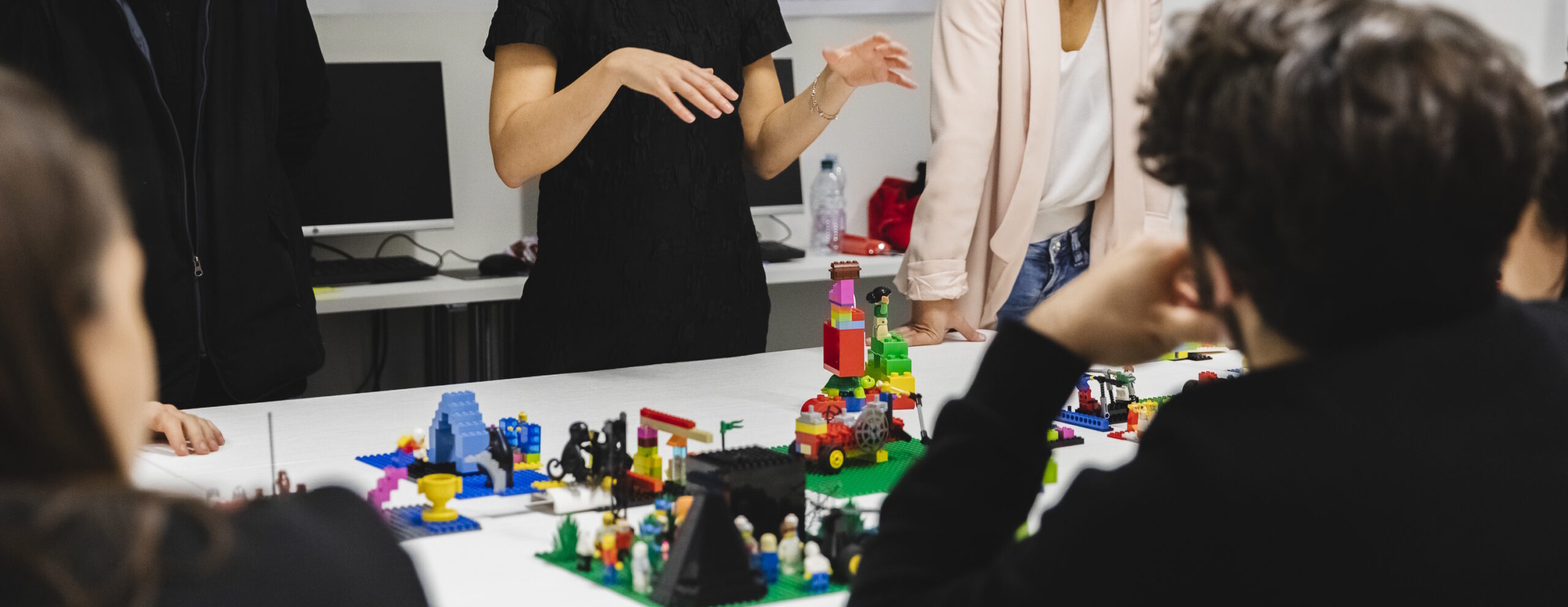
5. Facilitating for Rung-Awareness
Every article in this series about LEGO® Serious Play® so far has described what the method does for the topic being explored: the strategy, the organisational tension, the thing the session was actually convened to think about. Rung-awareness has been, so far, a side effect: something that happens because of how the method is structured, instead of something anyone was intentionally building toward. What does it change if a facilitator makes it the point, at least for one building challenge in a session, rather than a fortunate by-product of the others?
The shift is smaller than it sounds, and it lives almost entirely in the debrief. A standard sharing-phase question stays on the model: what does this represent, what story does it tell, what details are sitting inside each brick. A rung-aware version adds one layer, without breaking etiquette or reaching for the person: “was there anything you noticed that made you reach for this piece rather than another one?” That’s not a question about the person’s psychology, it’s still a question about the model, and about the moment the model started to exist, which happens to be exactly where rung two lives. Asked well, it doesn’t feel like a detour into methodology. It feels like a slightly more interesting version of the same question the sharing phase was already asking.
A facilitator who wants to leverage this has a few practical levers, and none of them requires mentioning anything like a cognitive bias (also because that would collapse the play frame faster than almost anything else on this blog’s list of ways to ruin a session). One is building challenge design itself: a challenge could be framed as “build the situation as you currently understand it, then build what you’re assuming but haven’t checked.” This would produce two models instead of one, and the gap between them is the ladder, visible, buildable through connections. I’ve done this a couple of times. What changes is that an Argyris-savvy facilitator now has a second thing they’re quietly listening for underneath the first: not just what the group knows, but how confidently they know it, and whether that confidence has actually earned its rung.





No Comments