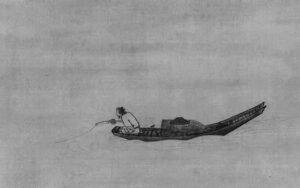
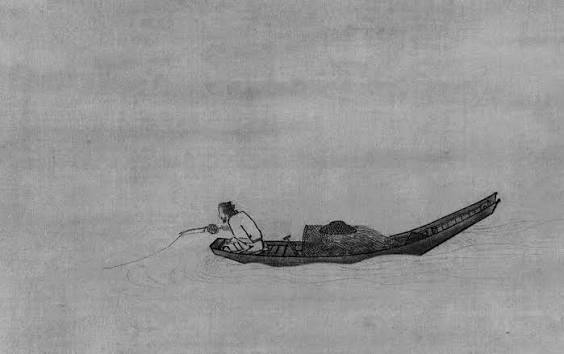
"All this he saw, for one moment breathless and intense, vivid on the morning sky; and still, as he looked, he lived; and still, as he lived, he wondered."

Kusa-Meikyu

Kyoka Izumi, born Kyotaro Izumi on November 4, 1873, in Kanazawa, Ishikawa, was a prominent Japanese novelist, writer, and kabuki playwright active during the prewar period. He is best known for his distinctive style that contrasted with the dominant naturalist literature of his era: his works often featured surrealist critiques of society and romantic tales with supernatural elements influenced by Edo period arts and literature. Izumi’s writing is celebrated for its rich, stylistic prose, and he is considered one of the supreme stylists in modern Japanese literature.

Izumi began his literary career under the mentorship of Ozaki Koyo, a leading literary figure of the time, serving as his houseboy while receiving instruction. His first published work appeared in 1893, and he later gained recognition for stories that vividly depicts melodramatic and often implausible characters and supernatural themes. Some of his noteworthy works include “The Holy Man of Mount Koya” and “A Woman’s Pedigree.”

Kusa Meikyu, translated in Italian as Labyrinth of Grass, is from 1908. It was originally a novel and has been adapted into other formats, including a notable short film released in 1979. The work includes elements of surrealism and the supernatural, with dreamlike and mystical narratives. A haunted house, a set of characters, a fateful night. The translation I have could use a ton of footnotes, as you’re left with the notion of having missed half of the point between plays on words and theatrical references. Even the linguistic barrier, though, can’t shield the way the story builds up and unravels, between heaven and hell, in a handful of hours.

You’ll crawl through the first half and then you won’t be able to put it down.

art and fashion

Escher: Milan welcomes back the impossible

After a decade-long absence, the visionary genius of Maurits Cornelis Escher returns to the city with M.C. Escher – Between Art and Science, the new exhibition at MUDEC running from September 25, 2025, to February 8, 2026. We step into Escher’s fascinating labyrinth of geometry

Read More »
calendar girl

Spooktober: that’s a wrap

As October draws to a close, so too does our month-long journey through haunted halls, spectral visions, and uneasy hearts. This Spooktober, we’ve celebrated a remarkable group of writers: Charlotte Riddell, Marjorie Bowen, Charlotte Perkins Gilman, Mary E. Wilkins Freeman, Elizabeth Gaskell, Anna Katharine Green,

Read More »
books and literature

Fairytale Friday – The Fool and the Birch-Tree

In a certain country there once lived an old man who had three sons. Two of them had their wits about them, but the third was a fool. The old man died and his sons divided his property among themselves by lot. The sharp-witted ones

Read More »
Share on LinkedIn
Throw on Reddit
Roll on Tumblr
Mail it
No Comments

Post A Comment

This site uses Akismet to reduce spam. Learn how your comment data is processed.

RELATED POSTS

Escher: Milan welcomes back the impossible

After a decade-long absence, the visionary genius of Maurits Cornelis Escher returns to the city with M.C. Escher – Between Art and Science, the new exhibition at MUDEC running from September 25, 2025, to February 8, 2026. We step into Escher’s fascinating labyrinth of geometry

Read More

Spooktober: that’s a wrap

As October draws to a close, so too does our month-long journey through haunted halls, spectral visions, and uneasy hearts. This Spooktober, we’ve celebrated a remarkable group of writers: Charlotte Riddell, Marjorie Bowen, Charlotte Perkins Gilman, Mary E. Wilkins Freeman, Elizabeth Gaskell, Anna Katharine Green,

Read More