
Every few months it comes back. A pencil drawing of a bee, a quote in a serif font, and different authorities invoked as the source: aerodynamically speaking, the bee cannot fly, but it doesn’t know that, so it flies anyway. It gets shared and liked, reposted with heartfelt warmth. It’s every HR’s ideals come true: a dream, with no grounding, everybody believes ’cause it’s soothing.
And yet the story is wrong in almost every detail: the animal, the quote, the source, and the physics. Yet it survives every debunking. That’s what interests me. The question isn’t why it’s false, but why people keep wanting it to be true.
So let’s take it apart, this week: where it comes from, what the hymenopteran actually does, what kind of animal it was in the first place, why we’re so attached to the idea that limits disappear if we ignore them, and what a Scottish playwright understood about flying more than a century ago.
1. Anatomy of a myth
Let’s start with the animal, because the meme always manages to get it wrong and by the life of me I can never understand why. Many mention the honeybee or the wasp. The story was never about them. It was about the bumblebee: round, fuzzy, with a heavy body on wings that look borrowed from a smaller insect. The bumblebee is still a bee, a cousin in the same family, but the whole “paradox” depends on her clumsy shape. Swap in the honeybee, and even the fake premise stops making sense.

The quote comes next, often unattributed as a matter-of-fact statement we still believe, and here things get interesting. The most likely written origin is Antoine Magnan’s 1934 book Le Vol des Insectes, where the entomologist refers to his assistant, the mathematician and engineer André Sainte-Laguë as the source of the calculations. The two men had applied the laws of air resistance used in aviation to insects and concluded that leur vol est impossible: their flight is impossible. Two details deserve attention. First, Magnan wrote this in the introduction to an entire book on how insects fly, so some have argued the remark was most likely meant as a joke, a provocation to set up the real work. Second, Sainte-Laguë is better known for something completely different: a seat allocation method, published in 1910, that is still named after him and used in elections today. He was a very good mathematician. He was just using the wrong model. Keep that in mind, because it’s the whole story.

Other threads exist. In 1989, an article in American Scientist reported that the story was already circulating in German technical universities in the early 1930s, apparently among the students around Ludwig Prandtl at Göttingen. In other words, it was an in-joke for engineers before it became a LinkedIn parable.
Then come the escalations, courtesy of social media and their inherent push to appear smarter than we are: the provocation loses its context and becomes a “scientific proof,” the proof needs a famous name, so it gets attached to Igor Sikorsky, an aviation pioneer, a man of helicopters rather than insects. Finally comes the institution: NASA. Supposedly, a bumblebee photograph hung in its lobby during the space race, yet the image has never been verified, and NASA’s historical records contain no evidence of such a display.

Look at the direction of travel. With each retelling, the source gets more authoritative and less verifiable: an entomologist’s aside, then a famous engineer, then the space agency itself. Meanwhile, the content gets simpler, from “this model doesn’t fit insects” to “science says it can’t fly, but it does.” That’s not a quirk of this one story: it’s how pretty narratives are built. They borrow credibility upwards and shed nuance downwards, until what’s left is a slogan with a logo on it.
Further readings:
- Tyler Irving – Bees can too fly;
- Snopes Fact Check: Bumblebees Can’t Fly;
- Futura-Sciences – the bumblebee myth.
2. No bumblebee was breaking the rules
So how does the bumblebee fly? The honest answer for most of the twentieth century was: we didn’t quite know. That is very different from “we know it can’t.”
The early calculations treated the bumblebee as a tiny aeroplane: rigid wings, smooth surfaces, steady airflow. Under those assumptions, the numbers really don’t add up. All that proves, though, is that a bumblebee with smooth, rigid wings couldn’t glide, which nobody ever claimed it did. A bumblebee doesn’t glide. It rows through the air, beating its wings well over a hundred times a second, twisting them on each stroke and sweeping them back and forth rather than holding them still.
Filming that motion took decades. Only in the 1990s did British zoologist Charles Ellington at Cambridge capture high-speed footage precise enough to explain it: the wings stir the air into small vortices, and the pressure drop inside those eddies generates lift. Engineers know a version of this as dynamic stall: the thing a fixed wing must avoid at all costs is exactly what a flapping wing exploits. The fixed-wing equations were correct, but they described a different object.

That is the lesson we throw away in favour of the inspirational bullshit: the bumblebee did not defy physics through persistence, optimism or blissful ignorance. It was obeying physics from the start. What changed was our ability to measure it. The “impossibility” was never a property of the bumblebee. It was a property of the model, and the model was wrong because someone used a tool built for one problem on another.
It’s a much less inspiring story, granted, but a useful one, for a change: it doesn’t tell you that limits vanish if you don’t look at them. It tells you to check whether the limit you’ve been shown belongs to the spreadsheet or sits squarely in reality. When the numbers say something can’t be done and it’s being done in front of you, the numbers lose. When the numbers say something can’t be done and nobody has ever done it, you might be looking at a real limit, and no amount of not-knowing will lift you over it.
That’s the reason nobody prints it on a poster: the bumblebee’s real message is not “ignore the experts,” it’s “make sure your model fits what you’re modelling.” That’s humbler, it’s harder, and you can’t sell it to a sales team on a Monday morning.
And yet.
3. Why people want it to be true
If the story is so easy to debunk, why does it keep winning? The answer is that it isn’t really about bumblebees, nobody gives a crap about them even if they’re cute: it’s about us, and it tells us several things we badly want to hear.
The first is that limits are a state of mind. That’s a flattering idea, because it puts the whole outcome under our control: if the only thing between you and the impossible is believing in it, then you’re the main character, and every wall is just a test of that character. It also has a darker reverse side that the poster never mentions: if limits are imaginary, then whoever hits one has only themselves to blame. That’s why the bumblebee appears so often on office walls and in HR slide decks. It’s a motivational tool that moves responsibility from the system to the individual, and that’s HR’s job in a nutshell, isn’t it? The deadline wasn’t unrealistic, John: you just didn’t believe hard enough.
The second, even more dangerous than the first, is that experts are killjoys. The myth has a clear cast: on one side, the pedantic scientists, holding a calculation and a frown; on the other side, the bumblebee, humming along and proving them wrong. It’s the oldest plot there is, the underdog against the establishment, and it lands particularly well at a time when “the experts” are a favourite target. The irony is that the people who solved the mystery were also scientists: they just had better cameras. In the myth, science plays the villain. In reality, it was both the problem and the solution, which is how it usually works.
The third, my personal favourite side of this thing, is that ignorance is a superpower. There’s a grain of truth here, which is why the idea is so sticky. Ask any statistician about George Dantzig. As a student in 1939, he arrived late to a lecture, copied two problems from the blackboard thinking they were homework, and solved them. They were famous unsolved problems in statistics. Not knowing they were “impossible” probably did help him. Look at what he didn’t ignore, though: he knew his mathematics. What he didn’t know was what other people believed about the problem. That distinction is the one the bumblebee myth erases.

The problem is that there are two kinds of limits. Some live in the world: physics, materials, time, budget, the number of hours in a day. Others live in our heads indeed: assumptions, inherited beliefs, “it’s always been done this way.” Ignoring the second kind can be liberating, and it’s something I’ll encourage you to do any time of the day. Ignoring the first kind gets you a collapsed beam, a failed project, or a very short flight. The myth works by blurring the two, so that the authority of the real constraint gets transferred onto the imaginary one and then dismissed along with it. It’s not funny. People get themselves killed, believing they can avoid catching a disease because they have willpower.
That’s the reason I sound angry.
This isn’t just a pretty narrative that confuses belief with physics. This isn’t harmless inspiration. It’s a small rehearsal of the habit that lets misinformation in: if the story feels good, and feels true, we stop checking the facts behind it.
4. Barrie knew better
There’s a story that understood all this more than a century ago, and it had the decency to call itself a fairy tale.
In Peter Pan in Kensington Gardens (1906), Barrie’s Peter isn’t yet the boy who won’t grow up: he’s a baby, seven days old, who remembers that all children were birds before they were human, so he climbs out of the nursery window and flies off to the Gardens. He’s perfectly fine until he lands among the birds and old Solomon Caw tells him the truth: he isn’t a bird anymore. He’s something in between, a Betwixt-and-Between. Peter is shaken and starts to doubt. With that, the ability he had a minute ago is gone. Barrie spells out the rule plainly: “The moment you doubt whether you can fly, you cease for ever to be able to do it.”
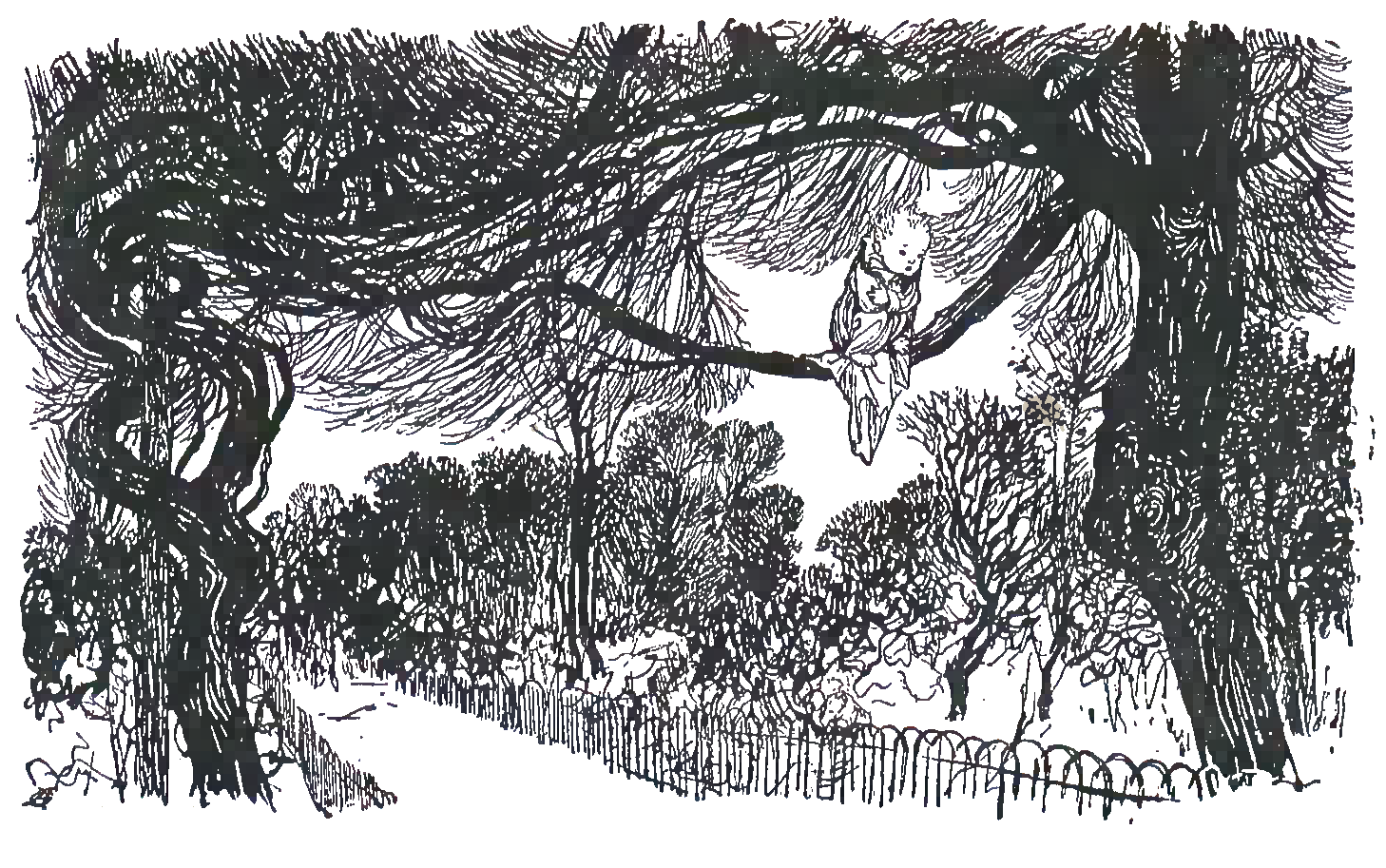
At first glance, this is the bumblebee myth all over again: belief makes you fly, knowledge grounds you. Look at what Barrie actually does with it, though.
First, he never pretends this is physics. The rule belongs to a world with fairies and talking birds, and he’s explicit about it: birds fly, he says, because they have perfect faith, “for to have faith is to have wings.” That’s a statement about magic, made in a book that never claims otherwise. The bumblebee myth takes the same structure, removes the fairies, and stamps NASA on it.
Second, and more importantly, the story isn’t a triumph: it’s a loss. Peter doesn’t overcome his limit by ignoring it. He’s stranded on an island he can’t leave. It takes fairy magic to give him back his flight, and by the time he gets home, the window is barred, and his mother has another baby in her arms. Barrie’s point isn’t “believe and you’ll fly.” It’s that some capabilities depend on a kind of innocence you can’t get back once it’s gone, and that losing it is part of growing up. It’s melancholy and honest, and it’s addressed to adults who know very well they can’t fly.

That’s the difference between a fairy tale and a fake fact. A fairy tale tells you what it is, so you can take its truth about people without mistaking it for a truth about the world. A fake fact borrows the shape of a fairy tale and the credibility of a lab coat, and asks you to believe both at once.
If you want a story about the power of belief, Barrie wrote a better one, and it doesn’t need a bumblebee to lie for it.
5. Pretty narratives in the age of fake news
Let’s be honest about how the bumblebee travels: nobody shares it because they’ve checked it, they share it because it’s pretty, and because it says something they’d like to be true about themselves.
The usual defence, when someone turns up with fact-checking, is that truth doesn’t matter because we’re dealing in dreams and inspiration. That defence is the real problem, more than the myth itself: it says that a statement’s emotional usefulness excuses its falsehood, and once you’ve accepted that trade for a bumblebee, you’ve accepted it in principle. The same reflex shares the miracle diet, the fake statistic about immigration, and the quote a politician never said. The subject changes, but the move is identical: it feels right, it comes with a name I respect, so I pass it on.

There’s also a structural unfairness at play. An Italian programmer, Alberto Brandolini, put it into a law that now carries his name: the energy needed to refute bullshit is an order of magnitude bigger than the energy needed to produce it. The bumblebee meme takes ten seconds to share. This article took considerably longer to write. That asymmetry is why debunking always looks pedantic. The correction is longer, less pretty, and arrives after people have reshared their inspirational bullshit a ton of times.
And it’s getting worse. Generating a convincing quote, a plausible attribution or a tasteful illustration now costs nothing. The pretty narrative used to need a poster, a printer, an account on Unsplash, a cracked Photoshop: now it just needs a prompt. When the packaging is free, the only defence left is the habit of looking inside it: who said this, where, and can I find the original?
In my own field, the bumblebee wears different clothes, and I wish it were a striped pajama but it’s not. The vendor slide promises the software will do it all, the conference keynote shows the digital twin alive and kicking, the AI demo designs a building in thirty seconds. The structure is the same: a beautiful outcome, a borrowed authority, and an implicit invitation to ignore the constraints. Those constraints are data quality, standards, contracts, and people who need training. They aren’t in our heads. They’re the physics of the job, and ignoring them doesn’t make the project fly.
None of this means giving up on inspiration: it means asking that our inspiring stories be true, or at least honest about being stories. That’s not a high bar, for fuck’s sake. Barrie cleared it in 1906.

Respect the bumblebee
So here’s my proposal: let’s give the bumblebee its story back.
Not the one where it flies out of sheer ignorance, but the real one: a heavy, furry insect with small wings beats them well over a hundred times a second, twists them on every stroke, and turns the very turbulence a plane must avoid into lift. Its flight seemed impossible only because we were using the wrong equations, and it took scientists with better cameras sixty years to catch up with it. That story contains everything the meme pretends to celebrate: persistence, ingenuity, the defeat of a confident wrong answer. The difference is that the persistence belongs to the people who kept measuring, and the ingenuity belongs to evolution, not to wishful thinking.
The bumblebee never ignored its limits: it simply had different ones from those we’d written down for it. That’s the useful lesson, for engineers and everyone else: before you celebrate breaking a rule, check that it was ever a rule, and whose rule was that.
Peter, meanwhile, lost his flight the moment he doubted it, and Barrie had the honesty to tell us it was a fairy tale telling us that growing up costs something. Between a fairy tale that knows what it is and a fake fact dressed as science, I know which one I’d hang in a lobby.
The bumblebee doesn’t know it can’t fly, because it can. We’re the ones who didn’t know, and that’s fine, as long as we’re willing to find out.


No Comments