"All this he saw, for one moment breathless and intense, vivid on the morning sky; and still, as he looked, he lived; and still, as he lived, he wondered."

Fantastici Quattro #276

black panther civil war

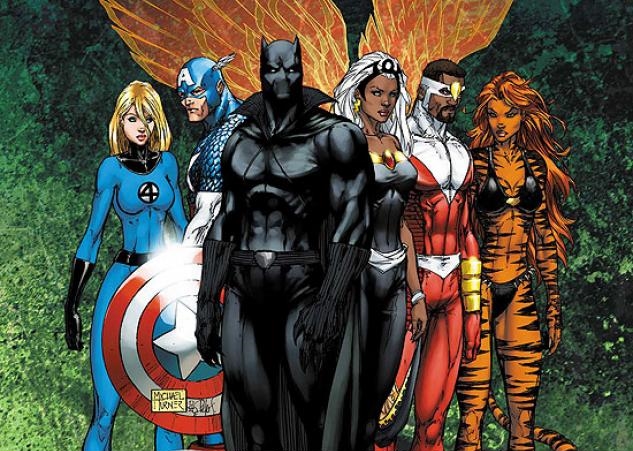
Crimini di guerra #2 e #3 (War Crimes #2  e #3 da Black Panther v.4 #24 e #25 del marzo e dell’aprile 2007). Ehi, Hudlin perde colpi? Non so decidere se questa storia, praticamente il motivo per cui compro la testata, mi sia piaciuta o meno. Il taglio politico continua a funzionare, ma il dialogo tra Ororo e Tony mi è sembrato un po’ troppo meccanico. Buona invece la costruzione del rapporto con Reed da una parte e Sue dall’altra, nel nuovo compromesso scenario. Al contrario, lo scontro tra la dea della tempesta e la magra imitazione del dio del tuono regge bene fino ad un certo punto, compresa l’intromissione di Sue e l’impulso elettromagnetico, ovvero fino all’entrata in scena di Ercole. La conclusione fuori campo e il tono dei commenti, nonché le espressioni delle due donne, mi è sembrato abbastanza fuori luogo, fuori registro, fuori di testa. A parte questo, i disegni di To & Turnbull non sono esattamente il mio genere ma mi piace la costruzione delle tavole: quelle in cui Ororo e Falcon volano speculari, ad esempio, o l’ultima tavola con “non valicare” in primo piano e oltre la coppia. Una discreta conclusione, insomma, ma un po’ al di sotto delle mie aspettative.

Dai, Suzie, non farti pregare (C’mon, Suzie, don’t leave us hangin’ da Fantastic Four v.3 #543 del gennaio 2007). Altra storia che mi ha suscitato apprezzamenti altalenanti. Se la sezione del dialogo tra Reed e Sue è veramente intensa e ben fatta, ho trovato la parte di Ben e Johnny di fronte alla televisione un po’ troppo destinata ad aficionados per i miei gusti. A questo ha contribuito la costruzione delle tavole, decisamente una noia mortale. Speriamo che migliori.
Ultima nota: solo io trovo che la linea editoriale di Guidi sia invasina e fastidiosa?

Spooktober

Spooktober 27 – The Black Monk (2)

Chapter 3 After supper, when the visitors had gone, he went to his room and lay down on the sofa: he wanted to think about the monk. But a minute later Tanya came in. “Here, Andryusha; read father’s articles,” she said, giving him a bundle

Read More »
Spooktober

Spooktober 26 – The Black Monk (1)

Anton Chekhov (1860–1904) was a Russian physician, short-story writer and playwright, and I’m not particularly fond of him, though he’s widely regarded as one of the greatest masters of modern short fiction and who am I to argue? His work is celebrated for its psychological

Read More »
art and fashion

Beauty and Ugliness: an exhibition

A few pictures from the recently closed exhibition on Beauty and Ugliness as an aesthetic paradigma in which what’s ideal and what’s grotesque melt together as sides of the same coin. The exhibition featured works by Brueghel (lent from the other exhibition at Palazzo Reale),

Read More »
Share on LinkedIn
Throw on Reddit
Roll on Tumblr
Mail it
No Comments

Post A Comment

This site uses Akismet to reduce spam. Learn how your comment data is processed.

RELATED POSTS

Spooktober 27 – The Black Monk (2)

Chapter 3 After supper, when the visitors had gone, he went to his room and lay down on the sofa: he wanted to think about the monk. But a minute later Tanya came in. “Here, Andryusha; read father’s articles,” she said, giving him a bundle

Read More

Spooktober 26 – The Black Monk (1)

Anton Chekhov (1860–1904) was a Russian physician, short-story writer and playwright, and I’m not particularly fond of him, though he’s widely regarded as one of the greatest masters of modern short fiction and who am I to argue? His work is celebrated for its psychological

Read More

Beauty and Ugliness: an exhibition

A few pictures from the recently closed exhibition on Beauty and Ugliness as an aesthetic paradigma in which what’s ideal and what’s grotesque melt together as sides of the same coin. The exhibition featured works by Brueghel (lent from the other exhibition at Palazzo Reale),

Read More
